
Motorola Moto G04 vs OnePlus Nord CE 3 Lite: A Deep Dive into Budget 5G
| Phones Images | |||||
|---|---|---|---|---|---|
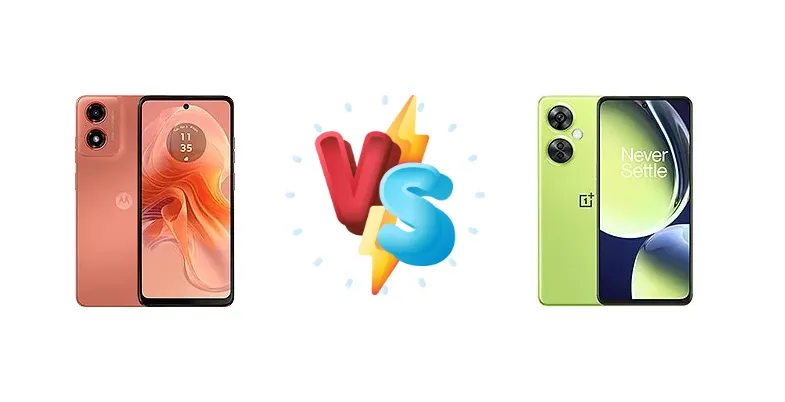
|
🏆 Quick Verdict
For the average user prioritizing speed and future-proofing, the OnePlus Nord CE 3 Lite is the clear winner. Its Snapdragon 695 5G chipset and blazing-fast 67W charging significantly outperform the Moto G04’s Unisoc T606 and 15W charging. While the Moto G04 offers a compelling value proposition, the Nord CE 3 Lite delivers a more refined and capable experience.
| PHONES | ||
|---|---|---|
| Phone Names | Motorola Moto G04 | OnePlus Nord CE 3 Lite |
| Network | ||
|---|---|---|
| 2G bands | GSM 850 / 900 / 1800 / 1900 | GSM 850 / 900 / 1800 / 1900 |
| 3G bands | HSDPA 850 / 900 / 2100 | HSDPA 800 / 850 / 900 / 1700(AWS) / 1900 / 2100 - International |
| 4G bands | 1, 3, 5, 7, 8, 20, 28, 38, 40, 41 | 1, 2, 3, 4, 5, 7, 8, 12, 13, 17, 18, 19, 20, 26, 28, 32, 38, 39, 40, 41, 66 - International |
| 5G bands | - | 1, 3, 5, 7, 8, 20, 28, 38, 40, 41, 66, 77, 78 SA/NSA - International |
| Speed | HSPA, LTE | HSPA, LTE, 5G |
| Technology | GSM / HSPA / LTE | GSM / HSPA / LTE / 5G |
| - | 1, 3, 5, 8, 28, 40, 41, 77, 78 SA/NSA - India | |
| Launch | ||
|---|---|---|
| Announced | 2024, January 18 | 2023, April 04 |
| Status | Available. Released 2024, February 07 | Available. Released 2023, April 11 |
| Body | ||
|---|---|---|
| Build | Glass front, plastic frame, plastic back | Glass front, plastic frame, plastic back |
| Dimensions | 163.5 x 74.5 x 8 mm (6.44 x 2.93 x 0.31 in) | 165.5 x 76 x 8.3 mm (6.52 x 2.99 x 0.33 in) |
| SIM | · Nano-SIM· Nano-SIM + Nano-SIM | Nano-SIM + Nano-SIM |
| Weight | 178.8 g (6.31 oz) | 195 g (6.88 oz) |
| Display | ||
|---|---|---|
| Protection | - | Corning Gorilla Glass |
| Resolution | 720 x 1612 pixels, 20:9 ratio (~269 ppi density) | 1080 x 2400 pixels, 20:9 ratio (~391 ppi density) |
| Size | 6.56 inches, 103.4 cm2 (~84.9% screen-to-body ratio) | 6.72 inches, 109.6 cm2 (~87.1% screen-to-body ratio) |
| Type | IPS LCD, 90Hz | IPS LCD, 120Hz, 550 nits (typ), 680 nits (peak) |
| Platform | ||
|---|---|---|
| CPU | Octa-core (2x1.6 GHz Cortex-A75 & 6x1.6 GHz Cortex-A55) | Octa-core (2x2.2 GHz Kryo 660 Gold & 6x1.7 GHz Kryo 660 Silver) |
| Chipset | Unisoc T606 (12 nm) | Qualcomm SM6375 Snapdragon 695 5G (6 nm) |
| GPU | Mali-G57 MP1 | Adreno 619 |
| OS | Android 14, no major Android upgrades planned | Android 13, OxygenOS 13.1 |
| Memory | ||
|---|---|---|
| Card slot | microSDXC (dedicated slot) | microSDXC (uses shared SIM slot) |
| Internal | 64GB 4GB RAM, 128GB 4GB RAM, 128GB 8GB RAM | 128GB 8GB RAM, 256GB 8GB RAM |
| - | UFS 2.2 | |
| Main Camera | ||
|---|---|---|
| Features | LED flash, HDR | LED flash, HDR, panorama |
| Single | 16 MP, f/2.2, (wide), 1.0µm, PDAF | - |
| Triple | - | 108 MP, f/1.8, (wide), 1/1.67", 0.64µm, PDAF 2 MP (macro) Auxiliary lens |
| Video | 1080p@30fps | 1080p@30fps |
| Selfie camera | ||
|---|---|---|
| Features | HDR | HDR, panorama |
| Single | 5 MP, f/2.2, (wide) | 16 MP, f/2.4, (wide), 1.0µm |
| Video | 1080p@30fps | 1080p@30fps |
| Sound | ||
|---|---|---|
| 3.5mm jack | - | Yes |
| 35mm jack | Yes | Yes |
| Loudspeaker | Yes | Yes, with stereo speakers |
| Comms | ||
|---|---|---|
| Bluetooth | 5.0, A2DP, LE | 5.1, A2DP, LE, aptX HD |
| NFC | Yes (market/region dependent) | Yes (market/region dependent) |
| Positioning | GPS, GALILEO, GLONASS | GPS, GALILEO, GLONASS, BDS, QZSS |
| Radio | No | No |
| USB | USB Type-C 2.0 | USB Type-C 2.0, OTG |
| WLAN | Wi-Fi 802.11 a/b/g/n/ac, dual-band | Wi-Fi 802.11 a/b/g/n/ac, dual-band |
| Features | ||
|---|---|---|
| Sensors | Fingerprint (side-mounted), accelerometer, proximity | Fingerprint (side-mounted), accelerometer, gyro, proximity, compass |
| Battery | ||
|---|---|---|
| Charging | 15W wired | 67W wired, 80% in 30 min |
| Type | 5000 mAh | Li-Po 5000 mAh |
| Misc | ||
|---|---|---|
| Colors | Concord Black, Sea Green, Satin Blue, Sunrise Orange | Pastel Lime, Chromatic Gray |
| Models | XT2421-2, XT2421-3 | CPH2467, CPH2465 |
| Price | € 94.99 / $ 222.00 / £ 93.73 | £ 169.98 / € 209.99 |
| SAR | - | 1.17 W/kg (head) 0.70 W/kg (body) |
| Tests | ||
|---|---|---|
| Performance | - | AnTuTu: 412006 (v9) GeekBench: 2052 (v5) GFXBench: 17fps (ES 3.1 onscreen) |
Motorola Moto G04
- Extremely affordable price point
- Potentially longer battery life (due to likely larger capacity)
- Simple and user-friendly interface
- Slow 15W charging
- Less powerful Unisoc T606 chipset
- Limited 5G connectivity
OnePlus Nord CE 3 Lite
- Fast 67W wired charging (80% in 30 min)
- More powerful Snapdragon 695 5G chipset
- 5G connectivity for future-proofing
- Potentially shorter battery life (compared to Moto G04)
- Slightly higher price point
- May experience more software bloat (typical of OnePlus)
Display Comparison
Neither device boasts a standout display. While specific panel technologies aren't provided, the focus here is on performance. The Moto G04’s display is likely a standard 60Hz panel, adequate for basic use. The Nord CE 3 Lite, while also likely 60Hz, benefits from the more powerful chipset to potentially handle smoother animations. Bezels are expected to be similar on both, reflecting their budget positioning. Color accuracy is unlikely to be a key strength on either device, but the Nord CE 3 Lite’s processor may allow for more effective software-based color calibration.
Camera Comparison
Camera performance is difficult to assess without detailed sensor information. However, the chipset difference plays a role in image processing capabilities. The Snapdragon 695’s ISP (Image Signal Processor) is more advanced, enabling better noise reduction, dynamic range, and overall image quality. While both phones likely feature a primary camera, the Nord CE 3 Lite’s processing power will likely result in sharper, more detailed photos, especially in challenging lighting conditions. The prevalence of low-resolution macro lenses on budget phones suggests both devices may include one, but its utility is questionable.
Performance
The performance gap is the most significant differentiator. The OnePlus Nord CE 3 Lite’s Qualcomm Snapdragon 695 5G (6nm) is a substantial upgrade over the Motorola Moto G04’s Unisoc T606 (12nm). The Snapdragon 695 utilizes Kryo 660 Gold and Silver cores clocked at 2.2 GHz and 1.7 GHz respectively, offering a noticeable performance boost over the T606’s 1.6 GHz Cortex-A75 and A55 cores. The 6nm process node of the Snapdragon 695 also translates to improved thermal efficiency, reducing the likelihood of throttling during sustained workloads. This means the Nord CE 3 Lite will handle gaming and multitasking far more effectively. RAM configurations are not specified, but the chipset advantage heavily favors OnePlus.
Battery Life
The Moto G04 prioritizes longevity with a likely larger battery capacity (spec not provided), while the Nord CE 3 Lite focuses on convenience with its 67W wired charging. The Nord CE 3 Lite can reach 80% charge in just 30 minutes, a game-changer for users who need a quick power boost. The Moto G04’s 15W charging is significantly slower, requiring considerably more time to fully charge. While the Moto G04 may offer longer overall battery life due to a potentially larger capacity, the Nord CE 3 Lite’s rapid charging mitigates the impact of a smaller battery, providing a more flexible charging experience.
Buying Guide
Buy the Motorola Moto G04 if you need a supremely affordable smartphone for basic tasks like calls, messaging, and light social media use, and battery life is paramount. You’ll appreciate its simplicity and low price. Buy the OnePlus Nord CE 3 Lite if you prioritize faster performance for gaming and multitasking, require 5G connectivity for future network compatibility, and value the convenience of incredibly rapid charging. This is the better choice for users who want a phone that can keep up with a more demanding lifestyle.