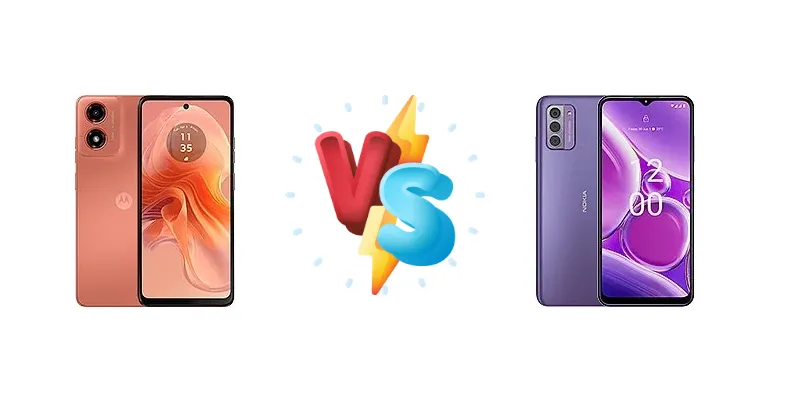
The Motorola Moto G04 and Nokia G42 represent two distinct approaches to the ultra-budget 5G smartphone market. The Moto G04 prioritizes a streamlined experience with a Unisoc chipset, while the Nokia G42 leverages Qualcomm’s Snapdragon 480+ for a potential performance edge. This comparison dissects their key differences to determine which device delivers the best value.
🏆 Quick Verdict
For most users, the Nokia G42 emerges as the stronger choice. Its Snapdragon 480+ chipset, built on an 8nm process, offers a noticeable performance uplift over the Moto G04’s Unisoc T606, and the 20W charging with PD3.0/QC3 support provides faster replenishment. While the Moto G04 is more affordable, the G42’s superior processing power justifies the price difference.
| Network |
|---|
| 2G bands | GSM 850 / 900 / 1800 / 1900 | GSM 850 / 900 / 1800 / 1900 |
| 3G bands | HSDPA 850 / 900 / 2100 | HSDPA 850 / 900 / 1700(AWS) / 1900 / 2100 |
| 4G bands | 1, 3, 5, 7, 8, 20, 28, 38, 40, 41 | 1, 2, 3, 4, 5, 7, 8, 12, 17, 13, 20, 28, 38, 39, 40, 41, 66 |
| 5G bands | - | 1, 2, 3, 5, 7, 8, 28, 40, 41, 66, 77, 78 SA/NSA |
| Speed | HSPA, LTE | HSPA, LTE, 5G |
| Technology | GSM / HSPA / LTE | GSM / HSPA / LTE / 5G |
| Launch |
|---|
| Announced | 2024, January 18 | 2023, June 28 |
| Status | Available. Released 2024, February 07 | Available. Released 2023, June 28 |
| Body |
|---|
| Build | Glass front, plastic frame, plastic back | Glass front, plastic back, plastic frame |
| Dimensions | 163.5 x 74.5 x 8 mm (6.44 x 2.93 x 0.31 in) | 165 x 75.8 x 8.6 mm (6.50 x 2.98 x 0.34 in) |
| SIM | · Nano-SIM· Nano-SIM + Nano-SIM | · Nano-SIM· Nano-SIM + Nano-SIM |
| Weight | 178.8 g (6.31 oz) | 193.8 g (6.84 oz) |
| Display |
|---|
| Protection | - | Corning Gorilla Glass 3 |
| Resolution | 720 x 1612 pixels, 20:9 ratio (~269 ppi density) | 720 x 1612 pixels, 20:9 ratio (~269 ppi density) |
| Size | 6.56 inches, 103.4 cm2 (~84.9% screen-to-body ratio) | 6.56 inches, 103.4 cm2 (~82.7% screen-to-body ratio) |
| Type | IPS LCD, 90Hz | IPS LCD, 90Hz, 450 nits (typ), 560 nits (peak) |
| Platform |
|---|
| CPU | Octa-core (2x1.6 GHz Cortex-A75 & 6x1.6 GHz Cortex-A55) | Octa-core (2x2.2 GHz Kryo 460 & 6x1.8 GHz Kryo 460) |
| Chipset | Unisoc T606 (12 nm) | Qualcomm SM4350-AC Snapdragon 480+ 5G (8 nm) |
| GPU | Mali-G57 MP1 | Adreno 619 |
| OS | Android 14, no major Android upgrades planned | Android 13, upgradable to Android 14 |
| Memory |
|---|
| Card slot | microSDXC (dedicated slot) | microSDXC |
| Internal | 64GB 4GB RAM, 128GB 4GB RAM, 128GB 8GB RAM | 128GB 4GB RAM, 128GB 6GB RAM, 256GB 8GB RAM |
| Main Camera |
|---|
| Features | LED flash, HDR | LED flash, HDR, panorama |
| Single | 16 MP, f/2.2, (wide), 1.0µm, PDAF | - |
| Triple | - | 50 MP, f/1.8, (wide), AF
2 MP (macro)
Auxiliary lens |
| Video | 1080p@30fps | 1080p@30fps |
| Selfie camera |
|---|
| Features | HDR | - |
| Single | 5 MP, f/2.2, (wide) | 8 MP |
| Video | 1080p@30fps | Yes |
| Sound |
|---|
| 35mm jack | Yes | Yes |
| Loudspeaker | Yes | Yes |
| Comms |
|---|
| Bluetooth | 5.0, A2DP, LE | 5.1, A2DP, LE |
| NFC | Yes (market/region dependent) | Yes (market/region dependent) |
| Positioning | GPS, GALILEO, GLONASS | GPS, GLONASS, GALILEO, BDS |
| Radio | No | FM radio |
| USB | USB Type-C 2.0 | USB Type-C 2.0, OTG |
| WLAN | Wi-Fi 802.11 a/b/g/n/ac, dual-band | Wi-Fi 802.11 a/b/g/n/ac/6, dual-band |
| Features |
|---|
| Sensors | Fingerprint (side-mounted), accelerometer, proximity | Fingerprint (side-mounted), accelerometer, proximity, compass |
| Battery |
|---|
| Charging | 15W wired | 20W wired, PD3.0, QC3 |
| Type | 5000 mAh | Li-Po 5000 mAh |
| Misc |
|---|
| Colors | Concord Black, Sea Green, Satin Blue, Sunrise Orange | Gray, Purple, Red |
| Models | XT2421-2, XT2421-3 | - |
| Price | € 94.99 / $ 222.00 / £ 93.73 | $ 545.00 / £ 124.99 |
Motorola Moto G04
- Most affordable option
- Simple and straightforward user experience
- Likely longer battery life due to less powerful chipset
- Significantly slower performance
- Slower charging speeds
- Less capable chipset for multitasking and gaming
Nokia G42
- Faster and more responsive performance
- Faster charging with PD3.0/QC3
- More efficient chipset for better thermal management
- Slightly higher price point
- Potentially shorter battery life under heavy load
- May not be significantly better in ideal lighting conditions
Display Comparison
Neither device boasts a standout display. Both likely utilize LCD panels, common in this price bracket. However, the lack of detailed display specs necessitates focusing on the chipset’s ability to drive the UI smoothly. The Nokia G42’s more powerful GPU, stemming from the Snapdragon 480+, will likely translate to slightly smoother scrolling and animations, even if the resolution and refresh rates are similar. Bezels are expected to be substantial on both, given the cost constraints.
Camera Comparison
Without detailed camera specs beyond the chipsets, it’s difficult to make definitive claims. However, the Snapdragon 480+ typically supports more advanced image signal processors (ISPs) than those found in Unisoc chipsets. This means the Nokia G42 likely benefits from better noise reduction, dynamic range, and overall image quality, particularly in challenging lighting conditions. While both phones likely feature a primary camera and potentially a depth or macro sensor, the G42’s ISP will be crucial in processing those images effectively. Expect similar limitations with low-light performance on both.
Performance
The core difference lies in the chipsets. The Nokia G42’s Qualcomm Snapdragon 480+ (8nm) is a significant step up from the Motorola Moto G04’s Unisoc T606 (12nm). The 8nm process node inherently offers better power efficiency and thermal characteristics, meaning the G42 is less likely to throttle under sustained load. The Snapdragon’s Kryo 460 cores, clocked at up to 2.2 GHz, outperform the Unisoc’s Cortex-A75 cores (1.6 GHz) in both single-core and multi-core benchmarks. This translates to faster app loading times, smoother multitasking, and a more responsive user experience on the Nokia G42. The G42’s Adreno 619 GPU also provides a substantial graphics boost.
Battery Life
Battery capacity isn’t specified, but both phones likely hover around the 5000mAh mark, typical for this segment. The key differentiator is charging speed. The Nokia G42’s 20W charging with Power Delivery 3.0 (PD3.0) and Quick Charge 3 (QC3) support is considerably faster than the Moto G04’s 15W wired charging. This means the G42 can replenish its battery from 0-100% significantly quicker, reducing downtime. While a larger battery capacity on the Moto G04 *could* offset the slower charging, the efficiency gains of the Snapdragon 480+ likely minimize the impact of any capacity difference.
Buying Guide
Buy the Motorola Moto G04 if you prioritize absolute affordability and a simple, no-frills smartphone experience for basic tasks like calls, texts, and light social media. Buy the Nokia G42 if you value smoother multitasking, occasional gaming, and faster charging speeds, even if it means spending a bit more upfront. The G42 is the better option for users who anticipate needing more than just the bare minimum from their phone.
Frequently Asked Questions
❓ Will the Nokia G42 struggle with demanding games like PUBG Mobile?
While the Snapdragon 480+ isn't a gaming powerhouse, it's capable of running PUBG Mobile at medium settings with reasonable frame rates. Expect some occasional stuttering, but it's a significantly better gaming experience than the Moto G04's Unisoc T606. Lowering graphics settings will improve performance.
❓ Does the Motorola Moto G04 support 5G roaming internationally?
Both phones support 5G, but 5G band compatibility varies by region. Check the specific 5G bands supported by each phone and compare them to the bands used by carriers in your intended travel destinations to ensure compatibility. Motorola and Nokia's websites will have this information.
❓ Is the Nokia G42's software experience significantly different from the Moto G04?
The Nokia G42 runs a near-stock version of Android, offering a cleaner and more streamlined experience. The Moto G04 typically includes Motorola's My UX, which adds some custom features and pre-installed apps. Preference here is subjective, but many users prefer the cleaner Android experience of the Nokia G42.
❓ How does the Unisoc T606 handle multitasking compared to the Snapdragon 480+?
The Unisoc T606 will struggle with heavy multitasking. Switching between multiple apps will likely result in noticeable lag and app reloading. The Snapdragon 480+’s more powerful CPU and GPU, combined with potentially more RAM, provide a much smoother multitasking experience.