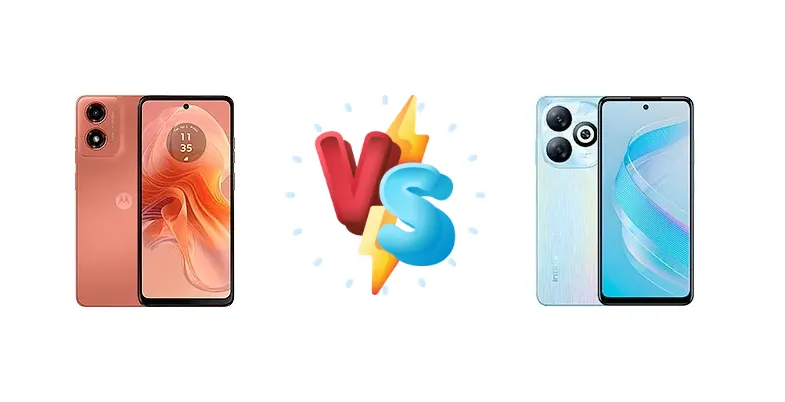
The Motorola Moto G04 and Infinix Smart 8 Pro represent the fiercely competitive sub-$150 smartphone market. Both aim to deliver essential smartphone functionality at an incredibly accessible price point, but they take different approaches to achieving this. The G04 prioritizes a more modern, albeit less clocked, processor, while the Smart 8 Pro opts for a slightly older chipset with a higher peak clock speed. This comparison will dissect these choices and determine which device offers the best overall experience.
🏆 Quick Verdict
For the average user prioritizing sustained performance and future-proofing, the Motorola Moto G04 is the better choice. Its Unisoc T606 chipset, built on a 12nm process, offers a more balanced CPU architecture and is likely to handle multitasking and demanding apps more efficiently than the Infinix Smart 8 Pro’s Helio G36, despite the latter’s higher clock speeds.
| Network |
|---|
| 2G bands | GSM 850 / 900 / 1800 / 1900 | GSM 850 / 900 / 1800 / 1900 |
| 3G bands | HSDPA 850 / 900 / 2100 | HSDPA 850 / 900 / 1700(AWS) / 1900 / 2100 |
| 4G bands | 1, 3, 5, 7, 8, 20, 28, 38, 40, 41 | 1, 2, 3, 4, 5, 7, 8, 20, 28, 38, 41, 40 |
| Speed | HSPA, LTE | HSPA, LTE |
| Technology | GSM / HSPA / LTE | GSM / HSPA / LTE |
| Launch |
|---|
| Announced | 2024, January 18 | 2024, January 29 |
| Status | Available. Released 2024, February 07 | Available. Released 2024, February |
| Body |
|---|
| Build | Glass front, plastic frame, plastic back | Glass front, plastic back, plastic frame |
| Dimensions | 163.5 x 74.5 x 8 mm (6.44 x 2.93 x 0.31 in) | 163.6 x 75.6 x 8.5 mm (6.44 x 2.98 x 0.33 in) |
| SIM | · Nano-SIM· Nano-SIM + Nano-SIM | Nano-SIM + Nano-SIM |
| Weight | 178.8 g (6.31 oz) | 189 g (6.67 oz) |
| Display |
|---|
| Resolution | 720 x 1612 pixels, 20:9 ratio (~269 ppi density) | 720 x 1612 pixels, 20:9 ratio (~267 ppi density) |
| Size | 6.56 inches, 103.4 cm2 (~84.9% screen-to-body ratio) | 6.6 inches, 104.6 cm2 (~84.6% screen-to-body ratio) |
| Type | IPS LCD, 90Hz | IPS LCD, 90Hz, 500 nits (peak) |
| Platform |
|---|
| CPU | Octa-core (2x1.6 GHz Cortex-A75 & 6x1.6 GHz Cortex-A55) | Octa-core (4x2.2 GHz Cortex-A53 & 4x1.6 GHz Cortex-A53) |
| Chipset | Unisoc T606 (12 nm) | Mediatek Helio G36 (12 nm) |
| GPU | Mali-G57 MP1 | PowerVR GE8320 |
| OS | Android 14, no major Android upgrades planned | Android 13 (Go edition), XOS 13 |
| Memory |
|---|
| Card slot | microSDXC (dedicated slot) | microSDXC (dedicated slot) |
| Internal | 64GB 4GB RAM, 128GB 4GB RAM, 128GB 8GB RAM | 64GB 4GB RAM, 128GB 8GB RAM, 256GB 4GB RAM |
| Main Camera |
|---|
| Features | LED flash, HDR | Ring-LED flash, HDR, panorama |
| Single | 16 MP, f/2.2, (wide), 1.0µm, PDAF | 50 MP, f/1.9, (wide), AF
Auxiliary lens |
| Video | 1080p@30fps | 1080p@30fps |
| Selfie camera |
|---|
| Features | HDR | - |
| Single | 5 MP, f/2.2, (wide) | 8 MP, f/2.0, (wide) |
| Video | 1080p@30fps | Yes |
| Sound |
|---|
| 35mm jack | Yes | Yes |
| Loudspeaker | Yes | Yes |
| Comms |
|---|
| Bluetooth | 5.0, A2DP, LE | 5.0, A2DP, LE |
| NFC | Yes (market/region dependent) | No |
| Positioning | GPS, GALILEO, GLONASS | GPS |
| Radio | No | FM radio |
| USB | USB Type-C 2.0 | USB Type-C 2.0, OTG |
| WLAN | Wi-Fi 802.11 a/b/g/n/ac, dual-band | Wi-Fi 802.11 a/b/g/n/ac, dual-band |
| Features |
|---|
| Sensors | Fingerprint (side-mounted), accelerometer, proximity | Fingerprint (side-mounted), accelerometer, gyro, proximity, compass |
| Battery |
|---|
| Charging | 15W wired | 10W wired
Reverse wired |
| Type | 5000 mAh | 5000 mAh |
| Misc |
|---|
| Colors | Concord Black, Sea Green, Satin Blue, Sunrise Orange | Rainbow Blue, Galaxy White, Shiny Gold, Timber Black |
| Models | XT2421-2, XT2421-3 | X6525B |
| Price | € 94.99 / $ 222.00 / £ 93.73 | About 100 EUR |
Motorola Moto G04
- More efficient processor architecture (Unisoc T606)
- Faster 15W charging
- Potentially smoother multitasking experience
- Lower peak CPU clock speed
- Lacks reverse wired charging
Infinix Smart 8 Pro
- Reverse wired charging capability
- Higher peak CPU clock speed (Helio G36)
- Potentially lower price point
- Less efficient processor architecture
- Slower 10W charging
Display Comparison
Neither device boasts a standout display. Both are likely to feature LCD panels, common in this price bracket. Specifics like resolution and peak brightness are not provided, but we can assume they are similar – around 720p+ and 400-500 nits respectively. The focus here isn't on visual fidelity, but on basic usability. Bezels are likely to be substantial on both, maximizing screen real estate within a compact form factor.
Camera Comparison
Camera performance is likely to be comparable, and largely dependent on software processing. Both phones will likely feature a primary camera alongside basic auxiliary lenses (potentially a 2MP macro). Without specific sensor size or aperture information, it’s difficult to definitively declare a winner. Image quality will likely be acceptable for social media sharing in good lighting conditions, but struggle in low-light scenarios. The focus should be on the primary sensor, as auxiliary lenses in this price range offer limited utility.
Performance
The core difference lies in the chipsets. The Motorola Moto G04’s Unisoc T606 utilizes a combination of Cortex-A75 and Cortex-A55 cores, offering a more modern architecture designed for efficiency and sustained performance. The Infinix Smart 8 Pro’s MediaTek Helio G36, while boasting a higher peak clock speed of 2.2 GHz on its Cortex-A53 cores, relies on an older, less efficient architecture. The G04’s octa-core configuration, with two performance cores, is likely to outperform the G36’s four A53 cores in multi-threaded tasks. While the G36's higher clock speed might show a slight edge in single-core benchmarks, the G04’s architecture will likely translate to a smoother overall user experience. Both utilize a 12nm process, meaning thermal management will be similar, but the G04's architecture is inherently more efficient.
Battery Life
The Infinix Smart 8 Pro offers a slight convenience with 10W wired charging *and* reverse wired charging, allowing it to function as a power bank for other devices. However, the Motorola Moto G04’s 15W charging, while not fast by modern standards, will replenish the battery faster. The actual battery capacity isn’t specified, but both are likely in the 5000mAh range. The G04’s faster charging speed will likely offset any potential capacity difference, resulting in similar real-world usage times.
Buying Guide
Buy the Motorola Moto G04 if you need a phone that can reliably handle everyday tasks, light gaming, and multitasking without significant slowdowns. Its processor architecture is better suited for sustained workloads. Buy the Infinix Smart 8 Pro if you prioritize a slightly faster initial response in single-core tasks and value the convenience of reverse wired charging, potentially for accessories or a friend's phone in a pinch.
Frequently Asked Questions
❓ Will the Unisoc T606 in the Moto G04 struggle with demanding games like PUBG Mobile?
While the Unisoc T606 isn't a gaming powerhouse, it should be capable of running PUBG Mobile at lower settings. Expect frame rate dips during intense action, but the more efficient architecture will prevent excessive throttling compared to the Helio G36 under sustained load.
❓ How useful is the reverse wired charging feature on the Infinix Smart 8 Pro in real-world scenarios?
The reverse wired charging is a niche feature, but can be helpful for topping up accessories like wireless earbuds or providing a small emergency charge to a friend's phone. However, at 10W, it's a slow process and not a replacement for a dedicated power bank.
❓ Is the difference in CPU clock speed (2.2 GHz vs 1.6 GHz) significant in everyday use?
Not as much as you might think. The Helio G36's higher clock speed is offset by its older Cortex-A53 architecture. The Moto G04's Cortex-A75 cores, despite the lower clock speed, are more efficient and deliver better performance in most real-world tasks.