
Google Pixel 6a vs. Motorola Moto G Stylus 5G: A Detailed Comparison
| Phones Images | |||||
|---|---|---|---|---|---|
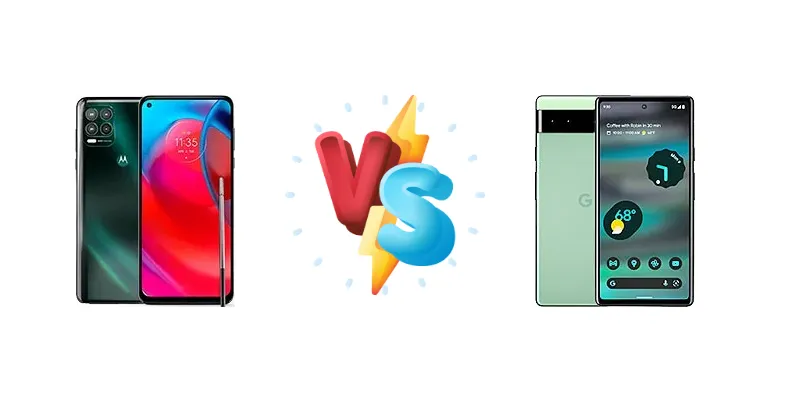
|
🏆 Quick Verdict
For most users, the Google Pixel 6a is the superior choice. Its Google Tensor chipset delivers significantly faster performance and superior image processing, justifying the price difference. While the Moto G Stylus 5G offers a stylus and 5G at a lower cost, its Snapdragon 480 struggles to keep pace with the Pixel’s capabilities.
| PHONES | ||
|---|---|---|
| Phone Names | Motorola Moto G Stylus 5G | Google Pixel 6a |
| Network | ||
|---|---|---|
| 2G bands | GSM 850 / 900 / 1800 / 1900 | GSM 850 / 900 / 1800 / 1900 |
| 3G bands | HSDPA 850 / 900 / 1700(AWS) / 1900 / 2100 | HSDPA 800 / 850 / 900 / 1700(AWS) / 1900 / 2100 |
| 4G bands | 1, 2, 3, 4, 5, 7, 8, 12, 13, 14, 17, 18, 19, 20, 25, 26, 29, 30, 38, 39, 40, 41, 48, 66, 71 | 1, 2, 3, 4, 5, 7, 8, 12, 13, 14, 17, 18, 19, 20, 25, 26, 28, 29, 30, 38, 39, 40, 41, 42, 48, 66, 71 - GX7AS, GB62Z (USA/Canada) |
| 5G bands | 2, 5, 25, 26, 41, 66, 71, 77, 78 SA/NSA | 1, 2, 3, 5, 7, 8, 12, 20, 25, 28, 30, 38, 40, 41, 48, 66, 71, 77, 78 SA/NSA/Sub6 - GX7AS (USA/Canada) |
| Speed | HSPA, LTE, 5G | HSPA, LTE, 5G |
| Technology | GSM / HSPA / LTE / 5G | GSM / HSPA / LTE / 5G |
| - | 1, 2, 3, 5, 7, 8, 12, 20, 25, 28, 30, 40, 48, 66, 71, 77, 78 SA/NSA/Sub6 - G1AZG (International) | |
| Launch | ||
|---|---|---|
| Announced | 2021, June 09 | 2022, May 11 |
| Status | Available. Released 2021, June 14 | Available. Released 2022, July 21 |
| Body | ||
|---|---|---|
| Build | Glass front, plastic frame, plastic back | Glass front (Gorilla Glass 3), aluminum frame, plastic back |
| Dimensions | 169.5 x 77.5 x 9.4 mm (6.67 x 3.05 x 0.37 in) | 152.2 x 71.8 x 8.9 mm (5.99 x 2.83 x 0.35 in) |
| SIM | Nano-SIM | Nano-SIM + eSIM |
| Weight | 217.5 g (7.69 oz) | 178 g (6.28 oz) |
| Stylus Water-repellent design | IP67 dust/water resistant (up to 1m for 30 min) | |
| Display | ||
|---|---|---|
| Protection | - | Corning Gorilla Glass 3 |
| Resolution | 1080 x 2400 pixels, 20:9 ratio (~387 ppi density) | 1080 x 2400 pixels, 20:9 ratio (~429 ppi density) |
| Size | 6.8 inches, 111.6 cm2 (~85.0% screen-to-body ratio) | 6.1 inches, 90.7 cm2 (~83.0% screen-to-body ratio) |
| Type | IPS LCD | OLED, HDR |
| - | Always-on display | |
| Platform | ||
|---|---|---|
| CPU | Octa-core (2x2.0 GHz Kryo 460 & 6x1.8 GHz Kryo 460) | Octa-core (2x2.80 GHz Cortex-X1 & 2x2.25 GHz Cortex-A76 & 4x1.80 GHz Cortex-A55) |
| Chipset | Qualcomm SM4350 Snapdragon 480 5G (8 nm) | Google Tensor (5 nm) |
| GPU | Adreno 619 | Mali-G78 MP20 |
| OS | Android 11, upgradable to Android 12 | Android 12, upgradable to Android 15, up to 5 major Android upgrades |
| Memory | ||
|---|---|---|
| Card slot | microSDXC (dedicated slot) | No |
| Internal | 128GB 4GB RAM, 256GB 6GB RAM | 128GB 6GB RAM |
| - | UFS 3.1 | |
| Main Camera | ||
|---|---|---|
| Dual | - | 12.2 MP, f/1.7, 27mm, (wide), 1/2.55", 1.4µm, dual pixel PDAF, OIS 12 MP, f/2.2, 17mm, 114˚ (ultrawide), 1.25µm |
| Features | LED flash, HDR, panorama | Dual-LED flash, Pixel Shift, Auto-HDR, panorama |
| Quad | 48 MP, f/1.7, 26mm (wide), 1/2.0", 0.8µm, PDAF 8 MP, f/2.2, 118˚ (ultrawide), 1/4.0, 1.12µm 5 MP (macro) Auxiliary lens | - |
| Single | - | 8 MP, f/2.0, 24mm (wide), 1.12µm |
| Video | 1080p@30/60fps | 4K@30/60fps, 1080p@30/60/120/240fps; gyro-EIS, OIS |
| Selfie camera | ||
|---|---|---|
| Features | HDR | HDR, panorama |
| Single | 16 MP, f/2.0, (wide), 1/3.06", 1.0µm | 8 MP, f/2.0, 24mm (wide), 1.12µm |
| Video | 1080p@30fps | 1080p@30fps |
| Sound | ||
|---|---|---|
| 3.5mm jack | Yes | No |
| 35mm jack | Yes | No |
| Loudspeaker | Yes | Yes, with stereo speakers |
| Comms | ||
|---|---|---|
| Bluetooth | 5.0, A2DP, LE | 5.2, A2DP, LE |
| NFC | No | Yes |
| Positioning | GPS, GLONASS, BDS, GALILEO | GPS, GLONASS, GALILEO, QZSS |
| Radio | Unspecified | No |
| USB | USB Type-C 2.0 | USB Type-C 3.1 |
| WLAN | Wi-Fi 802.11 a/b/g/n/ac, dual-band, Wi-Fi Direct | Wi-Fi 802.11 a/b/g/n/ac/6e, dual-band, Wi-Fi Direct |
| Features | ||
|---|---|---|
| Sensors | Fingerprint (rear-mounted), accelerometer, gyro, proximity | Fingerprint (under display, optical), accelerometer, gyro, proximity, compass, barometer |
| Battery | ||
|---|---|---|
| Charging | 10W wired | 18W wired, PD3.0 |
| Type | Li-Po 5000 mAh | Li-Po 4410 mAh |
| Misc | ||
|---|---|---|
| Colors | Cosmic Emerald | Chalk, Charcoal, Sage |
| Models | XT2131, XT2131DL, XT2131-1, XT2131-3, XT2131-4 | GX7AS, GB62Z, G1AZG, GB17L |
| Price | € 189.97 / $ 74.98 / £ 179.95 | $ 138.99 / C$ 228.74 / ₹ 23,999 |
| Tests | ||
|---|---|---|
| Battery life | - | Endurance rating 94h |
| Display | - | Contrast ratio: Infinite (nominal) |
Motorola Moto G Stylus 5G
- Superior performance with Google Tensor chip
- Exceptional camera quality and image processing
- Faster charging with 18W PD3.0 support
- Lacks integrated stylus functionality
- Higher price point than Moto G Stylus 5G
Google Pixel 6a
- Integrated stylus for note-taking and creativity
- Lower price point for budget-conscious buyers
- Large display for media consumption
- Significantly slower performance with Snapdragon 480
- Inferior camera quality compared to Pixel 6a
Display Comparison
The Pixel 6a boasts a significantly brighter display, reaching a measured 876 nits, compared to an assumed lower brightness on the Moto G Stylus 5G (spec not provided). This makes the Pixel 6a far more usable outdoors in direct sunlight. While both likely utilize OLED panels, the Pixel 6a’s ‘infinite’ contrast ratio suggests superior black levels and overall image quality. The Moto G Stylus 5G’s larger screen size is a benefit for media consumption, but the Pixel 6a’s superior brightness and contrast offer a more visually engaging experience.
Camera Comparison
The Pixel 6a leverages Google’s renowned computational photography prowess, even with a likely smaller sensor than some competitors. While specific sensor sizes aren’t provided, the Pixel 6a’s image processing algorithms excel in dynamic range, detail preservation, and low-light performance. The Moto G Stylus 5G’s camera system is likely more focused on versatility with multiple lenses, but image quality will likely fall short of the Pixel 6a’s consistently excellent results. Ignoring the typical 2MP macro lens found on both, the Pixel 6a’s software optimizations are the key differentiator.
Performance
The performance gap between these two phones is substantial. The Google Pixel 6a’s Google Tensor chip, built on a 5nm process, features a tri-cluster CPU configuration with high-performance Cortex-X1 cores, delivering significantly faster processing speeds than the Motorola’s Qualcomm Snapdragon 480 (8nm). The Snapdragon 480’s Kryo 460 cores, while efficient, are simply outmatched by the Tensor’s architecture. This translates to snappier app launches, smoother multitasking, and a more responsive overall user experience on the Pixel 6a. The Tensor also benefits from Google’s AI and machine learning optimizations.
Battery Life
Both phones achieve an endurance rating of 94 hours, suggesting comparable battery life despite the Pixel 6a’s more powerful processor. However, the Pixel 6a’s 18W charging with PD3.0 support offers faster charging speeds than the Moto G Stylus 5G’s 10W charging. This means the Pixel 6a can replenish its battery more quickly, minimizing downtime. While both offer all-day battery life for moderate use, the Pixel 6a’s faster charging provides a convenience advantage.
Buying Guide
Buy the Motorola Moto G Stylus 5G if you prioritize stylus input for note-taking or creative tasks and require a large screen on a tight budget. You’ll accept compromises in processing power and camera quality. Buy the Google Pixel 6a if you value a smooth user experience, exceptional camera performance, and guaranteed software updates, even if it means sacrificing the integrated stylus and paying a premium.