
Motorola Moto G Stylus 5G (2025) vs. TCL 40 NxtPaper 5G: A Deep Dive Comparison
| Phones Images | |||||
|---|---|---|---|---|---|
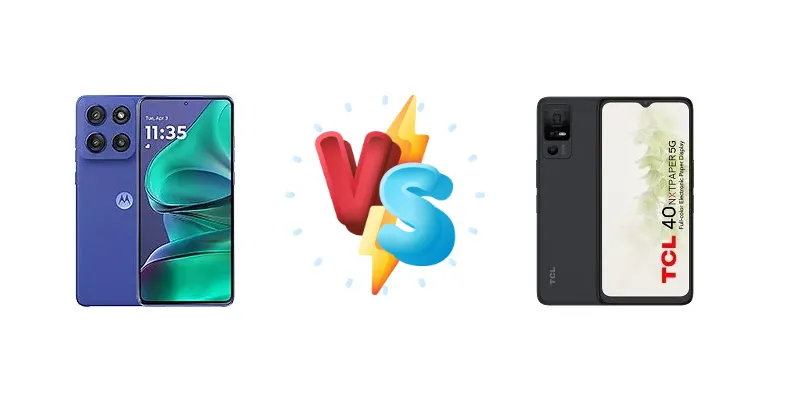
|
🏆 Quick Verdict
For users prioritizing performance and fast charging, the Motorola Moto G Stylus 5G (2025) is the clear winner. Its Snapdragon 6 Gen 3 chipset and 68W charging significantly outperform the TCL 40 NxtPaper 5G’s Dimensity 6020 and 15W charging, making it ideal for demanding tasks and minimizing downtime.
| PHONES | ||
|---|---|---|
| Phone Names | Motorola Moto G Stylus 5G (2025) | TCL 40 NxtPaper 5G |
| Network | ||
|---|---|---|
| 2G bands | GSM 850 / 900 / 1800 / 1900 | GSM 850 / 900 / 1800 / 1900 |
| 3G bands | HSDPA 850 / 900 / 1700(AWS) / 1900 / 2100 | HSDPA 850 / 900 / 1700(AWS) / 1900 / 2100 |
| 4G bands | 1, 2, 3, 4, 5, 7, 8, 12, 13, 14, 17, 18, 19, 20, 25, 26, 28, 29, 30, 38, 39, 40, 41, 42, 48, 66, 71 | 1, 3, 5, 7, 8, 20, 28, 32, 38, 40, 41, 42 |
| 5G bands | 1, 2, 3, 5, 7, 12, 14, 20, 25, 26, 28, 29, 30, 38, 40, 41, 48, 66, 70, 71, 77, 78 SA/NSA/Sub6 | 1, 3, 5, 7, 8, 20, 28, 38, 40, 41, 78 SA/NSA |
| Speed | HSPA, LTE, 5G | HSPA, LTE, 5G |
| Technology | GSM / HSPA / LTE / 5G | GSM / HSPA / LTE / 5G |
| Launch | ||
|---|---|---|
| Announced | 2025, April 08 | 2023, August 29 |
| Status | Available. Released 2025, April 17 | Available. Released 2023, October |
| Body | ||
|---|---|---|
| Build | Glass front (Gorilla Glass 3), silicone polymer (eco leather) back, plastic frame | - |
| Dimensions | 162.2 x 74.8 x 8.3 mm (6.39 x 2.94 x 0.33 in) | 164.5 x 75.4 x 9 mm (6.48 x 2.97 x 0.35 in) |
| SIM | Nano-SIM + eSIM | Nano-SIM + Nano-SIM |
| Weight | 191 g (6.74 oz) | 192 g (6.77 oz) |
| Display | ||
|---|---|---|
| Protection | Corning Gorilla Glass 3 | - |
| Resolution | 1220 x 2712 pixels, 20:9 ratio (~444 ppi density) | 720 x 1612 pixels, 20:9 ratio (~267 ppi density) |
| Size | 6.7 inches, 108.4 cm2 (~89.3% screen-to-body ratio) | 6.6 inches, 104.6 cm2 (~84.4% screen-to-body ratio) |
| Type | AMOLED, 1B colors, 120Hz, HDR, 3000 nits (peak) | LCD, 90Hz, 500 nits |
| Platform | ||
|---|---|---|
| CPU | Octa-core (4x2.4 GHz Cortex-A78 & 4x1.8 GHz Cortex-A55) | Octa-core (2x2.2 GHz Cortex-A76 & 6x2.0 GHz Cortex-A55) |
| Chipset | Qualcomm SM6475-AB Snapdragon 6 Gen 3 (4 nm) | Mediatek Dimensity 6020 (7 nm) |
| GPU | Adreno 710 | Mali-G57 MC2 |
| OS | Android 15, up to 2 major Android upgrades | Android 13, TCL UI |
| Memory | ||
|---|---|---|
| Card slot | microSDXC (dedicated slot) | microSDXC (uses shared SIM slot) |
| Internal | 128GB 8GB RAM, 256GB 8GB RAM | 256GB 6GB RAM |
| Main Camera | ||
|---|---|---|
| Dual | 50 MP, f/1.8, 24mm (wide), 1/1.56", 1.0µm, multi-directional PDAF, OIS 13 MP, f/2.2, 16mm, 120˚ (ultrawide), 1/3.0", 1.12µm, PDAF | - |
| Features | LED flash, HDR, panorama | LED flash, HDR, panorama |
| Triple | - | 50 MP, f/1.8, (wide), 1/2.76", 0.64µm, PDAF 2 MP (macro) Auxiliary lens |
| Video | 4K@30fps, 1080p@30/60/120fps | 1080p@30fps |
| Selfie camera | ||
|---|---|---|
| Features | HDR | - |
| Single | 32 MP, f/2.2, 25mm (wide), 1/3.14", 0.7µm | 8 MP, (wide), 1/4.0", 1.12µm |
| Video | 4K@30fps, 1080p@30/60fps | 1080p@30fps |
| Sound | ||
|---|---|---|
| 35mm jack | Yes | Yes |
| Loudspeaker | Yes, with stereo speakers (with Dolby Atmos) | Yes |
| Comms | ||
|---|---|---|
| Bluetooth | 5.4, A2DP, LE | 5.1, A2DP, LE |
| NFC | Yes | Yes |
| Positioning | GPS, GLONASS, GALILEO | GPS, GLONASS, BDS, GALILEO |
| Radio | No | FM radio |
| USB | USB Type-C 2.0 | USB Type-C 2.0 |
| WLAN | Wi-Fi 802.11 a/b/g/n/ac/6e, tri-band | Wi-Fi 802.11 a/b/g/n/ac, dual-band, Wi-Fi Direct |
| Features | ||
|---|---|---|
| Sensors | Fingerprint (under display, optical), accelerometer, gyro, proximity, compass | Fingerprint (side-mounted), accelerometer, proximity, compass |
| Battery | ||
|---|---|---|
| Charging | 68W wired 15W wireless | 15W wired |
| Type | 5000 mAh | Li-Ion 5000 mAh |
| Misc | ||
|---|---|---|
| Colors | Pantone: Gibraltar sea, Surf the Web | Starlight Black |
| Models | XT2517-1 | T771K |
| Price | $ 299.99 / C$ 368.17 | About 250 EUR |
Motorola Moto G Stylus 5G (2025)
- Significantly faster charging (68W)
- More powerful processor (Snapdragon 6 Gen 3)
- Brighter display for outdoor visibility
- Stylus may not be useful for all users
- Potentially larger and heavier due to stylus integration
TCL 40 NxtPaper 5G
- Unique NxtPaper display for eye comfort
- Potentially longer battery life due to less powerful processor
- More affordable price point (likely)
- Significantly slower charging (15W)
- Less powerful processor for demanding tasks
- Dimmer display for outdoor use
Display Comparison
The TCL 40 NxtPaper 5G boasts a unique selling point with its 'NxtPaper' display, achieving a high 1892:1 contrast ratio. However, its 611 nits of peak brightness falls significantly short of the Motorola Moto G Stylus 5G (2025)'s measured 1870 nits. This means the Motorola will be far more usable outdoors in direct sunlight. While the TCL aims for a paper-like experience, the Motorola’s higher brightness provides a more vibrant and versatile viewing experience. The TCL's focus is clearly on reducing eye strain, but at the cost of overall visual pop.
Camera Comparison
Neither device is positioned as a camera powerhouse, but the available data suggests a slight edge to the Motorola. While specific sensor details are missing, the chipset’s image signal processor (ISP) capabilities are generally stronger on Qualcomm platforms. The TCL 40 NxtPaper 5G likely relies heavily on software processing to compensate for its less powerful chipset. Given the market segment, focusing on the primary sensor performance is key, and the Motorola’s chipset suggests better image quality in most scenarios. We'd advise ignoring the likely inclusion of low-resolution macro lenses on both devices.
Performance
The Motorola Moto G Stylus 5G (2025) leverages the Qualcomm Snapdragon 6 Gen 3 (4nm) chipset, featuring an octa-core configuration with 4x2.4 GHz Cortex-A78 and 4x1.8 GHz Cortex-A55 cores. This is a substantial upgrade over the TCL 40 NxtPaper 5G’s MediaTek Dimensity 6020 (7nm), which uses a 2x2.2 GHz Cortex-A76 and 6x2.0 GHz Cortex-A55 setup. The 4nm process node of the Snapdragon offers superior power efficiency and thermal performance, translating to less throttling during sustained workloads. The Motorola will handle demanding apps and games with greater ease.
Battery Life
The Motorola Moto G Stylus 5G (2025) achieves an impressive 10:05 hours of active use, demonstrating excellent battery optimization despite its powerful processor. While the TCL 40 NxtPaper 5G’s battery capacity is unknown, its less demanding chipset likely contributes to reasonable endurance. However, the Motorola’s 68W wired charging is a game-changer, offering significantly faster top-ups compared to the TCL’s 15W charging. The Motorola also adds 15W wireless charging, a feature absent on the TCL, providing added convenience.
Buying Guide
Buy the Motorola Moto G Stylus 5G (2025) if you need a phone for multitasking, gaming, or frequent note-taking with the integrated stylus, and value fast charging speeds. Buy the TCL 40 NxtPaper 5G if you prioritize eye comfort, enjoy reading on a paper-like display, and are less concerned with raw processing power or rapid charging.