
Motorola Moto G Stylus 5G (2025) vs. Samsung Galaxy A35: A Detailed Comparison
| Phones Images | |||||
|---|---|---|---|---|---|
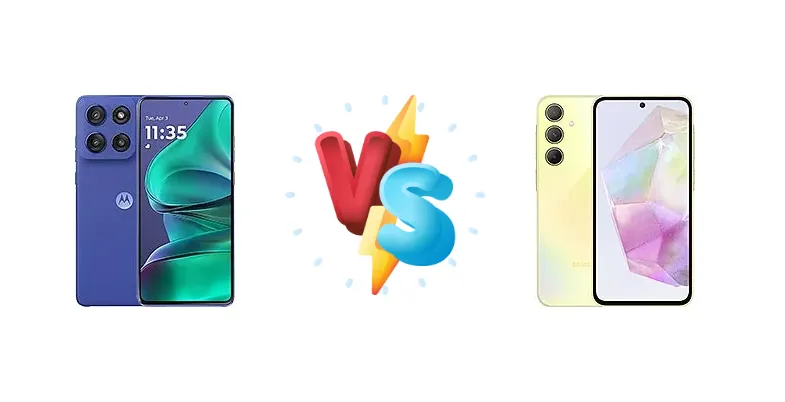
|
🏆 Quick Verdict
For the average user prioritizing battery life, the Samsung Galaxy A35 is the clear winner, offering over two hours of additional active use. However, the Motorola Moto G Stylus 5G (2025) counters with significantly faster 68W charging and a brighter display, making it ideal for power users and those who value quick top-ups.
| PHONES | ||
|---|---|---|
| Phone Names | Motorola Moto G Stylus 5G (2025) | Samsung Galaxy A35 |
| Network | ||
|---|---|---|
| 2G bands | GSM 850 / 900 / 1800 / 1900 | GSM 850 / 900 / 1800 / 1900 |
| 3G bands | HSDPA 850 / 900 / 1700(AWS) / 1900 / 2100 | HSDPA 850 / 900 / 1700(AWS) / 1900 / 2100 |
| 4G bands | 1, 2, 3, 4, 5, 7, 8, 12, 13, 14, 17, 18, 19, 20, 25, 26, 28, 29, 30, 38, 39, 40, 41, 42, 48, 66, 71 | 1, 2, 3, 4, 5, 7, 8, 12, 13, 17, 20, 25, 26, 28, 32, 38, 40, 41, 66 |
| 5G bands | 1, 2, 3, 5, 7, 12, 14, 20, 25, 26, 28, 29, 30, 38, 40, 41, 48, 66, 70, 71, 77, 78 SA/NSA/Sub6 | 1, 3, 5, 7, 8, 26, 28, 40, 41, 66, 77, 78 SA/NSA/Sub6 |
| Speed | HSPA, LTE, 5G | HSPA, LTE, 5G |
| Technology | GSM / HSPA / LTE / 5G | GSM / HSPA / LTE / 5G |
| Launch | ||
|---|---|---|
| Announced | 2025, April 08 | 2024, March 11 |
| Status | Available. Released 2025, April 17 | Available. Released 2024, March 15 |
| Body | ||
|---|---|---|
| Build | Glass front (Gorilla Glass 3), silicone polymer (eco leather) back, plastic frame | Glass front (Gorilla Glass Victus+), plastic frame, glass back |
| Dimensions | 162.2 x 74.8 x 8.3 mm (6.39 x 2.94 x 0.33 in) | 161.7 x 78 x 8.2 mm (6.37 x 3.07 x 0.32 in) |
| SIM | Nano-SIM + eSIM | · Nano-SIM + eSIM· Nano-SIM + Nano-SIM |
| Weight | 191 g (6.74 oz) | 209 g (7.37 oz) |
| Display | ||
|---|---|---|
| Protection | Corning Gorilla Glass 3 | Corning Gorilla Glass Victus+ |
| Resolution | 1220 x 2712 pixels, 20:9 ratio (~444 ppi density) | 1080 x 2340 pixels, 19.5:9 ratio (~390 ppi density) |
| Size | 6.7 inches, 108.4 cm2 (~89.3% screen-to-body ratio) | 6.6 inches, 106.9 cm2 (~84.8% screen-to-body ratio) |
| Type | AMOLED, 1B colors, 120Hz, HDR, 3000 nits (peak) | Super AMOLED, 120Hz, 1000 nits (HBM) |
| Platform | ||
|---|---|---|
| CPU | Octa-core (4x2.4 GHz Cortex-A78 & 4x1.8 GHz Cortex-A55) | Octa-core (4x2.4 GHz Cortex-A78 & 4x2.0 GHz Cortex-A55) |
| Chipset | Qualcomm SM6475-AB Snapdragon 6 Gen 3 (4 nm) | Exynos 1380 (5 nm) |
| GPU | Adreno 710 | Mali-G68 MP5 |
| OS | Android 15, up to 2 major Android upgrades | Android 14, up to 4 major Android upgrades, One UI 7 |
| Memory | ||
|---|---|---|
| Card slot | microSDXC (dedicated slot) | microSDXC (uses shared SIM slot) |
| Internal | 128GB 8GB RAM, 256GB 8GB RAM | 128GB 4GB RAM, 128GB 6GB RAM, 128GB 8GB RAM, 256GB 6GB RAM, 256GB 8GB RAM, 256GB 12GB RAM |
| Main Camera | ||
|---|---|---|
| Dual | 50 MP, f/1.8, 24mm (wide), 1/1.56", 1.0µm, multi-directional PDAF, OIS 13 MP, f/2.2, 16mm, 120˚ (ultrawide), 1/3.0", 1.12µm, PDAF | - |
| Features | LED flash, HDR, panorama | LED flash, panorama, HDR |
| Triple | - | 50 MP, f/1.8, (wide), 1/1.96", PDAF, OIS 8 MP, f/2.2, 123˚, (ultrawide), 1/4.0", 1.12µm 5 MP (macro) |
| Video | 4K@30fps, 1080p@30/60/120fps | 4K@30fps, 1080p@30/60fps, gyro-EIS |
| Selfie camera | ||
|---|---|---|
| Features | HDR | - |
| Single | 32 MP, f/2.2, 25mm (wide), 1/3.14", 0.7µm | 13 MP, f/2.2, (wide), 1/3.06", 1.12µm |
| Video | 4K@30fps, 1080p@30/60fps | 4K@30fps, 1080p@30fps |
| Sound | ||
|---|---|---|
| 35mm jack | Yes | No |
| Loudspeaker | Yes, with stereo speakers (with Dolby Atmos) | Yes, with stereo speakers |
| Comms | ||
|---|---|---|
| Bluetooth | 5.4, A2DP, LE | 5.3, A2DP, LE |
| NFC | Yes | Yes (market/region dependent) |
| Positioning | GPS, GLONASS, GALILEO | GPS, GALILEO, GLONASS, BDS, QZSS |
| Radio | No | No |
| USB | USB Type-C 2.0 | USB Type-C 2.0, OTG |
| WLAN | Wi-Fi 802.11 a/b/g/n/ac/6e, tri-band | Wi-Fi 802.11 a/b/g/n/ac/6, dual-band, Wi-Fi Direct |
| Features | ||
|---|---|---|
| Sensors | Fingerprint (under display, optical), accelerometer, gyro, proximity, compass | Fingerprint (under display, optical), accelerometer, gyro, compass |
| Battery | ||
|---|---|---|
| Charging | 68W wired 15W wireless | 25W wired |
| Type | 5000 mAh | Li-Ion 5000 mAh |
| Misc | ||
|---|---|---|
| Colors | Pantone: Gibraltar sea, Surf the Web | Iceblue, Lilac, Navy, Lemon |
| Models | XT2517-1 | SM-A356E, SM-A356E/DS, SM-A356B, SM-A356B/DS, SM-A356U, SM-A356U1 |
| Price | $ 299.99 / C$ 368.17 | $ 138.00 / C$ 419.99 / £ 205.99 / € 259.99 / ₹ 18,299 |
| SAR | - | 0.81 W/kg (head) |
| SAR EU | - | 0.44 W/kg (head) 0.92 W/kg (body) |
Motorola Moto G Stylus 5G (2025)
- Significantly brighter display for outdoor use
- Faster 68W wired and 15W wireless charging
- Integrated stylus for note-taking and creativity
- Shorter battery life compared to the Galaxy A35
- Potentially more thermal throttling under sustained load
Samsung Galaxy A35
- Exceptional battery life for all-day usage
- Samsung’s One UI software experience
- Potentially better power efficiency due to 5nm Exynos chip
- Slower 25W wired charging
- Dimmer display compared to the Moto G Stylus 5G (2025)
Display Comparison
The Motorola Moto G Stylus 5G (2025) boasts a significantly brighter display, reaching a measured 1870 nits, compared to the Samsung Galaxy A35’s 1024 nits. This difference translates to superior visibility in direct sunlight. While both utilize OLED technology, the higher peak brightness of the Motorola gives it a clear advantage for outdoor use. We lack data on refresh rates or panel technology (LTPO), but the brightness difference is a key differentiator. The A35's lower brightness isn't necessarily a dealbreaker for indoor use, but the Moto G offers a more versatile viewing experience.
Camera Comparison
Without detailed camera specifications, a direct comparison is limited. However, the market positioning suggests both phones will feature multi-camera systems geared towards everyday photography. We can assume the A35 will leverage Samsung’s image processing expertise, potentially offering more vibrant and saturated photos. The Moto G may focus on a more natural color profile. The absence of information regarding sensor sizes and optical image stabilization (OIS) makes a definitive judgment impossible, but the presence of a stylus on the Moto G suggests potential for creative photo editing workflows.
Performance
Both devices employ an octa-core CPU configuration with 4x2.4 GHz Cortex-A78 cores and 4x Cortex-A55 cores, suggesting similar CPU performance. However, the chipset differs: the Moto G utilizes the Qualcomm SM6475-AB Snapdragon 6 Gen 3 (4nm), while the A35 features the Exynos 1380 (5nm). The 4nm process node of the Snapdragon 6 Gen 3 *should* offer better power efficiency and potentially less thermal throttling under sustained load, despite the A35's slightly higher clock speed on the A55 cores (2.0 GHz vs 1.8 GHz). Real-world gaming performance will need further testing, but the Snapdragon has a theoretical edge in sustained performance.
Battery Life
Battery life is where the Samsung Galaxy A35 truly shines. Its active use score of 12:26h significantly surpasses the Motorola Moto G Stylus 5G (2025)’s 10:05h. This translates to a tangible difference in daily usage, allowing the A35 to comfortably last a full day, even with heavy use. However, the Moto G compensates with much faster charging: 68W wired and 15W wireless, compared to the A35’s 25W wired charging. This means the Moto G can quickly replenish its battery, minimizing downtime, even if its overall capacity is lower.
Buying Guide
Buy the Motorola Moto G Stylus 5G (2025) if you need a brighter screen for outdoor visibility, prioritize faster charging speeds, and appreciate the integrated stylus for note-taking and creative tasks. Buy the Samsung Galaxy A35 if you value exceptional battery endurance, prefer Samsung’s One UI software experience, and prioritize long-term reliability within the Galaxy ecosystem.