
Motorola Moto G Stylus 5G (2025) vs. Nothing Phone (2a) Plus: A Detailed Comparison
| Phones Images | |||||
|---|---|---|---|---|---|
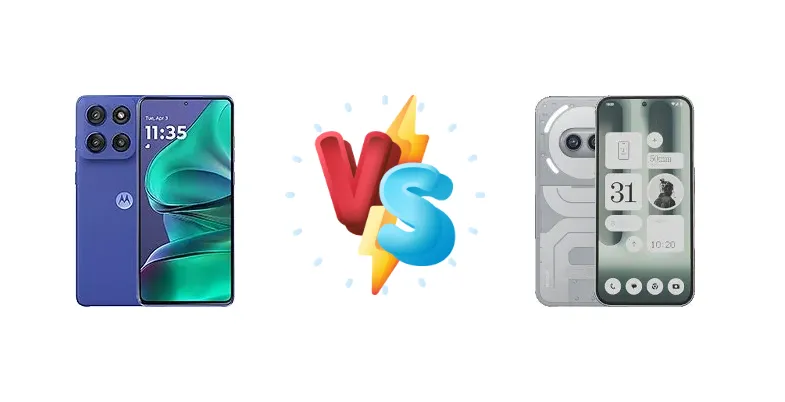
|
🏆 Quick Verdict
For the average user prioritizing battery life and a streamlined experience, the Nothing Phone (2a) Plus is the stronger choice. Its significantly longer 16:34 active use score outweighs the Moto G Stylus 5G (2025)'s stylus functionality for most consumers. However, the Motorola offers faster charging and a brighter display.
| PHONES | ||
|---|---|---|
| Phone Names | Motorola Moto G Stylus 5G (2025) | Nothing Phone (2a) Plus |
| Network | ||
|---|---|---|
| 2G bands | GSM 850 / 900 / 1800 / 1900 | GSM 850 / 900 / 1800 / 1900 |
| 3G bands | HSDPA 850 / 900 / 1700(AWS) / 1900 / 2100 | HSDPA 800 / 850 / 900 / 1700(AWS) / 1900 / 2100 |
| 4G bands | 1, 2, 3, 4, 5, 7, 8, 12, 13, 14, 17, 18, 19, 20, 25, 26, 28, 29, 30, 38, 39, 40, 41, 42, 48, 66, 71 | 1, 3, 4, 5, 7, 8, 18, 19, 20, 26, 28, 38, 39, 40, 41, 42, 66 |
| 5G bands | 1, 2, 3, 5, 7, 12, 14, 20, 25, 26, 28, 29, 30, 38, 40, 41, 48, 66, 70, 71, 77, 78 SA/NSA/Sub6 | 1, 3, 5, 7, 8, 20, 28, 38, 40, 41, 66, 77, 78 SA/NSA |
| Speed | HSPA, LTE, 5G | HSPA, LTE, 5G |
| Technology | GSM / HSPA / LTE / 5G | GSM / HSPA / LTE / 5G |
| Launch | ||
|---|---|---|
| Announced | 2025, April 08 | 2024, July 31 |
| Status | Available. Released 2025, April 17 | Available. Released 2024, August 03 |
| Body | ||
|---|---|---|
| Build | Glass front (Gorilla Glass 3), silicone polymer (eco leather) back, plastic frame | Glass front (Gorilla Glass 5), plastic frame, plastic back |
| Dimensions | 162.2 x 74.8 x 8.3 mm (6.39 x 2.94 x 0.33 in) | 161.7 x 76.3 x 8.5 mm (6.37 x 3.00 x 0.33 in) |
| SIM | Nano-SIM + eSIM | Nano-SIM + Nano-SIM |
| Weight | 191 g (6.74 oz) | 190 g (6.70 oz) |
| Display | ||
|---|---|---|
| Protection | Corning Gorilla Glass 3 | Corning Gorilla Glass 5 |
| Resolution | 1220 x 2712 pixels, 20:9 ratio (~444 ppi density) | 1080 x 2412 pixels, 20:9 ratio (~395 ppi density) |
| Size | 6.7 inches, 108.4 cm2 (~89.3% screen-to-body ratio) | 6.7 inches, 107.5 cm2 (~87.1% screen-to-body ratio) |
| Type | AMOLED, 1B colors, 120Hz, HDR, 3000 nits (peak) | AMOLED, 1B colors, 120Hz, 2160Hz PWM, HDR10+, 700 nits (typ), 1100 nits (HBM), 1300 nits (peak) |
| Platform | ||
|---|---|---|
| CPU | Octa-core (4x2.4 GHz Cortex-A78 & 4x1.8 GHz Cortex-A55) | Octa-core (2x3.0 GHz Cortex-A715 & 6x 2.0 GHz Cortex-A510) |
| Chipset | Qualcomm SM6475-AB Snapdragon 6 Gen 3 (4 nm) | Mediatek Dimensity 7350 Pro (4 nm) |
| GPU | Adreno 710 | Mali-G610 MC4 |
| OS | Android 15, up to 2 major Android upgrades | Android 14, up to 3 major Android upgrades, Nothing OS 3.0 |
| Memory | ||
|---|---|---|
| Card slot | microSDXC (dedicated slot) | No |
| Internal | 128GB 8GB RAM, 256GB 8GB RAM | 256GB 8GB RAM, 256GB 12GB RAM |
| Main Camera | ||
|---|---|---|
| Dual | 50 MP, f/1.8, 24mm (wide), 1/1.56", 1.0µm, multi-directional PDAF, OIS 13 MP, f/2.2, 16mm, 120˚ (ultrawide), 1/3.0", 1.12µm, PDAF | 50 MP, f/1.9, 24mm (wide), 1/1.57", 1.0µm, PDAF, OIS 50 MP, f/2.2, 114˚ (ultrawide), 1/2.76", 0.64µm |
| Features | LED flash, HDR, panorama | LED flash, panorama, HDR |
| Video | 4K@30fps, 1080p@30/60/120fps | 4K@30fps, 1080p@60/120fps, gyro-EIS |
| Selfie camera | ||
|---|---|---|
| Features | HDR | HDR |
| Single | 32 MP, f/2.2, 25mm (wide), 1/3.14", 0.7µm | 50 MP, f/2.2, (wide), 1/2.76" |
| Video | 4K@30fps, 1080p@30/60fps | 4K@30fps |
| Sound | ||
|---|---|---|
| 35mm jack | Yes | No |
| Loudspeaker | Yes, with stereo speakers (with Dolby Atmos) | Yes, with stereo speakers |
| Comms | ||
|---|---|---|
| Bluetooth | 5.4, A2DP, LE | 5.3, A2DP, LE |
| NFC | Yes | Yes, 360˚ |
| Positioning | GPS, GLONASS, GALILEO | GPS, GALILEO, GLONASS, BDS, QZSS |
| Radio | No | No |
| USB | USB Type-C 2.0 | USB Type-C 2.0, OTG |
| WLAN | Wi-Fi 802.11 a/b/g/n/ac/6e, tri-band | Wi-Fi 802.11 a/b/g/n/ac/6, dual-band, Wi-Fi Direct |
| Features | ||
|---|---|---|
| Sensors | Fingerprint (under display, optical), accelerometer, gyro, proximity, compass | Fingerprint (under display, optical), accelerometer, gyro, proximity, compass |
| Battery | ||
|---|---|---|
| Charging | 68W wired 15W wireless | 50W wired, 50% in 21 min, 100% in 56 min |
| Type | 5000 mAh | 5000 mAh |
| Misc | ||
|---|---|---|
| Colors | Pantone: Gibraltar sea, Surf the Web | Black, Grey |
| Models | XT2517-1 | A142P |
| Price | $ 299.99 / C$ 368.17 | € 269.90 / ₹ 22,599 |
Motorola Moto G Stylus 5G (2025)
- Integrated Stylus for note-taking and drawing
- Significantly brighter display (1870 nits)
- Faster 68W wired charging
- Significantly shorter battery life (10:05h active use)
- Potentially slower performance due to older CPU cores
Nothing Phone (2a) Plus
- Exceptional battery life (16:34h active use)
- More powerful CPU (Dimensity 7350 Pro)
- Fast 50W charging with quick top-ups
- Less bright display (1097 nits)
- Lacks integrated stylus functionality
Display Comparison
The Motorola Moto G Stylus 5G (2025) boasts a significantly brighter display, reaching a measured 1870 nits, making it more legible outdoors under direct sunlight. In contrast, the Nothing Phone (2a) Plus peaks at 1097 nits. While the Nothing Phone (2a) Plus likely employs a high refresh rate panel (spec not provided), the Motorola’s brightness advantage is substantial. Both devices utilize a 4nm process, suggesting similar power efficiency in display operation, but the Motorola’s higher peak brightness will draw more power when needed. The lack of LTPO on either device means refresh rate adjustments are likely less dynamic, impacting battery savings.
Camera Comparison
Without detailed camera specifications, a direct comparison is limited. However, given the market positioning, it’s reasonable to assume both phones feature multi-camera systems. The Nothing Phone (2a) Plus’s image processing is known for its natural color reproduction, while Motorola typically leans towards more saturated images. The absence of information regarding sensor sizes and optical image stabilization (OIS) makes it difficult to assess low-light performance. We can assume both phones will include a standard wide, ultrawide, and potentially a macro lens, but the quality will depend heavily on the sensor and software optimization.
Performance
The Nothing Phone (2a) Plus, powered by the Mediatek Dimensity 7350 Pro, features a CPU configuration of 2x3.0 GHz Cortex-A715 cores and 6x2.0 GHz Cortex-A510 cores. This contrasts with the Motorola’s Qualcomm SM6475-AB Snapdragon 6 Gen 3, utilizing 4x2.4 GHz Cortex-A78 and 4x1.8 GHz Cortex-A55 cores. The Dimensity 7350 Pro’s newer Cortex-A715 cores generally offer a performance advantage over the A78 cores in the Snapdragon 6 Gen 3, particularly in multi-threaded tasks. Both chipsets are built on a 4nm process, ensuring comparable efficiency, but the Nothing Phone (2a) Plus is expected to handle demanding applications and gaming more smoothly. The lack of LPDDR5x RAM specification for the Motorola raises concerns about potential memory bandwidth limitations.
Battery Life
The Nothing Phone (2a) Plus delivers a remarkable 16:34 hours of active use, significantly outperforming the Motorola Moto G Stylus 5G (2025)'s 10:05 hours. This difference is substantial and highlights the Nothing Phone (2a) Plus’s superior battery optimization. While the Motorola offers faster 68W wired charging, and 15W wireless, the Nothing Phone (2a) Plus’s 50W wired charging (0-50% in 21 minutes, 100% in 56 minutes) is still competitive. The larger battery life advantage of the Nothing Phone (2a) Plus mitigates the slower charging speed for most users.
Buying Guide
Buy the Motorola Moto G Stylus 5G (2025) if you frequently take handwritten notes, sketch, or require a built-in stylus for precise input. Buy the Nothing Phone (2a) Plus if you prioritize all-day battery life, a clean and efficient software experience, and a unique, minimalist aesthetic. The Nothing Phone (2a) Plus is the better option for media consumption and general productivity.