
Motorola Moto G Stylus 5G (2025) vs. Google Pixel 8a: A Deep Dive Comparison
| Phones Images | |||||
|---|---|---|---|---|---|
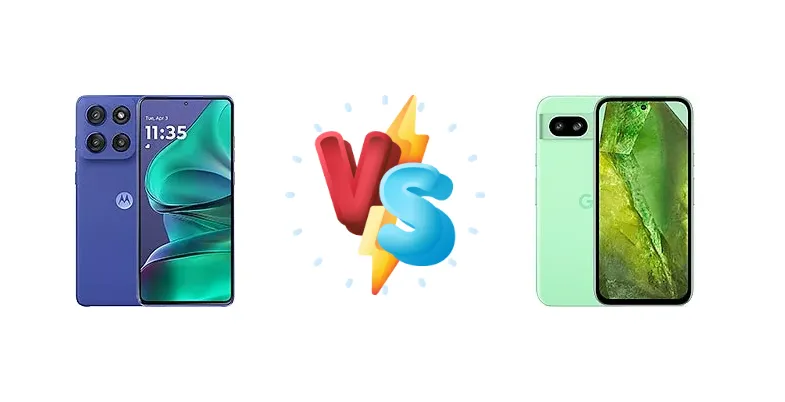
|
🏆 Quick Verdict
For the average user prioritizing long-term battery life and software experience, the Google Pixel 8a is the superior choice. Its impressive 11:25 active use score and 40:06h endurance rating significantly outperform the Moto G Stylus 5G (2025). However, the Motorola offers significantly faster 68W charging, a built-in stylus, and a brighter display.
| PHONES | ||
|---|---|---|
| Phone Names | Motorola Moto G Stylus 5G (2025) | Google Pixel 8a |
| Network | ||
|---|---|---|
| 2G bands | GSM 850 / 900 / 1800 / 1900 | GSM 850 / 900 / 1800 / 1900 |
| 3G bands | HSDPA 850 / 900 / 1700(AWS) / 1900 / 2100 | HSDPA 800 / 850 / 900 / 1700(AWS) / 1900 / 2100 |
| 4G bands | 1, 2, 3, 4, 5, 7, 8, 12, 13, 14, 17, 18, 19, 20, 25, 26, 28, 29, 30, 38, 39, 40, 41, 42, 48, 66, 71 | 1, 2, 3, 4, 5, 7, 8, 12, 17, 18, 19, 20, 26, 28, 32, 38, 40, 41, 42, 66 - G6GPR (International) |
| 5G bands | 1, 2, 3, 5, 7, 12, 14, 20, 25, 26, 28, 29, 30, 38, 40, 41, 48, 66, 70, 71, 77, 78 SA/NSA/Sub6 | 1, 2, 3, 5, 7, 8, 12, 20, 26, 28, 38, 40, 41, 66, 75, 76, 77, 78 SA/NSA/Sub6 - G6GPR (International) |
| Speed | HSPA, LTE, 5G | HSPA, LTE, 5G |
| Technology | GSM / HSPA / LTE / 5G | GSM / HSPA / LTE / 5G |
| Launch | ||
|---|---|---|
| Announced | 2025, April 08 | 2024, May 07 |
| Status | Available. Released 2025, April 17 | Available. Released 2024, May 14 |
| Body | ||
|---|---|---|
| Build | Glass front (Gorilla Glass 3), silicone polymer (eco leather) back, plastic frame | Glass front (Gorilla Glass 3), aluminum frame, plastic back |
| Dimensions | 162.2 x 74.8 x 8.3 mm (6.39 x 2.94 x 0.33 in) | 152.1 x 72.7 x 8.9 mm (5.99 x 2.86 x 0.35 in) |
| SIM | Nano-SIM + eSIM | Nano-SIM + eSIM |
| Weight | 191 g (6.74 oz) | 188 g (6.63 oz) |
| Display | ||
|---|---|---|
| Protection | Corning Gorilla Glass 3 | Corning Gorilla Glass 3, Mohs level 5 |
| Resolution | 1220 x 2712 pixels, 20:9 ratio (~444 ppi density) | 1080 x 2400 pixels, 20:9 ratio (~430 ppi density) |
| Size | 6.7 inches, 108.4 cm2 (~89.3% screen-to-body ratio) | 6.1 inches, 90.3 cm2 (~81.6% screen-to-body ratio) |
| Type | AMOLED, 1B colors, 120Hz, HDR, 3000 nits (peak) | OLED, HDR, 120Hz, 2000 nits (peak) |
| Platform | ||
|---|---|---|
| CPU | Octa-core (4x2.4 GHz Cortex-A78 & 4x1.8 GHz Cortex-A55) | Nona-core (1x3.0 GHz Cortex-X3 & 4x2.45 GHz Cortex-A715 & 4x2.15 GHz Cortex-A510) |
| Chipset | Qualcomm SM6475-AB Snapdragon 6 Gen 3 (4 nm) | Google Tensor G3 (4 nm) |
| GPU | Adreno 710 | Immortalis-G715s MC10 |
| OS | Android 15, up to 2 major Android upgrades | Android 14, upgradable to Android 16, up to 7 major Android upgrades |
| Memory | ||
|---|---|---|
| Card slot | microSDXC (dedicated slot) | No |
| Internal | 128GB 8GB RAM, 256GB 8GB RAM | 128GB 8GB RAM, 256GB 8GB RAM |
| Main Camera | ||
|---|---|---|
| Dual | 50 MP, f/1.8, 24mm (wide), 1/1.56", 1.0µm, multi-directional PDAF, OIS 13 MP, f/2.2, 16mm, 120˚ (ultrawide), 1/3.0", 1.12µm, PDAF | 64 MP (16 MP eff.), f/1.9, 26mm (wide), 1/1.73", 0.8µm, dual pixel PDAF, OIS 13 MP, f/2.2, 120˚ (ultrawide), 1.12µm |
| Features | LED flash, HDR, panorama | Dual-LED flash, Pixel Shift, Ultra HDR, panorama, Best Take |
| Video | 4K@30fps, 1080p@30/60/120fps | 4K@30/60fps, 1080p@30/60/120/240fps, OIS |
| Selfie camera | ||
|---|---|---|
| Features | HDR | HDR, panorama |
| Single | 32 MP, f/2.2, 25mm (wide), 1/3.14", 0.7µm | 13 MP, f/2.2, 20mm (ultrawide), 1.12µm |
| Video | 4K@30fps, 1080p@30/60fps | 4K@30fps, 1080p@30/60fps |
| Sound | ||
|---|---|---|
| 35mm jack | Yes | No |
| Loudspeaker | Yes, with stereo speakers (with Dolby Atmos) | Yes, with stereo speakers |
| Comms | ||
|---|---|---|
| Bluetooth | 5.4, A2DP, LE | 5.3, A2DP, LE |
| NFC | Yes | Yes |
| Positioning | GPS, GLONASS, GALILEO | GPS, GLONASS, GALILEO, BDS, QZSS, NavIC |
| Radio | No | No |
| USB | USB Type-C 2.0 | USB Type-C 3.2 |
| WLAN | Wi-Fi 802.11 a/b/g/n/ac/6e, tri-band | Wi-Fi 802.11 a/b/g/n/ac/6e, dual/tri-band (market/region dependent) |
| Features | ||
|---|---|---|
| Sensors | Fingerprint (under display, optical), accelerometer, gyro, proximity, compass | Fingerprint (under display, optical), accelerometer, gyro, proximity, compass, barometer |
| Battery | ||
|---|---|---|
| Charging | 68W wired 15W wireless | 18W wired, PD3.0 7.5W wireless Bypass charging |
| Type | 5000 mAh | Li-Po 4492 mAh |
| Misc | ||
|---|---|---|
| Colors | Pantone: Gibraltar sea, Surf the Web | Obsidian, Porcelain, Bay, Aloe |
| Models | XT2517-1 | GKV4X, G6GPR, G8HHN, G576D |
| Price | $ 299.99 / C$ 368.17 | $ 229.98 / C$ 417.99 / £ 279.00 / € 299.99 / ₹ 33,300 |
| EU LABEL | ||
|---|---|---|
| Battery | - | 40:06h endurance, 1000 cycles |
| Energy | - | Class B |
| Free fall | - | Class A (270 falls) |
| Repairability | - | Class B |
Motorola Moto G Stylus 5G (2025)
- Significantly faster 68W wired charging
- Integrated stylus for note-taking and creativity
- Brighter display for outdoor visibility (1870 nits)
- Shorter battery life compared to Pixel 8a (10:05h active use)
- Less powerful processor (Snapdragon 6 Gen 3 vs Tensor G3)
Google Pixel 8a
- Exceptional battery life (11:25h active use, 40:06h endurance)
- Powerful Google Tensor G3 processor with AI capabilities
- Superior camera processing and image quality
- Slower charging speeds (18W wired, 7.5W wireless)
- Less bright display compared to Moto G Stylus 5G (2025)
Display Comparison
The Motorola Moto G Stylus 5G (2025) boasts a brighter display, reaching a measured peak brightness of 1870 nits, compared to the Pixel 8a’s 1508 nits. This difference will be most noticeable outdoors under direct sunlight. While both utilize 4nm chipsets, the display tech isn't specified for either, so we can't comment on refresh rates or panel type. The higher brightness of the Motorola is a clear advantage for users who frequently consume content outdoors.
Camera Comparison
Without detailed camera specifications, a direct comparison is limited. However, Google’s Pixel line is renowned for its computational photography prowess, leveraging the Tensor G3’s AI capabilities to deliver exceptional image quality, even in challenging lighting conditions. The Motorola, while likely capable, will rely more on hardware specifications. The absence of information regarding sensor size and OIS makes it difficult to assess the Motorola’s low-light performance. We can assume the Pixel 8a will offer a more refined and consistent camera experience.
Performance
The Google Pixel 8a leverages Google’s Tensor G3 chipset, a nona-core processor featuring a Cortex-X3 prime core clocked at 3.0 GHz, alongside A715 and A510 cores. This contrasts with the Motorola’s Qualcomm Snapdragon 6 Gen 3, an octa-core chip with Cortex-A78 and A55 cores peaking at 2.4 GHz. While core count isn’t everything, the Tensor G3’s architecture, particularly the Cortex-X3, suggests superior single-core performance, beneficial for demanding applications and smoother multitasking. The 4nm fabrication process is shared, suggesting similar efficiency, but the Tensor G3’s design is optimized for AI tasks.
Battery Life
Battery life is a significant differentiator. The Pixel 8a achieves an impressive 11:25h active use score and a remarkable 40:06h endurance rating, based on 1000 cycles, indicating long-term battery health. The Moto G Stylus 5G (2025) manages a respectable 10:05h active use score, but falls short of the Pixel’s endurance. However, the Motorola compensates with significantly faster charging: 68W wired and 15W wireless, compared to the Pixel 8a’s 18W wired (PD3.0) and 7.5W wireless. The Pixel 8a also features bypass charging, allowing direct power from the charger while the battery is charging, reducing heat and potentially extending battery lifespan.
Buying Guide
Buy the Motorola Moto G Stylus 5G (2025) if you need a built-in stylus for note-taking or creative tasks, value extremely fast charging speeds, and prioritize a brighter screen for outdoor visibility. Buy the Google Pixel 8a if you prefer a cleaner software experience, exceptional battery life, and Google’s renowned computational photography capabilities, even if it means slower charging.