
Motorola Moto G Stylus 2023 vs Samsung Galaxy S9: A Head-to-Head Showdown
| Phones Images | |||||
|---|---|---|---|---|---|
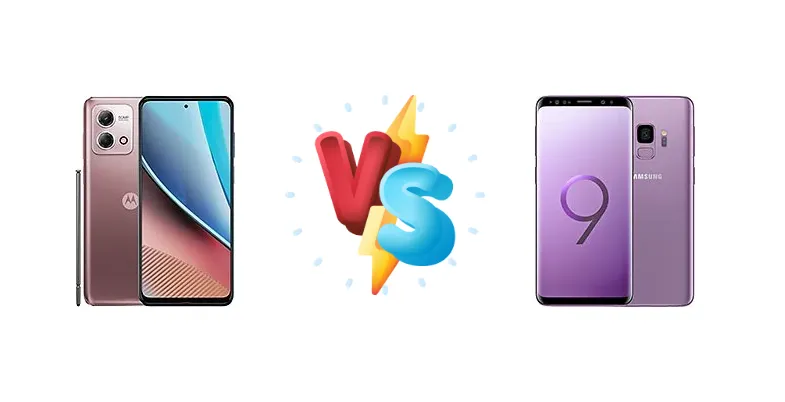
|
🏆 Quick Verdict
The Galaxy S9, despite its age, generally edges out the Moto G Stylus 2023 thanks to its superior chipset, display quality, and overall build. However, the Moto G Stylus offers a stylus and a more modern software experience, making it a compelling choice for budget-conscious users.
| PHONES | ||
|---|---|---|
| Phone Names | Motorola Moto G Stylus (2023) | Samsung Galaxy S9 |
| Network | ||
|---|---|---|
| 2G bands | GSM 850 / 900 / 1800 / 1900 | GSM 850 / 900 / 1800 / 1900 - SIM 1 & SIM 2 (dual-SIM model only) |
| 3G bands | HSDPA 850 / 900 / 1700(AWS) / 1900 / 2100 | HSDPA 850 / 900 / 1700(AWS) / 1900 / 2100 - Global, USA |
| 4G bands | 1, 2, 3, 4, 5, 7, 8, 12, 13, 14, 17, 25, 26, 29, 30, 38, 41, 66, 71 | 1, 2, 3, 4, 5, 7, 8, 12, 13, 17, 18, 19, 20, 25, 26, 28, 32, 38, 39, 40, 41, 66 - Global |
| Speed | HSPA, LTE | HSPA 42.2/5.76 Mbps, LTE (6CA) Cat18 1200/200 Mbps |
| Technology | GSM / HSPA / LTE | GSM / CDMA / HSPA / EVDO / LTE |
| - | 1, 2, 3, 4, 5, 7, 8, 12, 13, 14, 17, 18, 19, 20, 25, 26, 28, 29, 30, 38, 39, 40, 41, 46, 66, 71 - USA | |
| Launch | ||
|---|---|---|
| Announced | 2023, May 02 | 2018, February 25. Released 2018, March 09 |
| Status | Available. Released 2023, May 05 | Discontinued |
| Body | ||
|---|---|---|
| Build | Glass front, plastic frame, plastic back | Glass front (Gorilla Glass 5), glass back (Gorilla Glass 5), aluminum frame |
| Dimensions | 162.9 x 74.1 x 9.2 mm (6.41 x 2.92 x 0.36 in) | 147.7 x 68.7 x 8.5 mm (5.81 x 2.70 x 0.33 in) |
| SIM | Nano-SIM | · Nano-SIM· Nano-SIM + Nano-SIM |
| Weight | 195 g (6.88 oz) | 163 g (5.75 oz) |
| Stylus Water-repellent design | IP68 dust/water resistant (up to 1.5m for 30 min) | |
| Display | ||
|---|---|---|
| Protection | - | Corning Gorilla Glass 5 |
| Resolution | 720 x 1600 pixels, 20:9 ratio (~270 ppi density) | 1440 x 2960 pixels, 18.5:9 ratio (~570 ppi density) |
| Size | 6.5 inches, 102.0 cm2 (~84.5% screen-to-body ratio) | 5.8 inches, 84.8 cm2 (~83.6% screen-to-body ratio) |
| Type | IPS LCD, 90Hz | Super AMOLED, HDR10 |
| - | 3D Touch (home button only) Always-on display | |
| Platform | ||
|---|---|---|
| CPU | Octa-core (2x2.0 GHz Cortex-A75 & 6x1.8 GHz Cortex-A55) | Octa-core (4x2.7 GHz Mongoose M3 & 4x1.8 GHz Cortex-A55) - EMEAOcta-core (4x2.8 GHz Kryo 385 Gold & 4x1.7 GHz Kryo 385 Silver) - USA/LATAM, China |
| Chipset | Mediatek MT6769 Helio G85 (12 nm) | Exynos 9810 (10 nm) - EMEAQualcomm SDM845 Snapdragon 845 (10 nm) - USA/LATAM, China |
| GPU | Mali-G52 MC2 | Mali-G72 MP18 - EMEAAdreno 630 - USA/LATAM, China |
| OS | Android 13, planned upgrade to Android 14 | Android 8.0 (Oreo), upgradable to Android 10, One UI 2.5 |
| Memory | ||
|---|---|---|
| Card slot | microSDXC (dedicated slot) | microSDXC (uses shared SIM slot) - dual SIM model only |
| Internal | 64GB 4GB RAM | 64GB 4GB RAM, 128GB 4GB RAM, 256GB 4GB RAM |
| - | UFS 2.1 | |
| Main Camera | ||
|---|---|---|
| Dual | 50 MP, f/1.8, (wide), 0.64µm, PDAF 2 MP (macro) | - |
| Features | LED flash, HDR, panorama | LED flash, auto-HDR, panorama |
| Single | - | 12 MP, f/1.5-2.4, 26mm (wide), 1/2.55", 1.4µm, dual pixel PDAF, OIS |
| Triple | 50 MP, f/1.8, (wide), 0.64µm, PDAF 2 MP, f/2.4, (macro) | - |
| Video | 1080p@30/60fps | 4K@30/60fps, 1080p@30/60/240fps, 720p@960fps, HDR, stereo sound rec., gyro-EIS & OIS (30fps) |
| Selfie camera | ||
|---|---|---|
| Dual | - | 8 MP, f/1.7, 25mm (wide), 1/3.6", 1.22µm, AF 2 MP (dedicated iris scanner camera) |
| Features | HDR | HDR |
| Single | 8 MP, f/2.0, (wide), 1/4.0", 1.12µm | - |
| Video | 1080p@30fps | 1440p@30fps |
| Sound | ||
|---|---|---|
| 3.5mm jack | Yes | Yes |
| 35mm jack | Yes | Yes |
| Loudspeaker | Yes, with stereo speakers | Yes, with stereo speakers |
| - | 32-bit/384kHz audio Tuned by AKG | |
| Comms | ||
|---|---|---|
| Bluetooth | 5.0, A2DP, LE | 5.0, A2DP, LE, aptX |
| NFC | No | Yes |
| Positioning | GPS, GLONASS, GALILEO | GPS, GLONASS, BDS, GALILEO |
| Radio | No | FM radio (USA & Canada only) |
| USB | USB Type-C 2.0 | USB Type-C 3.1 |
| WLAN | Wi-Fi 802.11 a/b/g/n/ac, dual-band, Wi-Fi Direct | Wi-Fi 802.11 a/b/g/n/ac, dual-band, Wi-Fi Direct |
| Features | ||
|---|---|---|
| Sensors | Fingerprint (side-mounted), accelerometer, gyro, proximity, compass, barometer | Iris scanner, fingerprint (rear-mounted), accelerometer, gyro, proximity, compass, barometer, heart rate, SpO2 |
| - | ANT+ Bixby natural language commands and dictation Samsung Pay (Visa, MasterCard certified) | |
| Battery | ||
|---|---|---|
| Charging | 15W wired | 15W wired, QC2 Wireless (Qi) (market dependent) |
| Type | Li-Po 5000 mAh | Li-Ion 3000 mAh, non-removable (11.55 Wh) |
| Misc | ||
|---|---|---|
| Colors | Blue, Rose Gold | Midnight Black, Coral Blue, Titanium Gray, Lilac Purple, Burgundy Red, Sunrise Gold, Ice Blue |
| Models | - | SM-G960F, SM-G960, SM-G960F, SM-G960U, SM-G960W, SM-G9600, SM-G960U1, SM-G960N, SCV38, SM-G960X, SC-02K |
| Price | About 200 EUR | About 110 EUR |
| SAR | - | 0.63 W/kg (head) 0.96 W/kg (body) |
| SAR EU | - | 0.36 W/kg (head) 1.18 W/kg (body) |
| Tests | ||
|---|---|---|
| Audio quality | - | Noise -93.4dB / Crosstalk -93.9dB |
| Battery life | - | Endurance rating 78h |
| Camera | - | Photo / Video |
| Display | - | Contrast ratio: Infinite (nominal), 4.630 (sunlight) |
| Loudspeaker | - | Voice 68dB / Noise 74dB / Ring 81dB |
| Performance | - | AnTuTu: 250156 (v7) GeekBench: 8830 (v4.4) GFXBench: 14fps (ES 3.1 onscreen) |
Motorola Moto G Stylus (2023)
- Integrated stylus for note-taking and drawing
- Larger battery capacity (likely)
- Modern Android software experience
- More affordable price
- Weaker processor compared to S9
- LCD display with lower contrast
- Slower charging speed
- Less premium build quality
Samsung Galaxy S9
- Superior performance and speed
- Vibrant Super AMOLED display
- Premium design and build quality
- Better camera image quality
- Older device with potentially outdated software updates
- Slower charging speed
- Battery degradation over time (due to age)
- Less modern features
Display Comparison
The Galaxy S9's Super AMOLED display offers significantly better contrast and color accuracy than the Moto G Stylus 2023's LCD. While both have similar resolutions, the S9's panel is noticeably brighter and more vibrant, especially in direct sunlight. The S9's 'Infinite' contrast ratio is a key differentiator.
Camera Comparison
While both phones offer decent camera capabilities, the Galaxy S9 generally produces better image quality, particularly in low-light conditions. The S9's image processing is more refined, resulting in more natural-looking photos. The Moto G Stylus 2023's camera is adequate but lacks the S9's finesse.
Performance
The Samsung Galaxy S9, with its Exynos 9810 or Snapdragon 845 chipset, delivers considerably faster performance than the Moto G Stylus 2023's Helio G85. Apps launch quicker, multitasking is smoother, and gaming is more enjoyable on the S9. The S9's CPU architecture is more advanced.
Battery Life
Both phones boast an impressive endurance rating of 78 hours. While the Moto G Stylus 2023 likely has a larger battery capacity, the S9's more efficient chipset and software optimization contribute to similar battery life. Both charge at 15W, which is relatively slow by modern standards.
Buying Guide
The Motorola Moto G Stylus (2023) is ideal for students, note-takers, and anyone on a tight budget who wants a stylus. The Samsung Galaxy S9 is a good fit for users who prioritize performance, a vibrant display, and a more premium design, even if it means accepting an older device.