
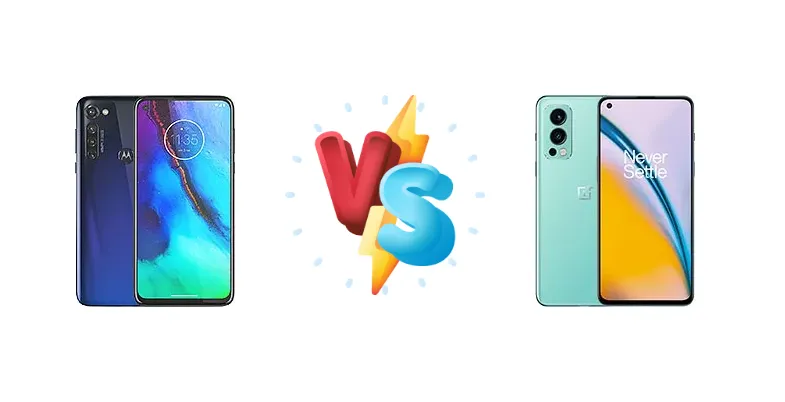
OnePlus Nord 2 5G vs Motorola Moto G Pro: A Detailed Comparison
| Phones Images | |||||
|---|---|---|---|---|---|
|
🏆 Quick Verdict
For most users, the OnePlus Nord 2 5G is the superior choice. Its Mediatek Dimensity 1200 chipset delivers significantly faster performance, and the 65W charging is a game-changer. However, the Motorola Moto G Pro remains a compelling option for those who absolutely prioritize battery endurance above all else.
| PHONES | ||
|---|---|---|
| Phone Names | Motorola Moto G Pro | OnePlus Nord 2 5G |
| Network | ||
|---|---|---|
| 2G bands | GSM 850 / 900 / 1800 / 1900 | GSM 850 / 900 / 1800 / 1900 |
| 3G bands | HSDPA 850 / 900 / 1700(AWS) / 1900 / 2100 | HSDPA 800 / 850 / 900 / 1700(AWS) / 1800 / 1900 / 2100 |
| 4G bands | 1, 2, 3, 4, 5, 7, 8, 12, 13, 14, 17, 18, 19, 20, 25, 26, 29, 30, 38, 39, 40, 41, 66, 71 | 1, 2, 3, 4, 5, 7, 8, 12, 17, 18, 19, 20, 26, 28, 32, 34, 38, 39, 40, 41, 66 - EU |
| 5G bands | - | 1, 3, 7, 8, 20, 28, 38, 41, 66, 78 SA/NSA - EU |
| Speed | HSPA 42.2/5.76 Mbps, LTE (2CA) Cat13 600/100 Mbps | HSPA 42.2/5.76 Mbps, LTE Cat18 1200/150 Mbps, 5G |
| Technology | GSM / HSPA / LTE | GSM / HSPA / LTE / 5G |
| Launch | ||
|---|---|---|
| Announced | 2020, May 26. Released 2020, June 15 | 2021, July 22 |
| Status | Discontinued | Available. Released 2021, July 28 |
| Body | ||
|---|---|---|
| Build | Glass front, plastic back, aluminum frame (6000 series) | Glass front (Gorilla Glass 5), glass back (Gorilla Glass 5), plastic frame |
| Dimensions | 158.6 x 75.8 x 9.2 mm (6.24 x 2.98 x 0.36 in) | 159.1 x 73.3 x 8.3 mm (6.26 x 2.89 x 0.33 in) |
| SIM | Nano-SIM + Nano-SIM | Nano-SIM + Nano-SIM |
| Weight | 192 g (6.77 oz) | 189 g (6.67 oz) |
| Stylus Water-repellent coating | - | |
| Display | ||
|---|---|---|
| Protection | - | Corning Gorilla Glass 5 |
| Resolution | 1080 x 2300 pixels (~399 ppi density) | 1080 x 2400 pixels, 20:9 ratio (~409 ppi density) |
| Size | 6.4 inches, 100.7 cm2 (~83.7% screen-to-body ratio) | 6.43 inches, 99.8 cm2 (~85.6% screen-to-body ratio) |
| Type | IPS LCD | Fluid AMOLED, 90Hz, HDR10+ |
| Platform | ||
|---|---|---|
| CPU | Octa-core (4x2.0 GHz Kryo 260 Gold & 4x1.8 GHz Kryo 260 Silver) | Octa-core (1x3.0 GHz Cortex-A78 & 3x2.6 GHz Cortex-A78 & 4x2.0 GHz Cortex-A55) |
| Chipset | Qualcomm SDM665 Snapdragon 665 (11 nm) | Mediatek Dimensity 1200 (6 nm) |
| GPU | Adreno 610 | Mali-G77 MC9 |
| OS | Android 10, upgradable to Android 12, Android One | Android 11, upgradable to Android 13, OxygenOS 13 |
| Memory | ||
|---|---|---|
| Card slot | microSDXC (uses shared SIM slot) | No |
| Internal | 128GB 4GB RAM | 128GB 6GB RAM, 128GB 8GB RAM, 256GB 8GB RAM, 256GB 12GB RAM |
| Main Camera | ||
|---|---|---|
| Features | Laser AF, LED flash, HDR, panorama | Dual-LED flash, HDR, panorama |
| Triple | 48 MP, f/1.7, 26mm (wide), 1/2.0", 0.8µm, PDAF 16 MP, f/2.2, 117˚ (ultrawide), dedicated video camera (1080p) 2 MP (macro) | 50 MP, f/1.9, 24mm (wide), 1/1.56", 1.0µm, PDAF, OIS 8 MP, f/2.3, 120˚ (ultrawide) Auxiliary lens |
| Video | 4K@30fps, 1080p@30/60/120fps, 1080p@30fps (gyro-EIS) | 4K@30fps, 1080p@30/60/120fps, gyro-EIS |
| Selfie camera | ||
|---|---|---|
| Features | HDR | Auto HDR |
| Single | 16 MP, f/2.0, (wide), 1/3.06", 1.0µm | 32 MP, f/2.5, (wide), 1/2.8", 0.8µm |
| Video | 1080p@30fps | 1080p@30fps, gyro-EIS |
| Sound | ||
|---|---|---|
| 3.5mm jack | Yes | No |
| 35mm jack | Yes | No |
| Loudspeaker | Yes, with stereo speakers | Yes, with stereo speakers |
| Comms | ||
|---|---|---|
| Bluetooth | 5.0, A2DP, LE | 5.2, A2DP, LE, aptX HD |
| NFC | Yes | Yes |
| Positioning | GPS, GLONASS, BDS, GALILEO | GPS, GLONASS, GALILEO, BDS, SBAS, NavIC |
| Radio | FM radio | No |
| USB | USB Type-C 2.0 | USB Type-C 2.0, OTG |
| WLAN | Wi-Fi 802.11 a/b/g/n/ac, dual-band, Wi-Fi Direct | Wi-Fi 802.11 a/b/g/n/ac/6, dual-band, Wi-Fi Direct |
| Features | ||
|---|---|---|
| Sensors | Fingerprint (rear-mounted), accelerometer, gyro, proximity | Fingerprint (under display, optical), accelerometer, gyro, proximity, compass |
| Battery | ||
|---|---|---|
| Charging | 15W wired | 65W wired, PD, 100% in 30 min |
| Type | Li-Po 4000 mAh | Li-Po 4500 mAh |
| Misc | ||
|---|---|---|
| Colors | Mystic indigo | Gray Sierra, Blue Haze, Green Wood, Pac-Man Edition |
| Models | XT2043-7 | DN2101, DN2103 |
| Price | About 320 EUR | € 189.00 / $ 219.99 / £ 148.00 |
| Tests | ||
|---|---|---|
| Battery life | Endurance rating 88h | Endurance rating 102h |
| Camera | Photo / Video | Photo / Video |
| Display | Contrast ratio: 1422:1 | Contrast ratio: Infinite (nominal) |
| Loudspeaker | -24.5 LUFS (Very good) | -24.3 LUFS (Very good) |
| Performance | AnTuTu: 173611 (v8) GeekBench: 1385 (v5.1) GFXBench: 6.6fps (ES 3.1 onscreen) | AnTuTu: 512164 (v8) | 598022 (v9) GeekBench: 2792 (v5.1) GFXBench: 38fps (ES 3.1 onscreen) |
Motorola Moto G Pro
- Exceptional battery life (88h endurance)
- Slightly higher peak display brightness
- More affordable price point (likely)
- Significantly slower processor
- Slow 15W charging
- Less advanced camera system (likely)
OnePlus Nord 2 5G
- Much faster processor (Dimensity 1200)
- Ultra-fast 65W charging (30 min to full)
- Superior display quality (likely OLED)
- Better camera performance (likely)
- Slightly lower battery endurance (102h)
- Higher price point
Display Comparison
The OnePlus Nord 2 5G and Motorola Moto G Pro present contrasting display experiences. While both offer adequate brightness – 633 nits for the Nord 2 5G and 642 nits for the Moto G Pro – the Nord 2 5G’s ‘Infinite’ contrast ratio (likely a marketing term for a high-quality OLED panel) suggests deeper blacks and more vibrant colors compared to the Moto G Pro’s 1422:1 contrast ratio. The Moto G Pro’s measured brightness is slightly higher, potentially offering better visibility in direct sunlight, but the Nord 2 5G’s panel technology likely provides a more visually appealing overall experience.
Camera Comparison
Both phones feature 'Photo / Video' capabilities, but the specifics are lacking in the provided data. However, given the Nord 2 5G’s positioning, it likely incorporates more advanced image processing and potentially larger sensor sizes. The Snapdragon 665’s ISP is older and less capable than the Dimensity 1200’s, suggesting the Nord 2 5G will deliver superior image quality, especially in challenging lighting conditions. Without further details, it’s difficult to assess the quality of video recording on either device, but the Nord 2 5G’s chipset is better equipped for advanced video features.
Performance
The performance gap between these two devices is substantial. The OnePlus Nord 2 5G’s Mediatek Dimensity 1200 (6nm) is a flagship-level chipset, featuring a powerful Cortex-A78 prime core clocked at 3.0 GHz, alongside additional A78 and A55 cores. This contrasts sharply with the Motorola Moto G Pro’s Qualcomm Snapdragon 665 (11nm), which utilizes a more modest Kryo 260 core configuration. The Dimensity 1200’s 6nm process also offers improved power efficiency, despite its higher performance. This translates to significantly faster app loading times, smoother multitasking, and a much better gaming experience on the Nord 2 5G.
Battery Life
Battery life is where the Motorola Moto G Pro shines, boasting an endurance rating of 88 hours. The OnePlus Nord 2 5G isn’t far behind at 102 hours, but the real differentiator is charging speed. The Moto G Pro is limited to 15W wired charging, while the Nord 2 5G supports blazing-fast 65W wired charging with Power Delivery (PD), achieving a full charge in just 30 minutes. This means the Nord 2 5G can quickly top up its battery, mitigating the impact of its slightly lower endurance rating. The Nord 2 5G’s faster charging is a significant convenience factor for users who don’t want to be tethered to a charger for hours.
Buying Guide
Buy the Motorola Moto G Pro if you need a phone that can reliably last two full days on a single charge and aren't demanding gamers or power users. Buy the OnePlus Nord 2 5G if you prioritize a smooth, responsive experience, fast charging, and are willing to charge your phone more frequently for the benefit of superior performance.