
Motorola Moto G Power vs. Samsung Galaxy A24 4G: A Deep Dive Comparison
| Phones Images | |||||
|---|---|---|---|---|---|
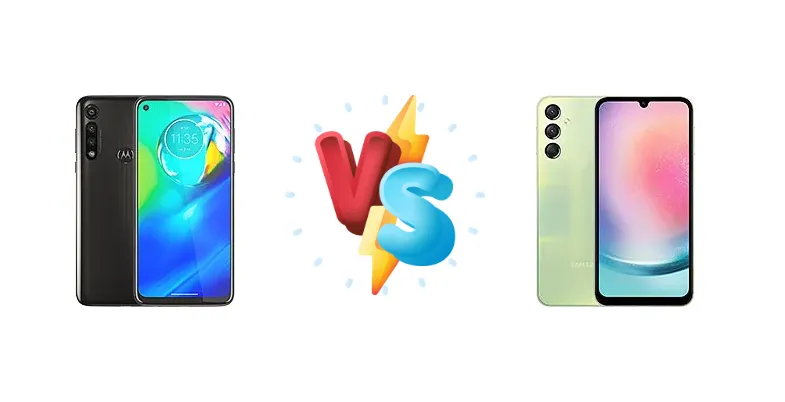
|
🏆 Quick Verdict
For users prioritizing longevity and minimizing charging frequency, the Motorola Moto G Power remains a compelling choice. However, the Samsung Galaxy A24 4G offers a noticeably smoother user experience and superior display quality thanks to its Mediatek Helio G99 chipset and 1012 nit brightness, making it the better all-rounder for most.
| PHONES | ||
|---|---|---|
| Phone Names | Motorola Moto G Power | Samsung Galaxy A24 4G |
| Network | ||
|---|---|---|
| 2G bands | GSM 850 / 900 / 1800 / 1900 | GSM 850 / 900 / 1800 / 1900 |
| 3G bands | HSDPA 850 / 900 / 1700(AWS) / 1900 / 2100 | HSDPA 850 / 900 / 2100 |
| 4G bands | 1, 2, 3, 4, 5, 7, 8, 12, 13, 14, 17, 18, 19, 20, 25, 26, 29, 30, 38, 39, 40, 41, 66, 71 | 1, 3, 5, 7, 8, 20, 28, 38, 40, 41 |
| Speed | HSPA 42.2/5.76 Mbps, LTE (2CA) Cat13 600/100 Mbps | HSPA, LTE |
| Technology | GSM / CDMA / HSPA / EVDO / LTE | GSM / HSPA / LTE |
| CDMA2000 1xEV-DO | - | |
| Launch | ||
|---|---|---|
| Announced | 2020, February 07. Released 2020, April 17 | 2023, April 19 |
| Status | Discontinued | Available. Released 2023, May 05 |
| Body | ||
|---|---|---|
| Build | Glass front, plastic back, aluminum frame (6000 series) | Glass front, plastic frame, plastic back |
| Dimensions | 159.9 x 75.8 x 9.6 mm (6.30 x 2.98 x 0.38 in) | 162.1 x 77.6 x 8.3 mm (6.38 x 3.06 x 0.33 in) |
| SIM | Nano-SIM | · Nano-SIM· Nano-SIM + Nano-SIM |
| Weight | 199 g (7.02 oz) | 195 g (6.88 oz) |
| Water-repellent coating | - | |
| Display | ||
|---|---|---|
| Resolution | 1080 x 2300 pixels (~399 ppi density) | 1080 x 2340 pixels, 19.5:9 ratio (~396 ppi density) |
| Size | 6.4 inches, 100.7 cm2 (~83.0% screen-to-body ratio) | 6.5 inches, 103.7 cm2 (~82.4% screen-to-body ratio) |
| Type | IPS LCD | Super AMOLED, 90Hz, 1000 nits (peak) |
| Platform | ||
|---|---|---|
| CPU | Octa-core (4x2.0 GHz Kryo 260 Gold & 4x1.8 GHz Kryo 260 Silver) | Octa-core (2x2.2 GHz Cortex-A76 & 6x2.0 GHz Cortex-A55) |
| Chipset | Qualcomm SDM665 Snapdragon 665 (11 nm) | Mediatek Helio G99 (6 nm) |
| GPU | Adreno 610 | Mali-G57 MC2 |
| OS | Android 10 | Android 13, up to 4 major Android upgrades, One UI 6 |
| Memory | ||
|---|---|---|
| Card slot | microSDXC (dedicated slot) | microSDXC (dedicated slot) |
| Internal | 64GB 4GB RAM | 128GB 4GB RAM, 128GB 6GB RAM, 128GB 8GB RAM |
| eMMC 5.1 | - | |
| Main Camera | ||
|---|---|---|
| Features | LED flash, HDR, panorama | LED flash, panorama, HDR |
| Triple | 16 MP, f/1.7, (wide), 1/2.8", 1.12µm, PDAF 8 MP, f/2.2, 118˚ (ultrawide), 1/4.0", 1.12µm 2 MP (macro) | 50 MP, f/1.8, 27mm (wide), 1/2.76", 0.64µm, PDAF, OIS 5 MP, f/2.2, 17mm, 123˚ (ultrawide), 1/5.0", 1.12µm 2 MP (macro) |
| Video | 4K@30fps, 1080p@30/60fps, 1080p@30fps (gyro-EIS) | 1080p@30fps, gyro-EIS |
| Selfie camera | ||
|---|---|---|
| Features | HDR | - |
| Single | 16 MP, f/2.0, (wide), 1/3.06", 1.0µm | 13 MP, f/2.2, 25mm (wide), 1/3.06", 1.12µm |
| Video | 1080p@30/120fps | 1080p@30fps |
| Sound | ||
|---|---|---|
| 3.5mm jack | Yes | - |
| 35mm jack | Yes | Yes |
| Loudspeaker | Yes, with stereo speakers | Yes |
| Comms | ||
|---|---|---|
| Bluetooth | 5.0, A2DP, LE | 5.3, A2DP, LE |
| NFC | No | Yes (market/region dependent) |
| Positioning | GPS, GLONASS, BDS, GALILEO | GPS, GLONASS, GALILEO, BDS, QZSS |
| Radio | FM radio | Unspecified |
| USB | USB Type-C 2.0 | USB Type-C 2.0 |
| WLAN | Wi-Fi 802.11 a/b/g/n/ac, dual-band, Wi-Fi Direct | Wi-Fi 802.11 a/b/g/n/ac, dual-band, Wi-Fi Direct |
| Features | ||
|---|---|---|
| Sensors | Fingerprint (rear-mounted), accelerometer, gyro, proximity | Fingerprint (side-mounted), accelerometer, gyro, compass |
| Battery | ||
|---|---|---|
| Charging | 10W wired | 25W wired |
| Type | Li-Po 5000 mAh | Li-Po 5000 mAh |
| Misc | ||
|---|---|---|
| Colors | Smoke Black | Black, Lime Green, Blue gradient, Dark red |
| Models | XT2041DL | SM-A245F, SM-A245F/DS, SM-A245F/DSN, SM-A245M, SM-A245M/DS, SM-A245N |
| Price | - | About 150 EUR |
| SAR EU | - | 0.41 W/kg (head) 1.30 W/kg (body) |
Motorola Moto G Power
- Exceptional battery life – potentially multi-day usage.
- More affordable price point (likely).
- Reliable and proven Qualcomm chipset.
- Slow 10W charging.
- Outdated Snapdragon 665 chipset.
- Likely dimmer display.
Samsung Galaxy A24 4G
- Bright and vibrant 1012 nit display.
- More powerful and efficient Mediatek Helio G99 chipset.
- Faster 25W wired charging.
- Battery life may not match the Moto G Power.
- Potentially higher price.
- Mediatek chipset may have less software support long-term.
Display Comparison
The Samsung Galaxy A24 4G immediately stands out with its significantly brighter display, peaking at 1012 nits measured. This is a substantial improvement over what we’d expect from the Moto G Power, making it far more usable outdoors in direct sunlight. While the Moto G Power’s display specs aren’t provided, it’s likely to be considerably dimmer. The A24’s brightness also translates to more vivid colors and better contrast. We can assume the A24 uses an LCD panel, but the high brightness mitigates some of the drawbacks compared to OLED. The Moto G Power likely uses a similar LCD, but the lower peak brightness will be a noticeable limitation.
Camera Comparison
Both phones feature a camera, but details are limited. The Galaxy A24 4G likely boasts a more sophisticated image processing pipeline, leveraging Mediatek’s ISP capabilities. While the Moto G Power may offer acceptable image quality in good lighting conditions, the A24’s newer chipset and potentially larger sensor (details not provided) should result in better low-light performance and dynamic range. It's important to note that many phones in this price range include low-resolution macro lenses that offer minimal practical benefit, and we should disregard those when evaluating overall camera quality.
Performance
The core difference here lies in the chipsets. The Samsung Galaxy A24 4G’s Mediatek Helio G99, built on a 6nm process, offers a clear advantage in efficiency and performance over the Motorola Moto G Power’s Qualcomm Snapdragon 665 (11nm). The Helio G99’s octa-core configuration, with 2x2.2 GHz Cortex-A76 cores and 6x2.0 GHz Cortex-A55 cores, provides a more responsive experience for multitasking and gaming compared to the Snapdragon 665’s 4x2.0 GHz Kryo 260 Gold and 4x1.8 GHz Kryo 260 Silver setup. The 6nm node of the Helio G99 also means less heat generation, potentially leading to sustained performance during extended use. The Moto G Power will handle basic tasks adequately, but the A24 will feel snappier and more capable.
Battery Life
The Motorola Moto G Power is renowned for its exceptional battery life, and while the Galaxy A24 4G has an endurance rating of 141 hours, the Moto G Power likely surpasses this. However, the A24 4G compensates with significantly faster 25W wired charging. The Moto G Power is limited to 10W charging, meaning a full charge will take considerably longer. This trade-off is crucial: the Moto G Power offers longer runtimes, but the A24 4G allows for quicker top-ups when needed. The A24’s faster charging is a significant convenience factor.
Buying Guide
Buy the Motorola Moto G Power if you absolutely need multi-day battery life and are willing to compromise on processing power for tasks like gaming or demanding apps. It’s ideal for users who primarily use their phone for calls, texts, and light social media. Buy the Samsung Galaxy A24 4G if you value a responsive user interface, a vibrant display for media consumption, and a more modern chipset capable of handling a wider range of applications without significant lag.