
Motorola Moto G Power vs Samsung Galaxy A14: A Deep Dive into Budget Smartphone Choices
| Phones Images | |||||
|---|---|---|---|---|---|
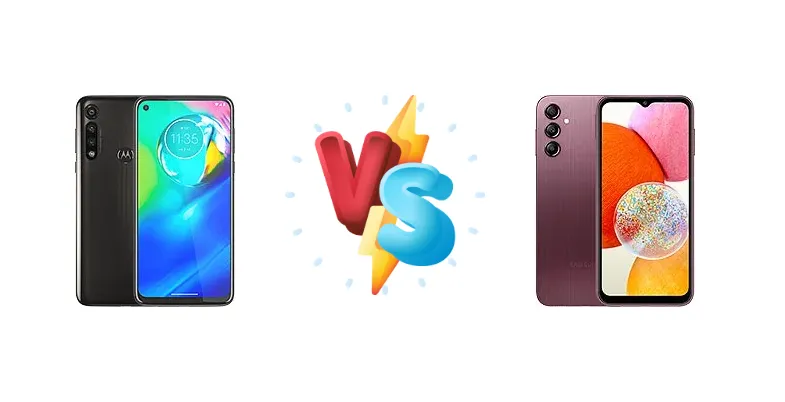
|
🏆 Quick Verdict
For users prioritizing all-day (and potentially multi-day) battery life, the Motorola Moto G Power is the clear winner. However, the Samsung Galaxy A14, particularly the Exynos 850 variant, offers a more responsive user experience and slightly faster charging, making it a better choice for those who value performance over sheer endurance.
| PHONES | ||
|---|---|---|
| Phone Names | Motorola Moto G Power | Samsung Galaxy A14 |
| Network | ||
|---|---|---|
| 2G bands | GSM 850 / 900 / 1800 / 1900 | GSM 850 / 900 / 1800 / 1900 |
| 3G bands | HSDPA 850 / 900 / 1700(AWS) / 1900 / 2100 | HSDPA 850 / 900 / 2100 |
| 4G bands | 1, 2, 3, 4, 5, 7, 8, 12, 13, 14, 17, 18, 19, 20, 25, 26, 29, 30, 38, 39, 40, 41, 66, 71 | 1, 3, 5, 7, 8, 20, 28, 38, 40, 41 |
| Speed | HSPA 42.2/5.76 Mbps, LTE (2CA) Cat13 600/100 Mbps | HSPA, LTE |
| Technology | GSM / CDMA / HSPA / EVDO / LTE | GSM / HSPA / LTE |
| CDMA2000 1xEV-DO | - | |
| Launch | ||
|---|---|---|
| Announced | 2020, February 07. Released 2020, April 17 | 2023, February 28 |
| Status | Discontinued | Available. Released 2023, March 27 |
| Body | ||
|---|---|---|
| Build | Glass front, plastic back, aluminum frame (6000 series) | Glass front, plastic back, plastic frame |
| Dimensions | 159.9 x 75.8 x 9.6 mm (6.30 x 2.98 x 0.38 in) | 167.7 x 78 x 9.1 mm (6.60 x 3.07 x 0.36 in) |
| SIM | Nano-SIM | · Nano-SIM· Nano-SIM + Nano-SIM |
| Weight | 199 g (7.02 oz) | 201 g (7.09 oz) |
| Water-repellent coating | - | |
| Display | ||
|---|---|---|
| Resolution | 1080 x 2300 pixels (~399 ppi density) | 1080 x 2408 pixels, 20:9 ratio (~400 ppi density) |
| Size | 6.4 inches, 100.7 cm2 (~83.0% screen-to-body ratio) | 6.6 inches, 104.9 cm2 (~80.2% screen-to-body ratio) |
| Type | IPS LCD | PLS LCD |
| Platform | ||
|---|---|---|
| CPU | Octa-core (4x2.0 GHz Kryo 260 Gold & 4x1.8 GHz Kryo 260 Silver) | Octa-core (2x2.0 GHz Cortex-A75 & 6x1.8 GHz Cortex-A55) - Version AOcta-core (4x2.0 GHz Cortex-A55 & 4x2.0 GHz Cortex-A55) - Version B |
| Chipset | Qualcomm SDM665 Snapdragon 665 (11 nm) | Mediatek MT6769 Helio G80 (12 nm) - Version AExynos 850 (8 nm) - Version B |
| GPU | Adreno 610 | Mali-G52 MC2 |
| OS | Android 10 | Android 13, upgradable to Android 15, One UI 7 |
| Memory | ||
|---|---|---|
| Card slot | microSDXC (dedicated slot) | microSDXC (dedicated slot) |
| Internal | 64GB 4GB RAM | 64GB 4GB RAM, 128GB 4GB RAM, 128GB 6GB RAM |
| eMMC 5.1 | - | |
| Main Camera | ||
|---|---|---|
| Features | LED flash, HDR, panorama | LED flash, panorama, HDR |
| Single | - | 13 MP, f/2.0, (wide) |
| Triple | 16 MP, f/1.7, (wide), 1/2.8", 1.12µm, PDAF 8 MP, f/2.2, 118˚ (ultrawide), 1/4.0", 1.12µm 2 MP (macro) | 50 MP, f/1.8, 26mm (wide), 1/2.75", 0.64µm, PDAF 5 MP, f/2.2, 17mm (ultrawide), 1/5.0", 1.12µm 2 MP (macro) |
| Video | 4K@30fps, 1080p@30/60fps, 1080p@30fps (gyro-EIS) | 1080p@30fps |
| Selfie camera | ||
|---|---|---|
| Features | HDR | - |
| Single | 16 MP, f/2.0, (wide), 1/3.06", 1.0µm | 13 MP, f/2.0, 26mm (wide), 1/3.1", 1.12µm |
| Video | 1080p@30/120fps | 1080p@30fps |
| Sound | ||
|---|---|---|
| 3.5mm jack | Yes | Yes |
| 35mm jack | Yes | Yes |
| Loudspeaker | Yes, with stereo speakers | Yes |
| Comms | ||
|---|---|---|
| Bluetooth | 5.0, A2DP, LE | 5.1 or 5.3, A2DP, LE |
| NFC | No | Yes (market/region dependent) |
| Positioning | GPS, GLONASS, BDS, GALILEO | GPS, GALILEO, GLONASS, BDS, QZSS |
| Radio | FM radio | Unspecified |
| USB | USB Type-C 2.0 | USB Type-C 2.0 |
| WLAN | Wi-Fi 802.11 a/b/g/n/ac, dual-band, Wi-Fi Direct | Wi-Fi 802.11 a/b/g/n/ac, dual-band, Wi-Fi Direct |
| Features | ||
|---|---|---|
| Sensors | Fingerprint (rear-mounted), accelerometer, gyro, proximity | Fingerprint (side-mounted), accelerometer, proximity, compass |
| Battery | ||
|---|---|---|
| Charging | 10W wired | 15W wired |
| Type | Li-Po 5000 mAh | Li-Po 5000 mAh |
| Misc | ||
|---|---|---|
| Colors | Smoke Black | Black, Dark Red, Silver, Green |
| Models | XT2041DL | SM-A145F, SM-A145F/DSN, SM-A145M, SM-A145M/DS, SM-A145P, SM-A145R |
| Price | - | € 85.76 / $ 147.60 / £ 79.95 |
| SAR EU | - | 0.46 W/kg (head) 1.37 W/kg (body) |
Motorola Moto G Power
- Exceptional battery life – easily lasts two days.
- More affordable price point.
- Reliable performance for basic tasks.
- Outdated Snapdragon 665 chipset.
- Slow 10W charging.
- Less responsive user experience.
Samsung Galaxy A14
- More powerful Helio G80 or Exynos 850 chipset.
- Faster 15W charging.
- More fluid user interface (Samsung One UI).
- Shorter battery life compared to Moto G Power.
- Potentially higher price.
- Performance varies significantly between Helio G80 and Exynos 850 variants.
Display Comparison
Neither device boasts a standout display. Both likely utilize LCD panels, a common cost-saving measure in this segment. The Galaxy A14's larger screen size (typically 6.6 inches vs. the Moto G Power's 6.5 inches) provides a slightly more immersive viewing experience. However, without specific brightness data, it's difficult to assess which offers better outdoor visibility. Color accuracy is likely similar on both, leaning towards the 'acceptable' range rather than 'vibrant' or 'accurate'.
Camera Comparison
Camera performance is likely similar in real-world results, despite potential sensor differences. Both phones likely feature a primary camera around the 13-16MP range, accompanied by auxiliary lenses of limited utility (often 2MP macro or depth sensors). The A14's image processing, benefiting from Samsung's software expertise, may produce slightly more pleasing results in good lighting conditions. Low-light performance will be a weakness on both devices. The absence of Optical Image Stabilization (OIS) on either phone means shaky hands will result in blurry photos.
Performance
The performance disparity is significant. The Samsung Galaxy A14's Mediatek Helio G80 (Version A) or Exynos 850 (Version B) represents a generational leap over the Motorola Moto G Power's Qualcomm Snapdragon 665. The Helio G80, built on a 12nm process, offers a more efficient architecture than the Snapdragon 665's 11nm node. The Exynos 850, fabricated on an 8nm process, further improves efficiency and performance. The A14's CPU configuration – Cortex-A75 and A55 cores – provides a noticeable boost in responsiveness for everyday tasks and app loading times compared to the Moto G Power's Kryo 260 cores. While neither phone is a gaming powerhouse, the A14 will handle less demanding titles with greater ease. The Snapdragon 665 will struggle with graphically intensive games.
Battery Life
Battery life is where the Moto G Power truly shines. Its larger battery capacity (typically 5000mAh) combined with the less power-hungry Snapdragon 665 chipset delivers exceptional endurance. The Galaxy A14, with a likely 5000mAh battery as well, is hampered by its more powerful processor. While the A14 offers 15W wired charging compared to the Moto G Power's 10W, the difference in charging speed isn't substantial enough to offset the G Power's significantly longer battery life. Expect the Moto G Power to easily last two days on a single charge with moderate use, while the A14 will likely require daily charging.
Buying Guide
Buy the Motorola Moto G Power if you need a phone that can reliably last through two full days of moderate use, and you aren't a demanding mobile gamer. It's ideal for users who prioritize talk time, streaming podcasts, and basic smartphone tasks. Buy the Samsung Galaxy A14 if you prefer a more fluid interface, occasionally play mobile games, and appreciate the Samsung One UI experience, even if it means sacrificing some battery longevity. The A14 is better suited for users who want a more versatile, albeit less enduring, device.