
Motorola Moto G Power (2025) vs. Samsung Galaxy A55: A Deep Dive into Battery, Performance, and Value
| Phones Images | |||||
|---|---|---|---|---|---|
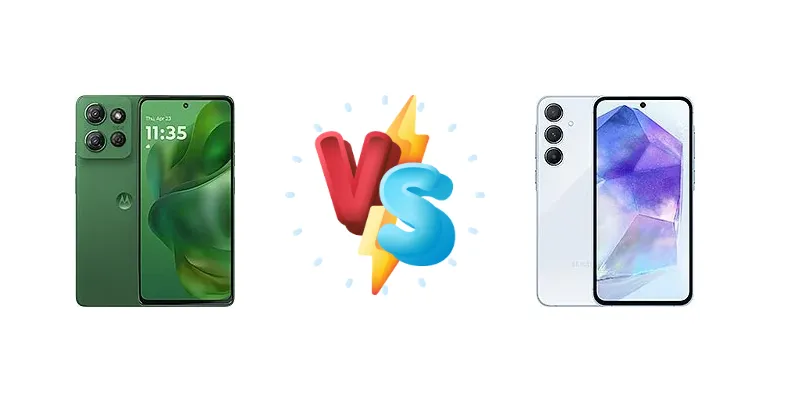
|
🏆 Quick Verdict
For the average user, the Samsung Galaxy A55 emerges as the stronger overall choice. While the Motorola Moto G Power (2025) boasts impressive battery endurance with 11:56h of active use, the Galaxy A55’s more efficient Exynos 1480 (4nm) chipset, coupled with its brighter display and potentially longer software support, provides a more balanced and future-proof experience.
| PHONES | ||
|---|---|---|
| Phone Names | Motorola Moto G Power (2025) | Samsung Galaxy A55 |
| Network | ||
|---|---|---|
| 2G bands | GSM 850 / 900 / 1800 / 1900 | GSM 850 / 900 / 1800 / 1900 |
| 3G bands | HSDPA 850 / 900 / 1700(AWS) / 1900 / 2100 | HSDPA 850 / 900 / 1700(AWS) / 1900 / 2100 |
| 4G bands | 1, 2, 3, 4, 5, 7, 8, 12, 13, 14, 17, 18, 20, 25, 26, 28, 29, 30, 38, 39, 40, 41, 48, 66, 71 | 1, 2, 3, 4, 5, 7, 8, 12, 17, 20, 25, 26, 28, 32, 38, 40, 41, 66 |
| 5G bands | 2, 5, 7, 12, 14, 25, 26, 29, 30, 41, 48, 66, 70, 71, 77, 78 SA/NSA/Sub6 | 1, 3, 5, 7, 8, 20, 28, 38, 40, 41, 66, 77, 78 SA/NSA/Sub6 |
| Speed | HSPA, LTE, 5G | HSPA, LTE, 5G |
| Technology | GSM / HSPA / LTE / 5G | GSM / HSPA / LTE / 5G |
| Launch | ||
|---|---|---|
| Announced | 2025, January 14 | 2024, March 11 |
| Status | Available. Released 2025, February 06 | Available. Released 2024, March 15 |
| Body | ||
|---|---|---|
| Build | Glass front (Gorilla Glass 5), silicone polymer (eco leather) back, plastic frame | Glass front (Gorilla Glass Victus+), glass back (Gorilla Glass), aluminum frame |
| Dimensions | 166.6 x 77.1 x 8.7 mm (6.56 x 3.04 x 0.34 in) | 161.1 x 77.4 x 8.2 mm (6.34 x 3.05 x 0.32 in) |
| SIM | Nano-SIM + eSIM | · Nano-SIM· Nano-SIM + eSIM· Nano-SIM + Nano-SIM· Nano-SIM + Nano-SIM + eSIM (max 2 at a time) |
| Weight | 208 g (7.34 oz) | 213 g (7.51 oz) |
| Display | ||
|---|---|---|
| Protection | Corning Gorilla Glass 5 | Corning Gorilla Glass Victus+ |
| Resolution | 1080 x 2388 pixels (~385 ppi density) | 1080 x 2340 pixels, 19.5:9 ratio (~390 ppi density) |
| Size | 6.8 inches, 112.0 cm2 (~87.2% screen-to-body ratio) | 6.6 inches, 106.9 cm2 (~85.8% screen-to-body ratio) |
| Type | IPS LCD, 120Hz | Super AMOLED, 120Hz, HDR10+, 1000 nits (HBM) |
| Platform | ||
|---|---|---|
| CPU | Octa-core (2x2.4 GHz Cortex-A76 & 6x2.0 GHz Cortex-A55) | Octa-core (4x2.75 GHz Cortex-A78 & 4x2.0 GHz Cortex-A55) |
| Chipset | Mediatek Dimensity 6300 (6 nm) | Exynos 1480 (4 nm) |
| GPU | Mali-G57 MC2 | Xclipse 530 |
| OS | Android 15, up to 2 major Android upgrades | Android 14, up to 4 major Android upgrades, One UI 6.1 |
| Memory | ||
|---|---|---|
| Card slot | microSDXC (dedicated slot) | microSDXC (uses shared SIM slot) |
| Internal | 128GB 8GB RAM | 128GB 6GB RAM, 128GB 8GB RAM, 256GB 6GB RAM, 256GB 8GB RAM, 256GB 12GB RAM |
| Main Camera | ||
|---|---|---|
| Dual | 50 MP, f/1.8, (wide), 1/2.88", 0.61µm, PDAF, OIS 8 MP, f/2.2, 119˚ 13mm (ultrawide), 1.12µm, AF | - |
| Features | LED flash, HDR, panorama | LED flash, panorama, HDR |
| Triple | - | 50 MP, f/1.8, (wide), 1/1.56", 1.0µm, PDAF, OIS 12 MP, f/2.2, 123˚ (ultrawide), 1/3.06", 1.12µm 5 MP (macro) |
| Video | 1080p@30fps | 4K@30fps, 1080p@30/60fps, gyro-EIS |
| Selfie camera | ||
|---|---|---|
| Single | 16 MP, f/2.4, 24mm (wide), 1/3.0", 1.0µm | 32 MP, f/2.2, 26mm (wide), 1/2.74", 0.8µm |
| Video | 1080p@30fps | 4K@30fps, 1080p@30/60fps |
| Sound | ||
|---|---|---|
| 35mm jack | Yes | No |
| Loudspeaker | Yes, with stereo speakers (with Dolby Atmos) | Yes, with stereo speakers |
| Comms | ||
|---|---|---|
| Bluetooth | Yes | 5.3, A2DP, LE |
| NFC | Yes | Yes (market/region dependent) |
| Positioning | GPS, GALILEO, GLONASS | GPS, GALILEO, GLONASS, BDS, QZSS |
| Radio | FM radio | No |
| USB | USB Type-C 2.0 | USB Type-C 2.0, OTG |
| WLAN | Wi-Fi 802.11 a/b/g/n/ac, dual-band | Wi-Fi 802.11 a/b/g/n/ac/6, dual-band, Wi-Fi Direct |
| Features | ||
|---|---|---|
| Sensors | Fingerprint (side-mounted), accelerometer, gyro, proximity, compass, barometer | Fingerprint (under display, optical), accelerometer, gyro, compass |
| Battery | ||
|---|---|---|
| Charging | 30W wired 15W wireless | 25W wired |
| Type | 5000 mAh | Li-Ion 5000 mAh |
| Misc | ||
|---|---|---|
| Colors | Slate Gray, Leaf Green | Iceblue, Lilac, Navy, Lemon |
| Models | XT2515-1 | SM-A556V, SM-A556B, SM-A556B/DS, SM-A556E, SM-A556E/DS, SM-A5560 |
| Price | $ 199.99 | $ 324.99 / £ 251.50 / € 319.99 / ₹ 23,998 |
| SAR EU | - | 0.68 W/kg (head) 1.04 W/kg (body) |
Motorola Moto G Power (2025)
- Exceptional battery life (11:56h active use)
- Supports 15W wireless charging
- High contrast ratio (1358:1) for vibrant visuals
- Less powerful chipset (Dimensity 6300)
- 6nm process less efficient than A55's 4nm
Samsung Galaxy A55
- More powerful and efficient Exynos 1480 (4nm)
- Brighter display (1010 nits)
- Potentially better camera image processing
- Shorter battery life (13:27h active use)
- No wireless charging support
Display Comparison
Both phones offer a solid visual experience, but differ in key areas. The Motorola Moto G Power (2025) achieves a high 1358:1 contrast ratio and a measured peak brightness of 993 nits, suggesting excellent visibility even in bright sunlight. However, the Samsung Galaxy A55 counters with a 1010 nits peak brightness, and benefits from Samsung’s display expertise, likely offering superior color accuracy and viewing angles. While the Moto G Power’s contrast is higher, the A55’s overall display quality is expected to be more refined, and the lack of information on PWM dimming frequency on the Moto G Power raises potential concerns for users sensitive to flicker.
Camera Comparison
Without detailed camera specs, a direct comparison is limited. However, given Samsung’s history, the Galaxy A55 is likely to feature a more sophisticated camera system with better image processing algorithms. The A55 likely benefits from features like Optical Image Stabilization (OIS) on its main sensor, which the Moto G Power may lack. While both phones likely include standard features like portrait mode and night mode, the A55’s image quality is expected to be superior, particularly in challenging lighting conditions. We can assume both will include a standard array of lenses, but the A55 will likely prioritize quality over quantity.
Performance
The performance gap is defined by the chipsets and their fabrication processes. The Samsung Galaxy A55’s Exynos 1480, built on a 4nm process, offers a clear advantage in efficiency and potentially sustained performance compared to the Motorola Moto G Power (2025)’s Mediatek Dimensity 6300 (6nm). The A55’s CPU configuration – 4x2.75 GHz Cortex-A78 cores – is also more powerful than the Moto G Power’s 2x2.4 GHz Cortex-A76 setup. This translates to faster app loading times, smoother multitasking, and a better gaming experience on the Galaxy A55. While both utilize Cortex-A55 cores for efficiency, the A55’s overall architecture is more modern and capable.
Battery Life
Battery life is where the Motorola Moto G Power (2025) truly shines, achieving an impressive 11:56h of active use. The Samsung Galaxy A55, while still excellent, posts a score of 13:27h. This difference is significant for heavy users. However, the A55’s more efficient 4nm Exynos 1480 chipset partially offsets the smaller battery capacity. The Moto G Power (2025) supports both 30W wired and 15W wireless charging, offering flexibility, while the Galaxy A55 is limited to 25W wired charging. The Moto G Power’s wireless charging is a notable advantage.
Buying Guide
Buy the Motorola Moto G Power (2025) if you absolutely need the longest possible battery life and prioritize affordability above all else. It’s ideal for users who frequently travel, rely heavily on their phone throughout the day, or have limited access to charging. Buy the Samsung Galaxy A55 if you prefer a more polished user experience, better performance for demanding tasks, and a brighter, more vibrant display, even if it means slightly shorter battery life. It’s a better fit for users who enjoy mobile gaming, content creation, or simply want a smoother, more responsive device.