
Motorola Moto G Power (2025) vs. Nothing Phone (2a) Plus: A Deep Dive Comparison
| Phones Images | |||||
|---|---|---|---|---|---|
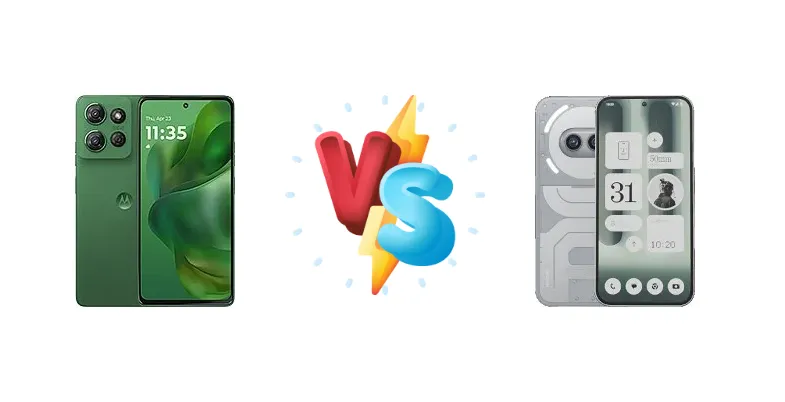
|
🏆 Quick Verdict
For the average user prioritizing longevity, the Nothing Phone (2a) Plus is the stronger choice. Its significantly longer 16:34h active use battery life, coupled with 50W fast charging, outweighs the Moto G Power's (2025) 11:56h runtime. The Dimensity 7350 Pro also provides a noticeable performance boost.
| PHONES | ||
|---|---|---|
| Phone Names | Motorola Moto G Power (2025) | Nothing Phone (2a) Plus |
| Network | ||
|---|---|---|
| 2G bands | GSM 850 / 900 / 1800 / 1900 | GSM 850 / 900 / 1800 / 1900 |
| 3G bands | HSDPA 850 / 900 / 1700(AWS) / 1900 / 2100 | HSDPA 800 / 850 / 900 / 1700(AWS) / 1900 / 2100 |
| 4G bands | 1, 2, 3, 4, 5, 7, 8, 12, 13, 14, 17, 18, 20, 25, 26, 28, 29, 30, 38, 39, 40, 41, 48, 66, 71 | 1, 3, 4, 5, 7, 8, 18, 19, 20, 26, 28, 38, 39, 40, 41, 42, 66 |
| 5G bands | 2, 5, 7, 12, 14, 25, 26, 29, 30, 41, 48, 66, 70, 71, 77, 78 SA/NSA/Sub6 | 1, 3, 5, 7, 8, 20, 28, 38, 40, 41, 66, 77, 78 SA/NSA |
| Speed | HSPA, LTE, 5G | HSPA, LTE, 5G |
| Technology | GSM / HSPA / LTE / 5G | GSM / HSPA / LTE / 5G |
| Launch | ||
|---|---|---|
| Announced | 2025, January 14 | 2024, July 31 |
| Status | Available. Released 2025, February 06 | Available. Released 2024, August 03 |
| Body | ||
|---|---|---|
| Build | Glass front (Gorilla Glass 5), silicone polymer (eco leather) back, plastic frame | Glass front (Gorilla Glass 5), plastic frame, plastic back |
| Dimensions | 166.6 x 77.1 x 8.7 mm (6.56 x 3.04 x 0.34 in) | 161.7 x 76.3 x 8.5 mm (6.37 x 3.00 x 0.33 in) |
| SIM | Nano-SIM + eSIM | Nano-SIM + Nano-SIM |
| Weight | 208 g (7.34 oz) | 190 g (6.70 oz) |
| Display | ||
|---|---|---|
| Protection | Corning Gorilla Glass 5 | Corning Gorilla Glass 5 |
| Resolution | 1080 x 2388 pixels (~385 ppi density) | 1080 x 2412 pixels, 20:9 ratio (~395 ppi density) |
| Size | 6.8 inches, 112.0 cm2 (~87.2% screen-to-body ratio) | 6.7 inches, 107.5 cm2 (~87.1% screen-to-body ratio) |
| Type | IPS LCD, 120Hz | AMOLED, 1B colors, 120Hz, 2160Hz PWM, HDR10+, 700 nits (typ), 1100 nits (HBM), 1300 nits (peak) |
| Platform | ||
|---|---|---|
| CPU | Octa-core (2x2.4 GHz Cortex-A76 & 6x2.0 GHz Cortex-A55) | Octa-core (2x3.0 GHz Cortex-A715 & 6x 2.0 GHz Cortex-A510) |
| Chipset | Mediatek Dimensity 6300 (6 nm) | Mediatek Dimensity 7350 Pro (4 nm) |
| GPU | Mali-G57 MC2 | Mali-G610 MC4 |
| OS | Android 15, up to 2 major Android upgrades | Android 14, up to 3 major Android upgrades, Nothing OS 3.0 |
| Memory | ||
|---|---|---|
| Card slot | microSDXC (dedicated slot) | No |
| Internal | 128GB 8GB RAM | 256GB 8GB RAM, 256GB 12GB RAM |
| Main Camera | ||
|---|---|---|
| Dual | 50 MP, f/1.8, (wide), 1/2.88", 0.61µm, PDAF, OIS 8 MP, f/2.2, 119˚ 13mm (ultrawide), 1.12µm, AF | 50 MP, f/1.9, 24mm (wide), 1/1.57", 1.0µm, PDAF, OIS 50 MP, f/2.2, 114˚ (ultrawide), 1/2.76", 0.64µm |
| Features | LED flash, HDR, panorama | LED flash, panorama, HDR |
| Video | 1080p@30fps | 4K@30fps, 1080p@60/120fps, gyro-EIS |
| Selfie camera | ||
|---|---|---|
| Features | - | HDR |
| Single | 16 MP, f/2.4, 24mm (wide), 1/3.0", 1.0µm | 50 MP, f/2.2, (wide), 1/2.76" |
| Video | 1080p@30fps | 4K@30fps |
| Sound | ||
|---|---|---|
| 35mm jack | Yes | No |
| Loudspeaker | Yes, with stereo speakers (with Dolby Atmos) | Yes, with stereo speakers |
| Comms | ||
|---|---|---|
| Bluetooth | Yes | 5.3, A2DP, LE |
| NFC | Yes | Yes, 360˚ |
| Positioning | GPS, GALILEO, GLONASS | GPS, GALILEO, GLONASS, BDS, QZSS |
| Radio | FM radio | No |
| USB | USB Type-C 2.0 | USB Type-C 2.0, OTG |
| WLAN | Wi-Fi 802.11 a/b/g/n/ac, dual-band | Wi-Fi 802.11 a/b/g/n/ac/6, dual-band, Wi-Fi Direct |
| Features | ||
|---|---|---|
| Sensors | Fingerprint (side-mounted), accelerometer, gyro, proximity, compass, barometer | Fingerprint (under display, optical), accelerometer, gyro, proximity, compass |
| Battery | ||
|---|---|---|
| Charging | 30W wired 15W wireless | 50W wired, 50% in 21 min, 100% in 56 min |
| Type | 5000 mAh | 5000 mAh |
| Misc | ||
|---|---|---|
| Colors | Slate Gray, Leaf Green | Black, Grey |
| Models | XT2515-1 | A142P |
| Price | $ 199.99 | € 269.90 / ₹ 22,599 |
Motorola Moto G Power (2025)
- Exceptional battery life for extended use.
- High contrast ratio display for vibrant visuals.
- Generally more affordable price point.
- Less powerful processor compared to the competition.
- Slower charging speeds.
- Potentially lower camera performance.
Nothing Phone (2a) Plus
- Significantly longer battery life in active use.
- Faster 50W wired charging.
- More powerful and efficient Dimensity 7350 Pro chipset.
- Slightly lower peak display brightness.
- Potentially higher price compared to the Moto G Power (2025).
- Unique design may not appeal to all users.
Display Comparison
Both phones offer respectable displays, but differ in brightness and efficiency. The Motorola Moto G Power (2025) achieves a measured peak brightness of 993 nits and a 1358:1 contrast ratio, suggesting excellent visibility and deep blacks. The Nothing Phone (2a) Plus, while slightly dimmer at 1097 nits, benefits from a more efficient 4nm chipset, potentially leading to lower power consumption during display use. Neither specification details refresh rate or panel type, but given the price points, 60Hz LCD or 90Hz AMOLED are likely candidates. The higher contrast ratio of the Moto G Power suggests a VA panel, potentially offering better viewing angles than an IPS LCD.
Camera Comparison
Without detailed camera specifications, a direct comparison is difficult. However, the chipset difference suggests the Nothing Phone (2a) Plus will have a more capable image signal processor (ISP), leading to better image processing. The Dimensity 7350 Pro supports higher resolution sensors and more advanced features. While both phones likely feature multi-camera setups, the Motorola Moto G Power (2025) often prioritizes affordability, potentially resulting in lower-quality secondary sensors. We anticipate the Nothing Phone (2a) Plus to offer superior image quality, particularly in low-light conditions.
Performance
The Nothing Phone (2a) Plus pulls ahead in performance thanks to its Mediatek Dimensity 7350 Pro (4nm) chipset, featuring a 2x3.0 GHz Cortex-A715 core configuration. This contrasts with the Motorola Moto G Power (2025)'s Dimensity 6300 (6nm) and its 2x2.4 GHz Cortex-A76 cores. The 4nm process node of the Dimensity 7350 Pro translates to improved thermal efficiency, reducing the likelihood of throttling during sustained workloads. While both utilize 6x2.0 GHz Cortex-A55/A510 efficiency cores, the Nothing Phone (2a) Plus’s more powerful cores will deliver a smoother experience in demanding applications and games.
Battery Life
Battery life is a key differentiator. The Motorola Moto G Power (2025) delivers an impressive 11:56h of active use, a hallmark of the G Power series. However, the Nothing Phone (2a) Plus significantly surpasses this with 16:34h of active use. This difference is likely attributable to the more efficient 4nm Dimensity 7350 Pro chipset. Charging speeds also diverge significantly: the Motorola supports 30W wired and 15W wireless, while the Nothing Phone (2a) Plus boasts 50W wired charging, reaching 50% in 21 minutes and 100% in 56 minutes. This faster charging mitigates the impact of any slight battery capacity differences.
Buying Guide
Buy the Motorola Moto G Power (2025) if you absolutely need the most screen-on time possible and are willing to compromise on processing power and charging speed. Buy the Nothing Phone (2a) Plus if you prefer a more balanced experience with faster performance, quicker charging, and a more modern chipset, even if it means slightly less ultimate battery endurance.