
Motorola Moto G Power (2025) vs. Motorola Edge (2024): A Deep Dive Comparison
| Phones Images | |||||
|---|---|---|---|---|---|
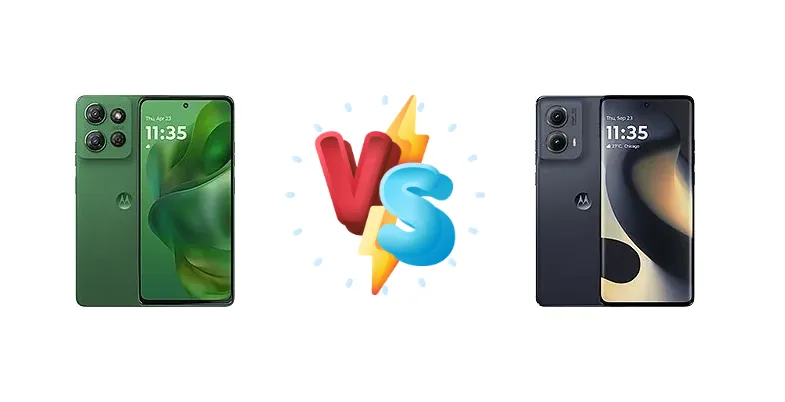
|
🏆 Quick Verdict
For the average user prioritizing longevity, the Motorola Moto G Power (2025) is the clear winner. Its impressive 11:56h active use battery life significantly outpaces what the Edge can offer. However, users who demand snappier performance and faster charging will find the Motorola Edge (2024) a more compelling choice.
| PHONES | ||
|---|---|---|
| Phone Names | Motorola Moto G Power (2025) | Motorola Edge (2024) |
| Network | ||
|---|---|---|
| 2G bands | GSM 850 / 900 / 1800 / 1900 | GSM 850 / 900 / 1800 / 1900 |
| 3G bands | HSDPA 850 / 900 / 1700(AWS) / 1900 / 2100 | HSDPA 850 / 900 / 1700(AWS) / 1900 / 2100 |
| 4G bands | 1, 2, 3, 4, 5, 7, 8, 12, 13, 14, 17, 18, 20, 25, 26, 28, 29, 30, 38, 39, 40, 41, 48, 66, 71 | 1, 2, 3, 4, 5, 7, 8, 12, 13, 14, 17, 18, 19, 20, 25, 26, 29, 30, 38, 39, 40, 41, 48, 66, 71 |
| 5G bands | 2, 5, 7, 12, 14, 25, 26, 29, 30, 41, 48, 66, 70, 71, 77, 78 SA/NSA/Sub6 | 1, 2, 3, 5, 7, 12, 14, 20, 25, 26, 29, 30, 38, 40, 41, 48, 66, 70, 71, 77, 78 SA/NSA/Sub6 |
| Speed | HSPA, LTE, 5G | HSPA, LTE, 5G |
| Technology | GSM / HSPA / LTE / 5G | GSM / HSPA / LTE / 5G |
| Launch | ||
|---|---|---|
| Announced | 2025, January 14 | 2024, June 04 |
| Status | Available. Released 2025, February 06 | Available. Released 2024, June 20 |
| Body | ||
|---|---|---|
| Build | Glass front (Gorilla Glass 5), silicone polymer (eco leather) back, plastic frame | Glass front, aluminum frame, silicone polymer back (eco leather) |
| Dimensions | 166.6 x 77.1 x 8.7 mm (6.56 x 3.04 x 0.34 in) | 159.6 x 72 x 8.1 mm (6.28 x 2.83 x 0.32 in) |
| SIM | Nano-SIM + eSIM | Nano-SIM + eSIM |
| Weight | 208 g (7.34 oz) | 174 g (6.14 oz) |
| Display | ||
|---|---|---|
| Protection | Corning Gorilla Glass 5 | Corning Gorilla Glass 3 |
| Resolution | 1080 x 2388 pixels (~385 ppi density) | 1080 x 2400 pixels, 20:9 ratio (~402 ppi density) |
| Size | 6.8 inches, 112.0 cm2 (~87.2% screen-to-body ratio) | 6.6 inches, 103.6 cm2 (~90.2% screen-to-body ratio) |
| Type | IPS LCD, 120Hz | P-OLED, 1B colors, 144Hz, 1300 nits (peak) |
| Platform | ||
|---|---|---|
| CPU | Octa-core (2x2.4 GHz Cortex-A76 & 6x2.0 GHz Cortex-A55) | Octa-core (4x2.40 GHz Cortex-A78 & 4x1.95 GHz Cortex-A55) |
| Chipset | Mediatek Dimensity 6300 (6 nm) | Qualcomm SM7435-AB Snapdragon 7s Gen 2 (4 nm) |
| GPU | Mali-G57 MC2 | Adreno 710 |
| OS | Android 15, up to 2 major Android upgrades | Android 14 |
| Memory | ||
|---|---|---|
| Card slot | microSDXC (dedicated slot) | No |
| Internal | 128GB 8GB RAM | 256GB 8GB RAM |
| Main Camera | ||
|---|---|---|
| Dual | 50 MP, f/1.8, (wide), 1/2.88", 0.61µm, PDAF, OIS 8 MP, f/2.2, 119˚ 13mm (ultrawide), 1.12µm, AF | 50 MP, f/1.8, (wide), 1/1.5", 1.0µm, multi-directional PDAF, OIS 13 MP, f/2.2, 120˚ (ultrawide), 1.12µm, AF |
| Features | LED flash, HDR, panorama | Dual-LED flash, HDR, panorama |
| Video | 1080p@30fps | 4K@30fps, 1080p@30/60fps, HDR, gyro-EIS |
| Selfie camera | ||
|---|---|---|
| Features | - | HDR |
| Single | 16 MP, f/2.4, 24mm (wide), 1/3.0", 1.0µm | 32 MP, f/2.4, (wide), 0.7µm, AF |
| Video | 1080p@30fps | 1080p@30fps |
| Sound | ||
|---|---|---|
| 35mm jack | Yes | No |
| Loudspeaker | Yes, with stereo speakers (with Dolby Atmos) | Yes, with stereo speakers |
| Comms | ||
|---|---|---|
| Bluetooth | Yes | 5.2, A2DP, LE |
| NFC | Yes | Yes |
| Positioning | GPS, GALILEO, GLONASS | GPS, GLONASS, GALILEO |
| Radio | FM radio | No |
| USB | USB Type-C 2.0 | USB Type-C 3.1, DisplayPort 1.4 |
| WLAN | Wi-Fi 802.11 a/b/g/n/ac, dual-band | Wi-Fi 802.11 a/b/g/n/ac/6e, tri-band, Wi-Fi Direct |
| Features | ||
|---|---|---|
| Sensors | Fingerprint (side-mounted), accelerometer, gyro, proximity, compass, barometer | Fingerprint (under display, optical), accelerometer, gyro, proximity, compass |
| Battery | ||
|---|---|---|
| Charging | 30W wired 15W wireless | 68W wired 15W wireless |
| Type | 5000 mAh | 5000 mAh |
| Misc | ||
|---|---|---|
| Colors | Slate Gray, Leaf Green | Black |
| Models | XT2515-1 | XT2405V, XT-2405V |
| Price | $ 199.99 | $ 186.72 / C$ 254.99 |
Motorola Moto G Power (2025)
- Exceptional battery life (11:56h active use)
- High display brightness (993 nits)
- More affordable price point
- Less powerful processor
- Slower charging speeds (30W wired)
Motorola Edge (2024)
- Faster and more responsive performance
- Significantly faster charging (68W wired)
- More efficient chipset (4nm process)
- Shorter battery life
- Likely higher price
Display Comparison
The Motorola Edge (2024) and Moto G Power (2025) both offer capable displays, but differ in key areas. The Moto G Power (2025) boasts a measured peak brightness of 993 nits and a 1358:1 contrast ratio, indicating a vibrant and easily viewable screen, even outdoors. While the Edge’s display specs aren’t provided, the G Power’s high contrast ratio suggests superior image depth. The lack of LTPO on either device means refresh rates are likely fixed, impacting power consumption. The G Power’s brightness is a significant advantage for outdoor visibility.
Camera Comparison
Without detailed camera specifications, a direct comparison is limited. However, Motorola typically focuses on main sensor quality in these price segments. The Edge (2024) likely benefits from Qualcomm’s image signal processor (ISP) within the Snapdragon 7s Gen 2, potentially offering improved image processing and low-light performance. The G Power (2025) will likely rely on Mediatek’s ISP, which is generally competent but may not match the Snapdragon’s capabilities. We anticipate both phones will include standard features like HDR and portrait modes, but the Edge likely has an edge in overall image quality.
Performance
The chipset choice defines the performance difference. The Motorola Edge (2024) utilizes the Qualcomm Snapdragon 7s Gen 2 (4nm), built on a more efficient process node than the Mediatek Dimensity 6300 (6nm) in the Moto G Power (2025). The Snapdragon 7s Gen 2’s Cortex-A78 cores (4x2.40 GHz) are architecturally superior to the G Power’s Cortex-A76 cores (2x2.4 GHz), promising faster single-core performance. While both are octa-core CPUs, the Edge’s architecture translates to a smoother experience in demanding applications and games. The 4nm process also contributes to better thermal management, potentially reducing throttling during sustained workloads.
Battery Life
Battery life is where the Moto G Power (2025) truly shines. Its active use score of 11:56h is exceptional, indicating a phone designed for multi-day usage. The Edge (2024), while offering 68W wired charging (compared to the G Power’s 30W), will likely require more frequent charging due to the more power-hungry Snapdragon 7s Gen 2. Both support 15W wireless charging. The Edge’s faster charging mitigates the inconvenience of shorter battery life, allowing for a quick top-up, but the G Power’s longevity is a significant advantage for users who dislike daily charging.
Buying Guide
Buy the Motorola Moto G Power (2025) if you need a phone that reliably lasts through a full day – and then some – of heavy use, and value affordability above all else. Buy the Motorola Edge (2024) if you prefer a more responsive user experience, frequently engage in demanding tasks like gaming, and appreciate the convenience of significantly faster 68W wired charging.