
Moto G Power (2025) vs. Google Pixel 8a: A Deep Dive into Battery, Performance, and Value
| Phones Images | |||||
|---|---|---|---|---|---|
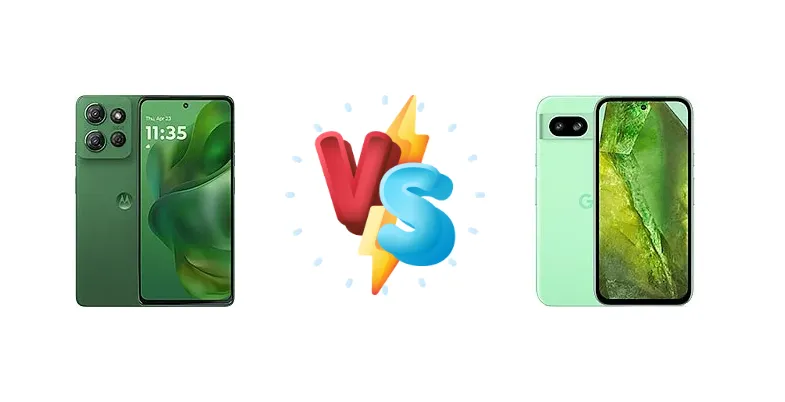
|
🏆 Quick Verdict
For users prioritizing all-day (and then some) battery life, the Motorola Moto G Power (2025) is the clear winner. However, the Google Pixel 8a delivers a more refined experience with its brighter display and significantly more powerful processor, making it ideal for those who value performance and camera capabilities.
| PHONES | ||
|---|---|---|
| Phone Names | Motorola Moto G Power (2025) | Google Pixel 8a |
| Network | ||
|---|---|---|
| 2G bands | GSM 850 / 900 / 1800 / 1900 | GSM 850 / 900 / 1800 / 1900 |
| 3G bands | HSDPA 850 / 900 / 1700(AWS) / 1900 / 2100 | HSDPA 800 / 850 / 900 / 1700(AWS) / 1900 / 2100 |
| 4G bands | 1, 2, 3, 4, 5, 7, 8, 12, 13, 14, 17, 18, 20, 25, 26, 28, 29, 30, 38, 39, 40, 41, 48, 66, 71 | 1, 2, 3, 4, 5, 7, 8, 12, 17, 18, 19, 20, 26, 28, 32, 38, 40, 41, 42, 66 - G6GPR (International) |
| 5G bands | 2, 5, 7, 12, 14, 25, 26, 29, 30, 41, 48, 66, 70, 71, 77, 78 SA/NSA/Sub6 | 1, 2, 3, 5, 7, 8, 12, 20, 26, 28, 38, 40, 41, 66, 75, 76, 77, 78 SA/NSA/Sub6 - G6GPR (International) |
| Speed | HSPA, LTE, 5G | HSPA, LTE, 5G |
| Technology | GSM / HSPA / LTE / 5G | GSM / HSPA / LTE / 5G |
| Launch | ||
|---|---|---|
| Announced | 2025, January 14 | 2024, May 07 |
| Status | Available. Released 2025, February 06 | Available. Released 2024, May 14 |
| Body | ||
|---|---|---|
| Build | Glass front (Gorilla Glass 5), silicone polymer (eco leather) back, plastic frame | Glass front (Gorilla Glass 3), aluminum frame, plastic back |
| Dimensions | 166.6 x 77.1 x 8.7 mm (6.56 x 3.04 x 0.34 in) | 152.1 x 72.7 x 8.9 mm (5.99 x 2.86 x 0.35 in) |
| SIM | Nano-SIM + eSIM | Nano-SIM + eSIM |
| Weight | 208 g (7.34 oz) | 188 g (6.63 oz) |
| Display | ||
|---|---|---|
| Protection | Corning Gorilla Glass 5 | Corning Gorilla Glass 3, Mohs level 5 |
| Resolution | 1080 x 2388 pixels (~385 ppi density) | 1080 x 2400 pixels, 20:9 ratio (~430 ppi density) |
| Size | 6.8 inches, 112.0 cm2 (~87.2% screen-to-body ratio) | 6.1 inches, 90.3 cm2 (~81.6% screen-to-body ratio) |
| Type | IPS LCD, 120Hz | OLED, HDR, 120Hz, 2000 nits (peak) |
| Platform | ||
|---|---|---|
| CPU | Octa-core (2x2.4 GHz Cortex-A76 & 6x2.0 GHz Cortex-A55) | Nona-core (1x3.0 GHz Cortex-X3 & 4x2.45 GHz Cortex-A715 & 4x2.15 GHz Cortex-A510) |
| Chipset | Mediatek Dimensity 6300 (6 nm) | Google Tensor G3 (4 nm) |
| GPU | Mali-G57 MC2 | Immortalis-G715s MC10 |
| OS | Android 15, up to 2 major Android upgrades | Android 14, upgradable to Android 16, up to 7 major Android upgrades |
| Memory | ||
|---|---|---|
| Card slot | microSDXC (dedicated slot) | No |
| Internal | 128GB 8GB RAM | 128GB 8GB RAM, 256GB 8GB RAM |
| Main Camera | ||
|---|---|---|
| Dual | 50 MP, f/1.8, (wide), 1/2.88", 0.61µm, PDAF, OIS 8 MP, f/2.2, 119˚ 13mm (ultrawide), 1.12µm, AF | 64 MP (16 MP eff.), f/1.9, 26mm (wide), 1/1.73", 0.8µm, dual pixel PDAF, OIS 13 MP, f/2.2, 120˚ (ultrawide), 1.12µm |
| Features | LED flash, HDR, panorama | Dual-LED flash, Pixel Shift, Ultra HDR, panorama, Best Take |
| Video | 1080p@30fps | 4K@30/60fps, 1080p@30/60/120/240fps, OIS |
| Selfie camera | ||
|---|---|---|
| Features | - | HDR, panorama |
| Single | 16 MP, f/2.4, 24mm (wide), 1/3.0", 1.0µm | 13 MP, f/2.2, 20mm (ultrawide), 1.12µm |
| Video | 1080p@30fps | 4K@30fps, 1080p@30/60fps |
| Sound | ||
|---|---|---|
| 35mm jack | Yes | No |
| Loudspeaker | Yes, with stereo speakers (with Dolby Atmos) | Yes, with stereo speakers |
| Comms | ||
|---|---|---|
| Bluetooth | Yes | 5.3, A2DP, LE |
| NFC | Yes | Yes |
| Positioning | GPS, GALILEO, GLONASS | GPS, GLONASS, GALILEO, BDS, QZSS, NavIC |
| Radio | FM radio | No |
| USB | USB Type-C 2.0 | USB Type-C 3.2 |
| WLAN | Wi-Fi 802.11 a/b/g/n/ac, dual-band | Wi-Fi 802.11 a/b/g/n/ac/6e, dual/tri-band (market/region dependent) |
| Features | ||
|---|---|---|
| Sensors | Fingerprint (side-mounted), accelerometer, gyro, proximity, compass, barometer | Fingerprint (under display, optical), accelerometer, gyro, proximity, compass, barometer |
| Battery | ||
|---|---|---|
| Charging | 30W wired 15W wireless | 18W wired, PD3.0 7.5W wireless Bypass charging |
| Type | 5000 mAh | Li-Po 4492 mAh |
| Misc | ||
|---|---|---|
| Colors | Slate Gray, Leaf Green | Obsidian, Porcelain, Bay, Aloe |
| Models | XT2515-1 | GKV4X, G6GPR, G8HHN, G576D |
| Price | $ 199.99 | $ 229.98 / C$ 417.99 / £ 279.00 / € 299.99 / ₹ 33,300 |
| EU LABEL | ||
|---|---|---|
| Battery | - | 40:06h endurance, 1000 cycles |
| Energy | - | Class B |
| Free fall | - | Class A (270 falls) |
| Repairability | - | Class B |
Motorola Moto G Power (2025)
- Exceptional battery life (11:56h active use)
- Faster 30W wired charging
- More affordable price point (likely)
- Less powerful processor (Dimensity 6300)
- Potentially lower camera quality
Google Pixel 8a
- Powerful Google Tensor G3 chipset
- Brighter display (1508 nits)
- Superior camera capabilities (Google’s ISP)
- Shorter battery life (11:25h active use)
- Slower 18W wired charging
Display Comparison
The Pixel 8a boasts a brighter display, reaching 1508 nits, compared to the Moto G Power’s 993 nits. This translates to better visibility outdoors under direct sunlight. While both displays are adequate, the Pixel 8a’s higher peak brightness provides a more vibrant and comfortable viewing experience. Contrast ratios are also respectable on both devices, with the Moto G Power achieving 1358:1. However, neither specification reveals information about panel technology (OLED vs LCD) or refresh rate, which are crucial for visual smoothness – a likely area where the Pixel 8a holds an advantage based on its price segment.
Camera Comparison
Without detailed camera specifications, a direct comparison is limited. However, Google’s Pixel line is renowned for its computational photography prowess, and the Tensor G3’s image signal processor (ISP) will likely deliver superior image quality, particularly in challenging lighting conditions. The Pixel 8a’s camera system likely benefits from features like Magic Eraser and Photo Unblur. While the Moto G Power may offer a decent camera for casual snapshots, it’s unlikely to match the Pixel 8a’s image processing capabilities. The absence of details regarding sensor size and optical image stabilization (OIS) on both devices makes a definitive assessment difficult, but Google’s software optimization is a significant advantage.
Performance
The Google Pixel 8a’s Tensor G3 chipset, built on a 4nm process, represents a significant leap in performance over the Motorola Moto G Power’s Mediatek Dimensity 6300 (6nm). The Tensor G3’s nona-core configuration, featuring a Cortex-X3 prime core, provides substantially more processing power for demanding tasks like video editing and gaming. The Dimensity 6300, while capable for everyday use, will likely struggle with more intensive applications. The 4nm fabrication process of the Tensor G3 also contributes to improved thermal efficiency, potentially reducing throttling during sustained workloads. The Pixel 8a’s CPU architecture (Cortex-X3, A715, A510) is a generation ahead of the Moto G Power’s (A76, A55), further solidifying its performance advantage.
Battery Life
The Motorola Moto G Power (2025) shines in battery endurance, achieving an active use score of 11:56h. The Pixel 8a, while still respectable at 11:25h, falls slightly behind. However, the Pixel 8a’s endurance rating of 40:06h (based on testing cycles) suggests a more robust battery overall, capable of withstanding 1000 full charge cycles. The Moto G Power supports 30W wired and 15W wireless charging, while the Pixel 8a offers 18W wired (with PD3.0) and 7.5W wireless charging, plus bypass charging. The Moto G Power’s faster wired charging offers quicker top-ups, but the Pixel 8a’s bypass charging allows for charging while the phone is in use, a convenient feature.
Buying Guide
Buy the Motorola Moto G Power (2025) if you need a phone that can reliably last through two full days of moderate use, and aren't heavily reliant on demanding apps or mobile gaming. Buy the Google Pixel 8a if you prefer a smoother, faster user experience, a superior camera system, and access to Google’s latest software features, even if it means charging your phone more frequently.