
Moto G Power (2025) vs. Google Pixel 7a: A Deep Dive into Battery, Performance, and Camera
| Phones Images | |||||
|---|---|---|---|---|---|
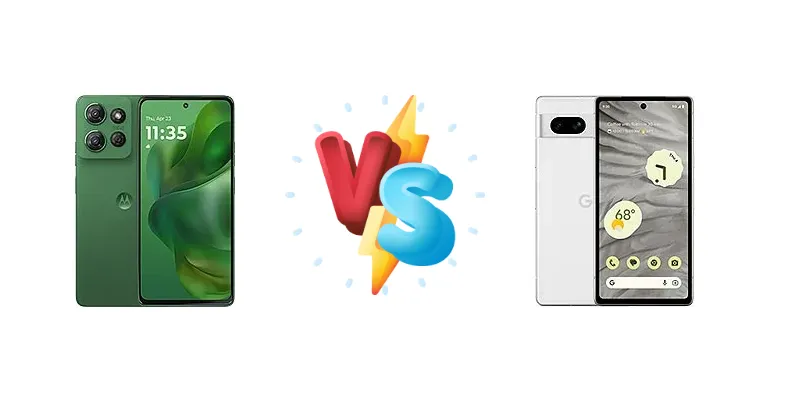
|
🏆 Quick Verdict
For the average user prioritizing all-day (and then some) battery life, the Motorola Moto G Power (2025) is the clear winner. Its impressive 11:56h active use score and 30W charging outweigh the Pixel 7a’s superior processing power and camera capabilities for those less concerned with demanding tasks.
| PHONES | ||
|---|---|---|
| Phone Names | Motorola Moto G Power (2025) | Google Pixel 7a |
| Network | ||
|---|---|---|
| 2G bands | GSM 850 / 900 / 1800 / 1900 | GSM 850 / 900 / 1800 / 1900 |
| 3G bands | HSDPA 850 / 900 / 1700(AWS) / 1900 / 2100 | HSDPA 800 / 850 / 900 / 1700(AWS) / 1900 / 2100 |
| 4G bands | 1, 2, 3, 4, 5, 7, 8, 12, 13, 14, 17, 18, 20, 25, 26, 28, 29, 30, 38, 39, 40, 41, 48, 66, 71 | 1, 2, 3, 4, 5, 7, 8, 12, 13, 14, 17, 20, 25, 26, 28, 29, 30, 38, 40, 41, 48, 66, 71 - GWKK3, G0DZQ |
| 5G bands | 2, 5, 7, 12, 14, 25, 26, 29, 30, 41, 48, 66, 70, 71, 77, 78 SA/NSA/Sub6 | 1, 2, 3, 5, 7, 8, 12, 14, 20, 25, 28, 30, 38, 41, 48, 66, 71, 77, 78 SA/NSA/Sub6 - GWKK3 |
| Speed | HSPA, LTE, 5G | HSPA, LTE, 5G |
| Technology | GSM / HSPA / LTE / 5G | GSM / HSPA / LTE / 5G |
| - | 1, 2, 3, 5, 7, 8, 12, 20, 25, 28, 38, 40, 41, 66, 75, 76, 77, 78, 79 SA/NSA/Sub6 - GHL1X, G82U8 | |
| Launch | ||
|---|---|---|
| Announced | 2025, January 14 | 2023, May 10 |
| Status | Available. Released 2025, February 06 | Available. Released 2023, May 10 |
| Body | ||
|---|---|---|
| Build | Glass front (Gorilla Glass 5), silicone polymer (eco leather) back, plastic frame | Glass front (Gorilla Glass 3), aluminum frame, plastic back |
| Dimensions | 166.6 x 77.1 x 8.7 mm (6.56 x 3.04 x 0.34 in) | 152 x 72.9 x 9 mm (5.98 x 2.87 x 0.35 in) |
| SIM | Nano-SIM + eSIM | Nano-SIM + eSIM |
| Weight | 208 g (7.34 oz) | 193.5 g (6.84 oz) |
| - | IP67 dust/water resistant (up to 1m for 30 min) | |
| Display | ||
|---|---|---|
| Protection | Corning Gorilla Glass 5 | Corning Gorilla Glass 3 |
| Resolution | 1080 x 2388 pixels (~385 ppi density) | 1080 x 2400 pixels, 20:9 ratio (~429 ppi density) |
| Size | 6.8 inches, 112.0 cm2 (~87.2% screen-to-body ratio) | 6.1 inches, 90.7 cm2 (~81.8% screen-to-body ratio) |
| Type | IPS LCD, 120Hz | OLED, HDR, 90Hz |
| - | Always-on display | |
| Platform | ||
|---|---|---|
| CPU | Octa-core (2x2.4 GHz Cortex-A76 & 6x2.0 GHz Cortex-A55) | Octa-core (2x2.85 GHz Cortex-X1 & 2x2.35 GHz Cortex-A78 & 4x1.80 GHz Cortex-A55) |
| Chipset | Mediatek Dimensity 6300 (6 nm) | Google Tensor G2 (5 nm) |
| GPU | Mali-G57 MC2 | Mali-G710 MP7 |
| OS | Android 15, up to 2 major Android upgrades | Android 13, upgradable to Android 15, up to 5 major Android upgrades |
| Memory | ||
|---|---|---|
| Card slot | microSDXC (dedicated slot) | No |
| Internal | 128GB 8GB RAM | 128GB 8GB RAM |
| - | UFS 3.1 | |
| Main Camera | ||
|---|---|---|
| Dual | 50 MP, f/1.8, (wide), 1/2.88", 0.61µm, PDAF, OIS 8 MP, f/2.2, 119˚ 13mm (ultrawide), 1.12µm, AF | 64 MP, f/1.9, 26mm (wide), 1/1.73", 0.8µm, dual pixel PDAF, OIS 13 MP, f/2.2, 120˚ (ultrawide), 1.12µm |
| Features | LED flash, HDR, panorama | Dual-LED flash, Pixel Shift, Auto-HDR, panorama |
| Video | 1080p@30fps | 4K@30/60fps, 1080p@30/60/120/240fps, OIS |
| Selfie camera | ||
|---|---|---|
| Features | - | HDR, panorama |
| Single | 16 MP, f/2.4, 24mm (wide), 1/3.0", 1.0µm | 13 MP, f/2.2, 20mm (ultrawide), 1.12µm |
| Video | 1080p@30fps | 4K@30fps, 1080p@30fps |
| Sound | ||
|---|---|---|
| 3.5mm jack | - | No |
| 35mm jack | Yes | No |
| Loudspeaker | Yes, with stereo speakers (with Dolby Atmos) | Yes, with stereo speakers |
| Comms | ||
|---|---|---|
| Bluetooth | Yes | 5.3, A2DP, LE |
| NFC | Yes | Yes |
| Positioning | GPS, GALILEO, GLONASS | GPS, GLONASS, GALILEO, BDS, QZSS, NavIC |
| Radio | FM radio | No |
| USB | USB Type-C 2.0 | USB Type-C 3.2 |
| WLAN | Wi-Fi 802.11 a/b/g/n/ac, dual-band | Wi-Fi 802.11 a/b/g/n/ac/6e, tri-band |
| Features | ||
|---|---|---|
| Sensors | Fingerprint (side-mounted), accelerometer, gyro, proximity, compass, barometer | Fingerprint (under display, optical), accelerometer, gyro, proximity, compass, barometer |
| Battery | ||
|---|---|---|
| Charging | 30W wired 15W wireless | 18W wired, PD3.0 7.5W wireless |
| Type | 5000 mAh | Li-Po 4385 mAh |
| Misc | ||
|---|---|---|
| Colors | Slate Gray, Leaf Green | Charcoal, Snow, Sea, Coral |
| Models | XT2515-1 | GWKK3, GHL1X, G0DZQ, G82U8 |
| Price | $ 199.99 | € 179.90 / $ 150.00 / £ 170.00 / ₹ 25,980 |
Motorola Moto G Power (2025)
- Exceptional battery life (11:56h active use)
- Faster 30W wired and 15W wireless charging
- Higher display contrast ratio for better visuals
- Less powerful processor than the Pixel 7a
- Camera likely lacks advanced features
Google Pixel 7a
- Powerful Google Tensor G2 processor
- Excellent camera image processing
- Polished software experience
- Shorter battery life compared to Moto G Power
- Slower 18W wired charging
Display Comparison
The Moto G Power (2025) boasts a display capable of reaching 993 nits of peak brightness, exceeding the Pixel 7a’s 1070 nits, though the difference is less significant in real-world use. More importantly, the Moto G Power’s 1358:1 contrast ratio suggests a deeper black level, enhancing visual clarity. While neither phone specifies panel technology, the Moto G Power’s brightness advantage is notable for outdoor visibility. The Pixel 7a benefits from Google’s color calibration, likely offering more accurate colors out of the box, but the Moto G Power’s higher contrast can compensate for this.
Camera Comparison
The Pixel 7a’s camera system, while details are limited in the provided data, is renowned for its computational photography capabilities. Google’s image processing algorithms excel at dynamic range, noise reduction, and detail preservation. The Moto G Power (2025) lacks specific camera details, suggesting a more basic camera setup focused on practicality rather than cutting-edge features. The Pixel 7a’s superior image processing will likely result in more consistently pleasing photos, especially in challenging lighting conditions. The absence of details on the Moto G Power’s sensor size and aperture makes a direct comparison difficult, but the Pixel 7a is expected to deliver a more versatile and higher-quality camera experience.
Performance
The Google Pixel 7a’s Tensor G2 (5nm) chipset, with its Cortex-X1 prime core clocked at 2.85 GHz, demonstrably outperforms the Motorola Moto G Power (2025)’s Dimensity 6300 (6nm) in raw processing power. The Tensor G2’s architecture, including the A78 performance cores, provides a significant boost in multi-threaded tasks and gaming. However, the Dimensity 6300’s 6nm process node offers improved efficiency, contributing to the Moto G Power’s exceptional battery life. The Pixel 7a’s performance advantage will be most noticeable in demanding applications and sustained workloads, while the Moto G Power prioritizes smooth, everyday performance without sacrificing endurance.
Battery Life
The Motorola Moto G Power (2025) truly shines in battery performance, achieving an impressive 11:56h of active use. This significantly surpasses the Pixel 7a’s reported 76h endurance rating (which is not directly comparable to active use time). While the Pixel 7a supports faster wired charging at 18W with PD3.0, the Moto G Power’s 30W wired and 15W wireless charging options offer greater flexibility. The Dimensity 6300’s efficiency, combined with a likely larger battery capacity (not specified), allows the Moto G Power to deliver exceptional longevity, making it ideal for users who prioritize minimizing charging frequency.
Buying Guide
Buy the Motorola Moto G Power (2025) if you need a phone that can reliably last through two full days of moderate use, or if you frequently travel and have limited access to charging. Buy the Google Pixel 7a if you prioritize a polished software experience, excellent camera image processing, and smoother performance for tasks like gaming and video editing.