
Motorola Moto G Power (2022) vs Samsung Galaxy A03s: The Ultimate Budget Battle
| Phones Images | |||||
|---|---|---|---|---|---|
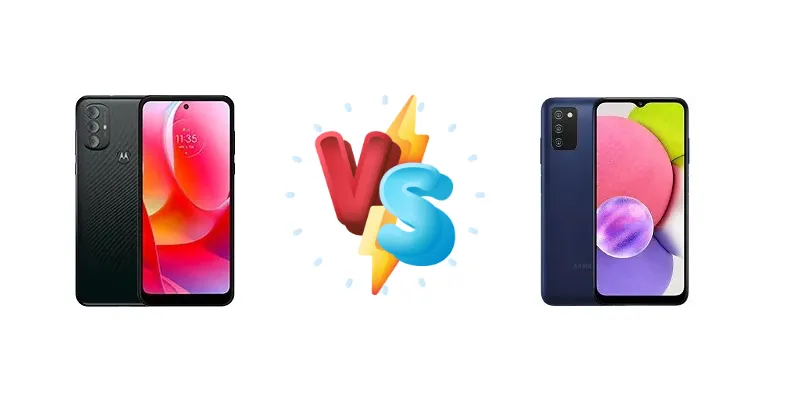
|
🏆 Quick Verdict
The Samsung Galaxy A03s edges out the Moto G Power (2022) thanks to its slightly faster chipset, faster charging, and potentially better display brightness. However, the Moto G Power's reputation for exceptional battery life remains a strong selling point.
| PHONES | ||
|---|---|---|
| Phone Names | Motorola Moto G Power (2022) | Samsung Galaxy A03s |
| Network | ||
|---|---|---|
| 2G bands | GSM 850 / 900 / 1800 / 1900 | GSM 850 / 900 / 1800 / 1900 |
| 3G bands | HSDPA 850 / 900 / 1700(AWS) / 1900 / 2100 | HSDPA 850 / 900 / 2100 |
| 4G bands | 1, 2, 3, 4, 5, 7, 8, 12, 13, 14, 17, 25, 26, 29, 30, 38, 41, 66, 71 - USA | 1, 3, 5, 7, 8, 20, 28, 38, 40, 41 |
| Speed | HSPA, LTE | HSPA 42.2/5.76 Mbps, LTE Cat4 150/50 Mbps |
| Technology | GSM / HSPA / LTE | GSM / HSPA / LTE |
| - | 2, 4, 5, 7, 12, 13, 14, 25, 26, 41, 66, 71 - SM-A037U | |
| Launch | ||
|---|---|---|
| Announced | 2021, November 17 | 2021, August 18 |
| Status | Available. Released 2022, February 22 | Available. Released 2021, August 18 |
| Body | ||
|---|---|---|
| Build | Glass front, plastic back, plastic frame | Glass front, plastic frame, plastic back |
| Dimensions | 167.2 x 76.5 x 9.4 mm (6.58 x 3.01 x 0.37 in) | 164.2 x 75.9 x 9.1 mm (6.46 x 2.99 x 0.36 in) |
| SIM | Nano-SIM | Nano-SIM + Nano-SIM |
| Weight | 203 g (7.16 oz) | 196 g (6.91 oz) |
| Water-repellent coating | - | |
| Display | ||
|---|---|---|
| Resolution | 720 x 1600 pixels, 20:9 ratio (~270 ppi density) | 720 x 1600 pixels, 20:9 ratio (~270 ppi density) |
| Size | 6.5 inches, 102.0 cm2 (~79.7% screen-to-body ratio) | 6.5 inches, 102.0 cm2 (~81.8% screen-to-body ratio) |
| Type | IPS LCD, 90Hz | PLS LCD |
| Platform | ||
|---|---|---|
| CPU | - | Octa-core (4x2.35 GHz Cortex-A53 & 4x1.8 GHz Cortex-A53) |
| Chipset | Mediatek MT6765 Helio G37 (12 nm) | Mediatek MT6765 Helio P35 (12 nm) |
| GPU | - | PowerVR GE8320 |
| OS | Android 11 | Android 11, upgradable to Android 13, One UI 5.1 Core |
| Memory | ||
|---|---|---|
| Card slot | microSDXC (dedicated slot) | microSDXC (dedicated slot) |
| Internal | 64GB 4GB RAM, 128GB 4GB RAM | 32GB 2GB RAM, 32GB 3GB RAM, 32GB 4GB RAM, 64GB 3GB RAM, 64GB 4GB RAM |
| eMMC 5.1 | eMMC 5.1 | |
| Main Camera | ||
|---|---|---|
| Features | LED flash, HDR | LED flash |
| Single | - | 5 MP, f/2.2 |
| Triple | 50 MP, f/1.8, (wide), 0.65µm, PDAF 2 MP (macro) Auxiliary lens | 13 MP, f/2.2, (wide), AF 2 MP (macro) Auxiliary lens |
| Video | 1080p@30fps, gyro-EIS | 1080p@30fps |
| Selfie camera | ||
|---|---|---|
| Single | 8 MP, f/2.0, 1.12µm | 5 MP, f/2.2 |
| Video | 1080p@30fps | 1080p@30fps |
| Sound | ||
|---|---|---|
| 3.5mm jack | Yes | Yes |
| 35mm jack | Yes | Yes |
| Loudspeaker | Yes | Yes |
| Comms | ||
|---|---|---|
| Bluetooth | 5.0, A2DP, LE | 5.0, A2DP |
| NFC | No | Yes (market/region dependent) |
| Positioning | GPS, GLONASS, GALILEO | GPS, GLONASS, GALILEO, BDS |
| Radio | Unspecified | No |
| USB | USB Type-C 2.0 | USB Type-C 2.0 |
| WLAN | Wi-Fi 802.11 a/b/g/n/ac, dual-band, Wi-Fi Direct | Wi-Fi 802.11 b/g/n, Wi-Fi Direct |
| Features | ||
|---|---|---|
| Sensors | Fingerprint (side-mounted), accelerometer, gyro, proximity, compass, barometer | Fingerprint (side-mounted), accelerometer, proximity |
| Battery | ||
|---|---|---|
| Charging | 10W wired | 15W wired |
| Type | Li-Po 5000 mAh | Li-Po 5000 mAh |
| Misc | ||
|---|---|---|
| Colors | Black | Black, Blue, White |
| Models | - | SM-A037F, SM-A037F/DS, SM-A037M, SM-A037G, SM-A037U, SM-S134DL, SM-A037W, SM-A037U1, SM-S135DL |
| Price | About 70 EUR | $ 65.65 / £ 82.99 / ₹ 10,800 |
| SAR EU | - | 0.36 W/kg (head) 1.09 W/kg (body) |
| Tests | ||
|---|---|---|
| Battery life | - | Endurance rating 122h |
| Camera | - | Photo / Video |
| Display | - | Contrast ratio: 1718:1 (nominal) |
| Loudspeaker | - | -27.4 LUFS (Good) |
| Performance | - | AnTuTu: 103465 (v8), 101299 (v9) GeekBench: 889 (v5.1) GFXBench: 5.5fps (ES 3.1 onscreen) |
Motorola Moto G Power (2022)
- Exceptional battery life
- Large display
- Clean Android experience
- Generally reliable
- Slower chipset
- Slow charging (10W)
- Basic camera performance
- Design can feel bulky
Samsung Galaxy A03s
- Slightly faster chipset
- Faster charging (15W)
- Samsung's One UI
- Potentially brighter display
- Battery life slightly less than Moto G Power
- Basic camera performance
- Can feel plasticky
- Performance still limited
Display Comparison
Both phones feature large displays, but the Galaxy A03s boasts a measured peak brightness of 488 nits, potentially offering better visibility in sunlight. The contrast ratio is similar on both, suggesting decent image quality. The Moto G Power (2022) typically has a slightly larger screen, which some users may prefer.
Camera Comparison
Camera performance is often a weak point in budget phones. Both devices feature basic camera setups. The Galaxy A03s might offer slightly better image processing due to Samsung's software optimization, but overall, expect similar results in most lighting conditions. Low-light performance will likely be subpar on both.
Performance
The Samsung Galaxy A03s utilizes a Mediatek Helio P35, which generally offers a small performance advantage over the Moto G Power's Helio G37. While neither phone is a powerhouse, the A03s should handle everyday tasks and light gaming slightly better. Both phones will likely exhibit some lag with demanding apps.
Battery Life
The Moto G Power (2022) is renowned for its exceptional battery life, often lasting well over a day with moderate usage. While the Galaxy A03s also boasts an impressive endurance rating of 122h, the Moto G Power typically outperforms in real-world scenarios due to software optimization and power management.
Buying Guide
The Motorola Moto G Power (2022) is ideal for users prioritizing long battery life and a large display for media consumption. The Samsung Galaxy A03s is a better choice for those who value slightly improved performance and faster charging speeds, and appreciate the Samsung ecosystem.