
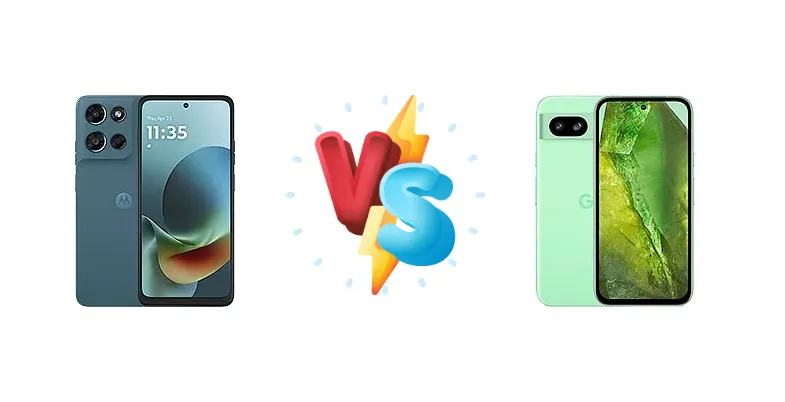
Google Pixel 8a vs. Motorola Moto G Play (2026): A Detailed Comparison
| Phones Images | |||||
|---|---|---|---|---|---|
|
🏆 Quick Verdict
For most users, the Google Pixel 8a is the superior choice. Its Google Tensor G3 chipset offers significantly better performance and AI features, complemented by a brighter display and longer battery endurance. While the Moto G Play (2026) provides excellent value, the Pixel 8a’s overall experience justifies the price difference.
| PHONES | ||
|---|---|---|
| Phone Names | Motorola Moto G Play (2026) | Google Pixel 8a |
| Network | ||
|---|---|---|
| 2G bands | GSM 850 / 900 / 1800 / 1900 | GSM 850 / 900 / 1800 / 1900 |
| 3G bands | HSDPA 850 / 900 / 1700(AWS) / 1900 / 2100 | HSDPA 800 / 850 / 900 / 1700(AWS) / 1900 / 2100 |
| 4G bands | 1, 2, 3, 4, 5, 7, 8, 12, 13, 14, 17, 18, 20, 25, 26, 28, 29, 30, 38, 39, 40, 41, 48, 66, 71 | 1, 2, 3, 4, 5, 7, 8, 12, 17, 18, 19, 20, 26, 28, 32, 38, 40, 41, 42, 66 - G6GPR (International) |
| 5G bands | 2, 5, 7, 12, 14, 25, 26, 29, 30, 41, 48, 66, 70, 71, 77, 78 SA/NSA/Sub6 | 1, 2, 3, 5, 7, 8, 12, 20, 26, 28, 38, 40, 41, 66, 75, 76, 77, 78 SA/NSA/Sub6 - G6GPR (International) |
| Speed | HSPA, LTE, 5G | HSPA, LTE, 5G |
| Technology | GSM / HSPA / LTE / 5G | GSM / HSPA / LTE / 5G |
| Launch | ||
|---|---|---|
| Announced | 2025, November 05 | 2024, May 07 |
| Status | Available. Released 2025, November 13 | Available. Released 2024, May 14 |
| Body | ||
|---|---|---|
| Build | Glass front (Gorilla Glass 3), silicone polymer (eco leather) back, plastic frame | Glass front (Gorilla Glass 3), aluminum frame, plastic back |
| Dimensions | 167.2 x 76.4 x 8.5 mm (6.58 x 3.01 x 0.33 in) | 152.1 x 72.7 x 8.9 mm (5.99 x 2.86 x 0.35 in) |
| SIM | Nano-SIM + eSIM | Nano-SIM + eSIM |
| Weight | 202 g (7.13 oz) | 188 g (6.63 oz) |
| Display | ||
|---|---|---|
| Protection | Corning Gorilla Glass 3 | Corning Gorilla Glass 3, Mohs level 5 |
| Resolution | 720 x 1604 pixels, 20:9 ratio (~262 ppi density) | 1080 x 2400 pixels, 20:9 ratio (~430 ppi density) |
| Size | 6.7 inches, 108.2 cm2 (~84.7% screen-to-body ratio) | 6.1 inches, 90.3 cm2 (~81.6% screen-to-body ratio) |
| Type | IPS LCD, 120Hz, 1000 nits (peak) | OLED, HDR, 120Hz, 2000 nits (peak) |
| Platform | ||
|---|---|---|
| CPU | Octa-core (2x2.4 GHz Cortex-A76 & 6x2.0 GHz Cortex-A55) | Nona-core (1x3.0 GHz Cortex-X3 & 4x2.45 GHz Cortex-A715 & 4x2.15 GHz Cortex-A510) |
| Chipset | Mediatek Dimensity 6300 (6 nm) | Google Tensor G3 (4 nm) |
| GPU | Mali-G57 MC2 | Immortalis-G715s MC10 |
| OS | Android 16 | Android 14, upgradable to Android 16, up to 7 major Android upgrades |
| Memory | ||
|---|---|---|
| Card slot | microSDXC (dedicated slot) | No |
| Internal | 64GB 4GB RAM | 128GB 8GB RAM, 256GB 8GB RAM |
| Main Camera | ||
|---|---|---|
| Dual | - | 64 MP (16 MP eff.), f/1.9, 26mm (wide), 1/1.73", 0.8µm, dual pixel PDAF, OIS 13 MP, f/2.2, 120˚ (ultrawide), 1.12µm |
| Features | LED flash, HDR, panorama | Dual-LED flash, Pixel Shift, Ultra HDR, panorama, Best Take |
| Single | 32 MP, f/2.2, (wide), 0.64µm, PDAF | - |
| Video | 1080p@30fps | 4K@30/60fps, 1080p@30/60/120/240fps, OIS |
| Selfie camera | ||
|---|---|---|
| Features | - | HDR, panorama |
| Single | 8 MP, f/2.0, (wide) | 13 MP, f/2.2, 20mm (ultrawide), 1.12µm |
| Video | 1080p@30fps | 4K@30fps, 1080p@30/60fps |
| Sound | ||
|---|---|---|
| 35mm jack | Yes | No |
| Loudspeaker | Yes, with stereo speakers (with Dolby Atmos) | Yes, with stereo speakers |
| Comms | ||
|---|---|---|
| Bluetooth | Yes | 5.3, A2DP, LE |
| NFC | Yes | Yes |
| Positioning | GPS, GALILEO, GLONASS | GPS, GLONASS, GALILEO, BDS, QZSS, NavIC |
| Radio | No | No |
| USB | USB Type-C 2.0 | USB Type-C 3.2 |
| WLAN | Wi-Fi 802.11 a/b/g/n/ac, dual-band | Wi-Fi 802.11 a/b/g/n/ac/6e, dual/tri-band (market/region dependent) |
| Features | ||
|---|---|---|
| Sensors | Fingerprint (side-mounted), accelerometer, gyro, proximity, compass | Fingerprint (under display, optical), accelerometer, gyro, proximity, compass, barometer |
| Battery | ||
|---|---|---|
| Charging | 18W wired | 18W wired, PD3.0 7.5W wireless Bypass charging |
| Type | 5200 mAh | Li-Po 4492 mAh |
| Misc | ||
|---|---|---|
| Colors | Pantone Tapestry | Obsidian, Porcelain, Bay, Aloe |
| Models | - | GKV4X, G6GPR, G8HHN, G576D |
| Price | $ 179.99 | $ 229.98 / C$ 417.99 / £ 279.00 / € 299.99 / ₹ 33,300 |
| EU LABEL | ||
|---|---|---|
| Battery | - | 40:06h endurance, 1000 cycles |
| Energy | - | Class B |
| Free fall | - | Class A (270 falls) |
| Repairability | - | Class B |
Motorola Moto G Play (2026)
- Superior performance with Google Tensor G3
- Brighter and more vibrant display
- Exceptional camera capabilities and AI features
- Higher price point
- May not offer expandable storage
Google Pixel 8a
- Extremely affordable price
- Decent battery life for basic usage
- Reliable for essential smartphone tasks
- Significantly weaker performance
- Lower quality display
- Limited camera capabilities
Display Comparison
The Pixel 8a boasts a significantly brighter display, reaching a measured peak of 1508 nits, ensuring excellent visibility even in direct sunlight. While the Moto G Play (2026) display specs are not provided, Motorola typically uses LCD panels in this price range, which will likely fall far short of the Pixel 8a’s brightness and color accuracy. The Pixel 8a’s panel likely benefits from OLED technology, offering deeper blacks and a higher contrast ratio. The absence of refresh rate information for the Moto G Play suggests a standard 60Hz panel, while the Pixel 8a is expected to have a smoother experience.
Camera Comparison
The Pixel 8a is expected to excel in camera performance, leveraging Google’s renowned computational photography. While specific sensor details are missing for both devices, the Pixel 8a’s image processing capabilities, powered by the Tensor G3, will likely deliver superior image quality, especially in low-light conditions. The Moto G Play (2026) will likely feature a more basic camera system focused on providing acceptable results in good lighting. The Pixel 8a’s AI-powered features, such as Magic Eraser and Photo Unblur, offer significant advantages for post-processing.
Performance
The core difference lies in the chipsets. The Google Tensor G3, fabricated on a 4nm process, features a nona-core architecture with a high-performance Cortex-X3 core clocked at 3.0 GHz. This contrasts with the Mediatek Dimensity 6300 (6nm) in the Moto G Play (2026), which utilizes an octa-core configuration with older Cortex-A76 cores. The Tensor G3’s more advanced architecture and smaller process node translate to superior CPU and GPU performance, particularly in demanding tasks like gaming and video editing. The Pixel 8a will also benefit from Google’s software optimizations and AI acceleration capabilities. While the Dimensity 6300 is adequate for everyday tasks, it will struggle with more intensive workloads.
Battery Life
The Pixel 8a demonstrates impressive battery endurance, achieving a measured 40:06h endurance rating and 11:25h of active use. This suggests a well-optimized combination of hardware and software. While the Moto G Play (2026) charging is limited to 18W, the Pixel 8a supports 18W wired charging with PD3.0, 7.5W wireless charging, and bypass charging. The Pixel 8a’s 1000 cycle battery life indicates a higher quality battery cell and longer-term reliability. The Pixel 8a’s endurance rating, even considering its more powerful processor, suggests superior power efficiency.
Buying Guide
Buy the Motorola Moto G Play (2026) if you prioritize affordability above all else and need a reliable device for basic tasks like calling, texting, and light social media use. Buy the Google Pixel 8a if you value a smoother user experience, superior camera capabilities, longer software support, and access to Google’s advanced AI features, even if it means spending more.