
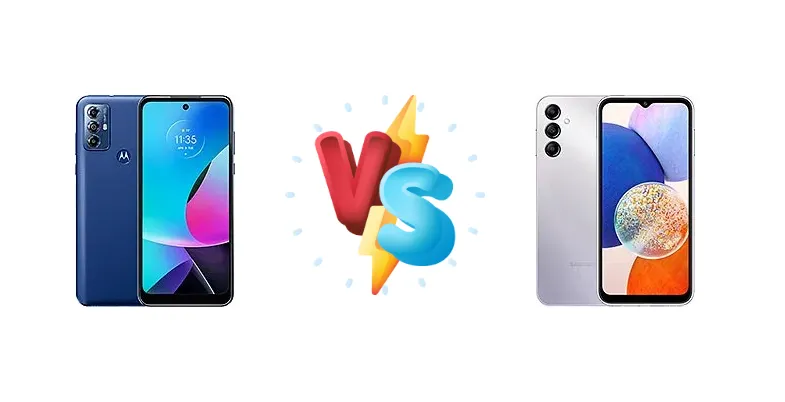
Motorola Moto G Play (2023) vs Samsung Galaxy A14 5G: The Ultimate Budget Showdown
| Phones Images | |||||
|---|---|---|---|---|---|
|
🏆 Quick Verdict
The Samsung Galaxy A14 5G emerges as the clear winner, thanks to its superior chipset, brighter display, and 5G connectivity. While the Moto G Play (2023) offers a more budget-friendly price point, the A14 5G's overall performance and features justify the slight price difference.
| PHONES | ||
|---|---|---|
| Phone Names | Motorola Moto G Play (2023) | Samsung Galaxy A14 5G |
| Network | ||
|---|---|---|
| 2G bands | GSM 850 / 900 / 1800 / 1900 | GSM 850 / 900 / 1800 / 1900 |
| 3G bands | HSDPA 850 / 900 / 1700(AWS) / 1900 / 2100 | HSDPA 850 / 900 / 1700(AWS) / 1900 / 2100 |
| 4G bands | 1, 2, 3, 4, 5, 7, 8, 12, 13, 14, 17, 18, 19, 20, 25, 26, 29, 30, 38, 39, 40, 41, 66, 71 | 1, 2, 3, 4, 5, 7, 8, 12, 17, 20, 26, 28, 38, 40, 41, 66 - International |
| 5G bands | - | 2, 5, 66, 77 Sub6/mmWave - USA |
| Speed | HSPA, LTE | HSPA, LTE, 5G |
| Technology | GSM / CDMA / HSPA / LTE | GSM / HSPA / LTE / 5G |
| CDMA 800 / 1900 | 1, 3, 5, 7, 8, 20, 28, 40, 41, 78 SA/NSA/Sub6 - India | |
| Launch | ||
|---|---|---|
| Announced | 2022, December 08 | 2023, January 04 |
| Status | Available. Released 2022, December 12 | Available. Released 2023, January 12 |
| Body | ||
|---|---|---|
| Build | Plastic frame, plastic back | Glass front, plastic back, plastic frame |
| Dimensions | 167.2 x 76.5 x 9.4 mm (6.58 x 3.01 x 0.37 in) | 167.7 x 78 x 9.1 mm (6.60 x 3.07 x 0.36 in) |
| SIM | Nano-SIM | · Nano-SIM· Nano-SIM + Nano-SIM |
| Weight | 203 g (7.20 oz) | 202 g (7.13 oz) |
| Water-repellent coating | - | |
| Display | ||
|---|---|---|
| Resolution | 720 x 1600 pixels, 20:9 ratio (~270 ppi density) | 1080 x 2408 pixels, 20:9 ratio (~400 ppi density) |
| Size | 6.5 inches, 102.0 cm2 (~79.7% screen-to-body ratio) | 6.6 inches, 104.9 cm2 (~80.2% screen-to-body ratio) |
| Type | IPS LCD, 90Hz | PLS LCD, 90Hz |
| Platform | ||
|---|---|---|
| CPU | Octa-core (4x2.3 GHz Cortex-A53 & 4x1.8 GHz Cortex-A53) | Octa-core (2x2.4 GHz Cortex-A78 & 6x2.0 GHz Cortex-A55) - SM-A146BOcta-core (2x2.2 GHz Cortex-A76 & 6x2.0 GHz Cortex-A55) - SM-A146P |
| Chipset | Mediatek MT6765 Helio G37 (12 nm) | Exynos 1330 (5 nm) - SM-A146BMediatek Dimensity 700 (7 nm) - SM-A146P |
| GPU | PowerVR GE8320 | Mali-G68 MP2 - SM-A146BMali-G57 MC2 - SM-A146P |
| OS | Android 12 | Android 13, upgradable to Android 15, One UI Core 7 |
| Memory | ||
|---|---|---|
| Card slot | microSDXC (dedicated slot) | microSDXC (uses shared SIM slot) - USA onlymicroSDXC (dedicated slot) - International |
| Internal | 32GB 3GB RAM | 64GB 4GB RAM, 128GB 4GB RAM, 128GB 6GB RAM, 128GB 8GB RAM |
| eMMC 5.1 | - | |
| Main Camera | ||
|---|---|---|
| Features | LED flash, HDR, panorama | LED flash, panorama, HDR |
| Single | - | 13 MP, f/2.0, (wide) |
| Triple | 16 MP, f/2.2, (wide), 1.12µm, PDAF 2 MP (macro) Auxiliary lens | 50 MP, f/1.8, 26mm (wide), 1/2.76", 0.64µm, PDAF 2 MP (macro) Auxiliary lens |
| Video | 1080p@30/60fps | 1080p@30fps |
| Selfie camera | ||
|---|---|---|
| Features | HDR | - |
| Single | 5 MP, f/2.4, (wide), 1.12µm | 13 MP, f/2.0, 26mm (wide), 1.12µm |
| Video | 1080p@30fps | 1080p@30fps |
| Sound | ||
|---|---|---|
| 3.5mm jack | Yes | Yes |
| 35mm jack | Yes | Yes |
| Loudspeaker | Yes | Yes |
| Comms | ||
|---|---|---|
| Bluetooth | 5.0, A2DP, LE | 5.2, A2DP, LE |
| NFC | No | Yes |
| Positioning | GPS, GLONASS | GPS, GLONASS, GALILEO |
| Radio | No | FM radio (Exynos 1330 chipset only), recording |
| USB | USB Type-C 2.0 | USB Type-C 2.0 |
| WLAN | Wi-Fi 802.11 a/b/g/n/ac, dual-band | Wi-Fi 802.11 a/b/g/n/ac, dual-band, Wi-Fi Direct |
| Features | ||
|---|---|---|
| Sensors | Fingerprint (rear-mounted), accelerometer, proximity, barometer | Fingerprint (side-mounted), accelerometer, gyro, proximity, compass, barometer (USA only) |
| Battery | ||
|---|---|---|
| Charging | 10W wired | 15W wired |
| Type | Li-Po 5000 mAh | Li-Po 5000 mAh |
| Misc | ||
|---|---|---|
| Colors | Deep Indigo | Black, Light Green, Dark Red, Silver |
| Models | XT2271-1, XT2271-3, XT2271-5, XT2271-4 | SM-A146B, SM-A146B/DS, SM-A146P, SM-A146P/DS, SM-A146U, SM-A146U1, SM-A146U1/DS, SM-A146W, SM-A146P/N, SM-A146P/DSN, SM-S146VL, SM-A146M |
| Price | $ 54.00 / C$ 129.00 | $ 77.63 / C$ 151.00 / £ 97.00 / € 159.79 / ₹ 14,990 |
| SAR | - | 1.00 W/kg (head) 1.00 W/kg (body) |
| SAR EU | - | 0.56 W/kg (head) 1.28 W/kg (body) |
| Tests | ||
|---|---|---|
| Battery life | - | Endurance rating 130h |
| Camera | - | Photo / Video |
| Display | - | Contrast ratio: 1334:1 (nominal) |
| Loudspeaker | - | -26.8 LUFS (Good) |
| Performance | - | AnTuTu: 307886 (v9) GeekBench: 1727 (v5.1) GFXBench: 12fps (ES 3.1 onscreen) |
Motorola Moto G Play (2023)
- Very affordable
- Decent battery life
- Clean Android experience
- Expandable storage (likely via microSD)
- Weak performance
- Dim display
- Basic camera
- Slow charging (10W)
Samsung Galaxy A14 5G
- Faster performance (Exynos/Dimensity chipset)
- Brighter display
- Better camera
- 5G connectivity
- Faster charging (15W)
- Slightly more expensive
- Samsung's One UI (can be polarizing)
Display Comparison
The Samsung Galaxy A14 5G boasts a significantly brighter display (519 nits vs. estimated 380-400 nits for the Moto G Play), making it easier to view outdoors. Both offer a high contrast ratio (1334:1), but the A14 5G's brightness advantage gives it the edge. The A14 5G also likely has slightly better color accuracy, a common Samsung trait.
Camera Comparison
While both phones offer 'Photo / Video' capabilities, the Galaxy A14 5G is expected to deliver superior image quality. Samsung's image processing is generally well-regarded, and the Exynos/Dimensity chipset provides more processing power for better photos and videos. The Moto G Play's camera is likely to be more basic, with less detail and dynamic range.
Performance
Here's where the A14 5G truly shines. The Exynos 1330 (or Dimensity 700 depending on region) is a much more powerful chipset than the Helio G37. Expect noticeably faster app loading times, smoother multitasking, and better gaming performance on the A14 5G. The Moto G Play's Helio G37 is adequate for basic tasks but will struggle with demanding applications.
Battery Life
Both phones boast impressive endurance ratings (130h), suggesting excellent battery life. However, the A14 5G's more efficient chipset might give it a slight advantage in real-world usage, especially with 5G enabled.
Buying Guide
The Motorola Moto G Play (2023) is ideal for users on a very tight budget who prioritize affordability and basic functionality. The Samsung Galaxy A14 5G is a better choice for those seeking a smoother experience, 5G connectivity, a brighter display, and a more capable camera, even if it means spending a bit more.