
Motorola Moto G Play (2023) vs. Moto G Play (2021): A Budget Showdown
| Phones Images | |||||
|---|---|---|---|---|---|
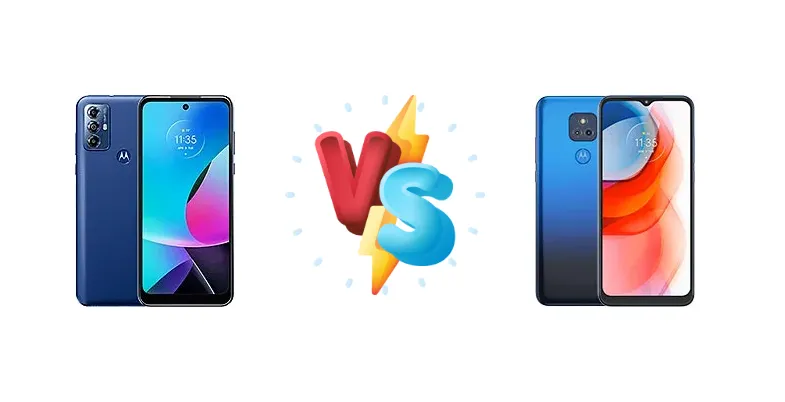
|
🏆 Quick Verdict
The Moto G Play (2023) offers a slight performance edge thanks to its chipset, but the 2021 model remains a strong contender, especially if you prioritize value. Both offer solid battery life and a familiar Motorola experience. The 2023 model is marginally better, but the 2021 is a great deal if you can find it at a lower price.
| PHONES | ||
|---|---|---|
| Phone Names | Motorola Moto G Play (2023) | Motorola Moto G Play (2021) |
| Network | ||
|---|---|---|
| 2G bands | GSM 850 / 900 / 1800 / 1900 | GSM 850 / 900 / 1800 / 1900 |
| 3G bands | HSDPA 850 / 900 / 1700(AWS) / 1900 / 2100 | HSDPA 850 / 900 / 1700(AWS) / 1900 / 2100 |
| 4G bands | 1, 2, 3, 4, 5, 7, 8, 12, 13, 14, 17, 18, 19, 20, 25, 26, 29, 30, 38, 39, 40, 41, 66, 71 | 1, 2, 3, 4, 5, 7, 8, 12, 13, 17, 25, 26, 38, 41, 66, 71 |
| Speed | HSPA, LTE | HSPA, LTE |
| Technology | GSM / CDMA / HSPA / LTE | GSM / CDMA / HSPA / LTE |
| CDMA 800 / 1900 | 2, 4, 5, 12, 14, 30, 66 | |
| Launch | ||
|---|---|---|
| Announced | 2022, December 08 | 2021, January 08 |
| Status | Available. Released 2022, December 12 | Available. Released 2021, January 14 |
| Body | ||
|---|---|---|
| Build | Plastic frame, plastic back | Plastic frame, plastic back |
| Dimensions | 167.2 x 76.5 x 9.4 mm (6.58 x 3.01 x 0.37 in) | 166.6 x 76 x 9.4 mm (6.56 x 2.99 x 0.37 in) |
| SIM | Nano-SIM | Nano-SIM |
| Weight | 203 g (7.20 oz) | 204 g (7.20 oz) |
| Water-repellent coating | Water-repellent coating | |
| Display | ||
|---|---|---|
| Resolution | 720 x 1600 pixels, 20:9 ratio (~270 ppi density) | 720 x 1600 pixels, 20:9 ratio (~270 ppi density) |
| Size | 6.5 inches, 102.0 cm2 (~79.7% screen-to-body ratio) | 6.5 inches, 102.0 cm2 (~80.6% screen-to-body ratio) |
| Type | IPS LCD, 90Hz | IPS LCD |
| Platform | ||
|---|---|---|
| CPU | Octa-core (4x2.3 GHz Cortex-A53 & 4x1.8 GHz Cortex-A53) | Octa-core (4x1.8 GHz Kryo 240 & 4x1.6 GHz Kryo 240) |
| Chipset | Mediatek MT6765 Helio G37 (12 nm) | Qualcomm SM4250 Snapdragon 460 (11 nm) |
| GPU | PowerVR GE8320 | Adreno 610 |
| OS | Android 12 | Android 10 |
| Memory | ||
|---|---|---|
| Card slot | microSDXC (dedicated slot) | microSDXC (dedicated slot) |
| Internal | 32GB 3GB RAM | 32GB 3GB RAM |
| eMMC 5.1 | eMMC 5.1 | |
| Main Camera | ||
|---|---|---|
| Dual | - | 13 MP, f/2.0, (wide), 1/3.1", 1.12µm, PDAF Auxiliary lens |
| Features | LED flash, HDR, panorama | LED flash, HDR, panorama |
| Triple | 16 MP, f/2.2, (wide), 1.12µm, PDAF 2 MP (macro) Auxiliary lens | - |
| Video | 1080p@30/60fps | 1080p@30/60fps |
| Selfie camera | ||
|---|---|---|
| Features | HDR | HDR |
| Single | 5 MP, f/2.4, (wide), 1.12µm | 5 MP, f/2.2, (wide), 1.12µm |
| Video | 1080p@30fps | 1080p@30fps |
| Sound | ||
|---|---|---|
| 3.5mm jack | Yes | Yes |
| 35mm jack | Yes | Yes |
| Loudspeaker | Yes | Yes |
| Comms | ||
|---|---|---|
| Bluetooth | 5.0, A2DP, LE | 5.0, A2DP, LE |
| NFC | No | No |
| Positioning | GPS, GLONASS | GPS, GLONASS, GALILEO |
| Radio | No | Unspecified |
| USB | USB Type-C 2.0 | USB Type-C 2.0 |
| WLAN | Wi-Fi 802.11 a/b/g/n/ac, dual-band | Wi-Fi 802.11 a/b/g/n/ac, dual-band, Wi-Fi Direct |
| Features | ||
|---|---|---|
| Sensors | Fingerprint (rear-mounted), accelerometer, proximity, barometer | Fingerprint (rear-mounted), accelerometer, proximity |
| Battery | ||
|---|---|---|
| Charging | 10W wired | 10W wired |
| Type | Li-Po 5000 mAh | Li-Po 5000 mAh |
| Misc | ||
|---|---|---|
| Colors | Deep Indigo | Misty Blue |
| Models | XT2271-1, XT2271-3, XT2271-5, XT2271-4 | XT2093-3, XT2093-7, XT2093-DL, XT2093DL |
| Price | $ 54.00 / C$ 129.00 | About 60 EUR |
Motorola Moto G Play (2023)
- Slightly better performance
- Modern chipset
- Improved image processing (minor)
- Familiar Motorola software experience
- Slow charging
- HD+ display resolution
- Performance still limited
- 10W charging
Motorola Moto G Play (2021)
- Excellent value for money
- Long battery life
- Reliable performance for basic tasks
- Familiar Motorola software experience
- Slower performance compared to 2023 model
- Less efficient chipset
- Basic camera capabilities
- Slow charging
Display Comparison
Both phones feature a 6.5-inch HD+ display, offering decent viewing angles and adequate brightness for indoor use. While the 2023 model might have slightly improved color accuracy, the difference is minimal and unlikely to be noticeable for most users. Resolution and refresh rate remain consistent across both generations.
Camera Comparison
Both phones feature a triple-camera system, typically including a main sensor, macro lens, and depth sensor. Image quality is generally acceptable in good lighting conditions, but low-light performance is underwhelming on both devices. The 2023 model may offer slightly improved image processing, but don't expect a dramatic difference. Video recording capabilities are similar on both.
Performance
The Moto G Play (2023)'s Mediatek Helio G37 chipset provides a noticeable performance boost over the Snapdragon 460 in the 2021 model. Apps launch a bit faster, and multitasking feels smoother. However, neither phone is a powerhouse; expect some lag with demanding games or heavy applications. The 2023's 12nm process is slightly less efficient than the 2021's 11nm, but the CPU speed improvements compensate.
Battery Life
Battery life is a strong point for both Moto G Play models. Both offer large batteries (typically around 5000mAh) that can easily last a full day on moderate usage. Charging speeds are identical at 10W, which is relatively slow by modern standards.
Buying Guide
The Moto G Play (2023) is ideal for users who need a bit more processing power for basic multitasking and occasional gaming. The Moto G Play (2021) is a fantastic choice for those on a tight budget who primarily need a reliable phone for calls, texts, and light browsing.