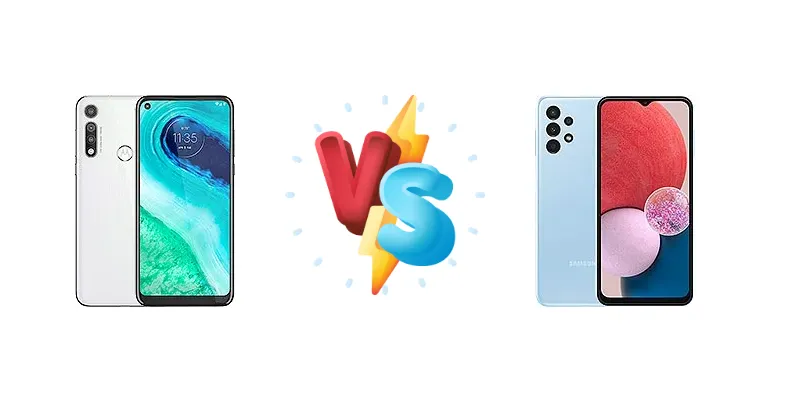
The Motorola Moto G Fast and Samsung Galaxy A13 represent the fiercely competitive sub-$200 smartphone market. Both aim to deliver essential smartphone functionality at an accessible price, but they take different approaches to achieving this. This comparison dissects their core components – from chipsets to charging – to determine which device offers the best value for your money.
🏆 Quick Verdict
For the average user prioritizing slightly faster charging and a potentially more optimized software experience, the Samsung Galaxy A13 (SM-A137) is the better choice. However, the Moto G Fast remains a viable option for those seeking a simple, straightforward Android experience and aren't heavily reliant on demanding applications.
| Network |
|---|
| 2G bands | GSM 850 / 900 / 1800 / 1900 | GSM 850 / 900 / 1800 / 1900 |
| 3G bands | HSDPA 850 / 900 / 1700(AWS) / 1900 / 2100 | HSDPA 850 / 900 / 2100 |
| 4G bands | 1, 2, 3, 4, 5, 7, 8, 12, 13, 14, 17, 25, 26, 29, 30, 38, 41, 66, 71 | 1, 3, 5, 7, 8, 20, 28, 38, 40, 41 |
| Speed | HSPA, LTE | HSPA, LTE |
| Technology | GSM / CDMA / HSPA / EVDO / LTE | GSM / HSPA / LTE |
| | CDMA2000 1xEV-DO | - |
| Launch |
|---|
| Announced | 2020, June 05. Released 2020, June 12 | 2022, June |
| Status | Discontinued | Available. Released 2022, July |
| Body |
|---|
| Build | - | Glass front (Gorilla Glass 5), plastic frame, plastic back |
| Dimensions | 161.9 x 75.7 x 9.1 mm (6.37 x 2.98 x 0.36 in) | 165.1 x 76.4 x 8.8 mm (6.5 x 3.01 x 0.35 in) |
| SIM | Nano-SIM + Nano-SIM | · Nano-SIM· Nano-SIM + Nano-SIM |
| Weight | 189.4 g (6.67 oz) | 195 g (6.88 oz) |
| | Water-repellent coating | - |
| Display |
|---|
| Protection | - | Corning Gorilla Glass 5 |
| Resolution | 720 x 1560 pixels, 19.5:9 ratio (~268 ppi density) | 1080 x 2408 pixels, 20:9 ratio (~400 ppi density) |
| Size | 6.4 inches, 100.5 cm2 (~82.0% screen-to-body ratio) | 6.6 inches, 104.9 cm2 (~83.2% screen-to-body ratio) |
| Type | IPS LCD | PLS LCD |
| Platform |
|---|
| CPU | Octa-core (4x2.0 GHz Kryo 260 Gold & 4x1.8 GHz Kryo 260 Silver) | Octa-core (2x2.0 GHz Cortex-A75 & 6x1.8 GHz Cortex-A55) |
| Chipset | Qualcomm SM6125 Snapdragon 665 (11 nm) | Mediatek MT6769V/CU Helio G80 (12 nm) |
| GPU | Adreno 610 | Mali-G52 MC2 |
| OS | Android 10 | Android 12, upgradable to Android 14, One UI 6.1 |
| Memory |
|---|
| Card slot | microSDXC (uses shared SIM slot) | microSDXC (dedicated slot) |
| Internal | 32GB 3GB RAM | 32GB 3GB RAM, 32GB 4GB RAM, 64GB 4GB RAM, 128GB 4GB RAM |
| | eMMC 5.1 | eMMC 5.1 |
| Main Camera |
|---|
| Features | LED flash, HDR, panorama | LED flash, panorama, HDR |
| Quad | - | 50 MP, f/1.8, (wide), PDAF
5 MP, f/2.2, 123˚ (ultrawide), 1/5.0", 1.12µm
2 MP (macro)
Auxiliary lens |
| Single | - | 8 MP, f/2.2, (wide) |
| Triple | 16 MP, f/1.7, (wide), 1/2.8", 1.12µm, PDAF
8 MP, f/2.2, 118˚ (ultrawide), 1/4.0", 1.12µm
2 MP (macro) | - |
| Video | 4K@30fps, 1080p@30/60fps, gyro-EIS | 1080p@30fps |
| Selfie camera |
|---|
| Features | HDR | - |
| Single | 8 MP, f/2.0, (wide), 1.12µm | 8 MP, f/2.2, (wide) |
| Video | 1080p@30fps, gyro-EIS | 1080p@30fps |
| Sound |
|---|
| 3.5mm jack | Yes | Yes |
| 35mm jack | Yes | Yes |
| Loudspeaker | Yes | Yes |
| Comms |
|---|
| Bluetooth | 5.0, A2DP, LE | 5.2, A2DP, LE |
| NFC | No | Yes |
| Positioning | GPS, GLONASS, GALILEO | GPS, GLONASS, GALILEO, BDS |
| Radio | - | No |
| USB | USB Type-C 2.0 | USB Type-C 2.0, OTG |
| WLAN | Wi-Fi 802.11 a/b/g/n/ac, dual-band, Wi-Fi Direct | Wi-Fi 802.11 a/b/g/n/ac, dual-band, Wi-Fi Direct |
| Features |
|---|
| Sensors | Fingerprint (rear-mounted), accelerometer, gyro, proximity | Fingerprint (side-mounted), accelerometer, compass |
| | - | Virtual proximity sensing |
| Battery |
|---|
| Charging | 10W wired | 15W wired |
| Type | Li-Po 4000 mAh | Li-Po 5000 mAh |
| Misc |
|---|
| Colors | Pearl White | Black, White, Blue |
| Models | XT2045-3 | SM-A137F, SM-A137F/DSN, SM-A137F/DS |
| Price | About 90 EUR | About 180 EUR |
| SAR EU | - | 0.35 W/kg (head) 1.22 W/kg (body) |
Motorola Moto G Fast
- Clean Android experience with minimal bloatware
- Potentially better thermal management due to the Snapdragon 665's efficiency
- Simple and straightforward user interface
- Slower 10W charging
- Less powerful chipset compared to the Helio G80
Samsung Galaxy A13 (SM-A137)
- Faster 15W charging
- Potentially better gaming performance with the Helio G80
- Samsung's image processing may improve camera results
- Samsung's One UI can be more resource-intensive
- Potential for more bloatware compared to the Moto G Fast
Display Comparison
Neither device boasts a standout display. Both likely utilize LCD panels, common in this price bracket. The key difference lies under the hood: processing power. Display quality will be similar, with both likely targeting 720p+ resolution. Bezels are expected to be substantial on both, and color accuracy will be adequate but not exceptional. Without specific display specs, it's difficult to declare a clear winner; the experience will be largely comparable.
Camera Comparison
Camera performance is likely to be similar, with both devices relying on budget sensors. Without specific sensor details, it’s safe to assume both will struggle in low-light conditions. The A13 may benefit from Samsung’s image processing algorithms, potentially delivering slightly more pleasing results. The inclusion of a 2MP macro camera on both is largely a marketing gimmick and offers limited practical value. Focusing on the main sensor’s capabilities is more important, and the A13’s potential for better software processing gives it a slight edge.
Performance
The performance gap centers around the chipsets. The Samsung Galaxy A13’s MediaTek Helio G80 (12nm) has a slight architectural advantage over the Motorola Moto G Fast’s Qualcomm Snapdragon 665 (11nm). While both are octa-core CPUs, the G80 utilizes 2x Cortex-A75 performance cores alongside 6x A55 efficiency cores, offering a potential boost in single-core performance compared to the G Fast’s 4x Kryo 260 Gold and 4x Kryo 260 Silver configuration. The 12nm process node of the Helio G80, while slightly larger than the Snapdragon’s 11nm, doesn’t necessarily translate to worse efficiency; MediaTek’s optimizations can mitigate this. This translates to a smoother experience with moderately demanding apps and potentially better gaming performance on the A13.
Battery Life
Both phones offer all-day battery life for moderate users. The real differentiator is charging speed. The Samsung Galaxy A13 supports 15W wired charging, while the Moto G Fast is limited to 10W. This means the A13 will charge significantly faster, reducing downtime. While battery capacity isn’t specified, the faster charging of the A13 is a tangible benefit for users who frequently need to top up their devices.
Buying Guide
Buy the Motorola Moto G Fast if you need a no-frills Android experience with a focus on simplicity and a clean software interface. It's ideal for basic communication, light social media use, and users who prioritize a straightforward device. Buy the Samsung Galaxy A13 (SM-A137) if you prefer a more feature-rich experience, potentially benefit from the slightly more powerful Helio G80 chipset for gaming, and value the convenience of 15W fast charging.
Frequently Asked Questions
❓ Will the Helio G80 in the Galaxy A13 overheat during extended gaming sessions?
While the Helio G80 is more powerful than the Snapdragon 665, it's still a budget chipset. Prolonged gaming at high settings *could* lead to thermal throttling, reducing performance. However, Samsung's software optimizations may mitigate this, and casual gaming should be fine. The Moto G Fast's Snapdragon 665 is less prone to overheating but also offers lower peak performance.
❓ Is the 2MP macro camera on either phone worth using?
Generally, no. 2MP macro cameras on budget phones typically produce low-resolution, soft images with limited detail. They are often included for marketing purposes but offer minimal practical benefit. Focusing on the main camera sensor for most photography is recommended.
❓ How long will it take to fully charge each phone from 0%?
With 10W charging, the Moto G Fast will likely take around 3-4 hours to fully charge. The Samsung Galaxy A13’s 15W charging should reduce this to approximately 2-2.5 hours, offering a significant time saving.
❓ Does the Samsung Galaxy A13 support software updates for a long period?
Samsung generally provides longer software support than Motorola for its budget devices. The Galaxy A13 is likely to receive at least two major Android updates and several years of security patches, offering better long-term value compared to the Moto G Fast.