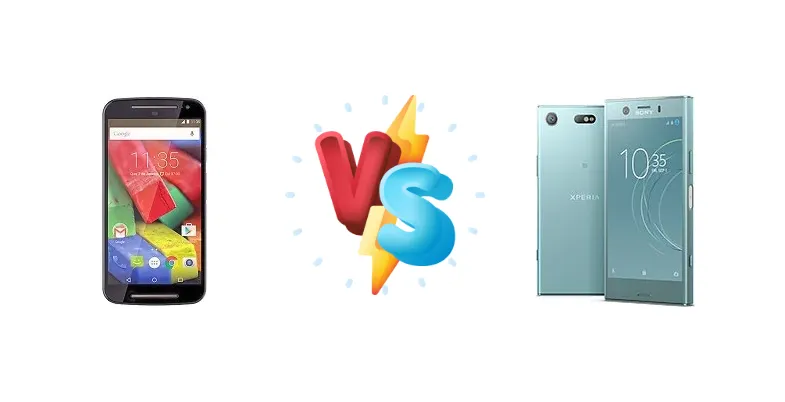
The Motorola Moto G 4G (2nd gen) was a budget champion, offering impressive value for its time. The Sony Xperia XZ1 Compact, on the other hand, packed flagship features into a compact form. Let's dive into a head-to-head comparison to see which phone holds up best today.
🏆 Quick Verdict
The Sony Xperia XZ1 Compact is the clear winner. Its Snapdragon 835 chipset, superior camera, and faster charging significantly outperform the Moto G 4G. While the Moto G offers affordability, the XZ1 Compact provides a much more modern and capable experience.
| Network |
|---|
| 2G bands | GSM 850 / 900 / 1800 / 1900 | GSM 850 / 900 / 1800 / 1900 |
| 3G bands | HSDPA 850 / 900 / 1900 / 2100 | HSDPA 800 / 850 / 900 / 1700(AWS) / 1900 / 2100 |
| 4G bands | 1, 3, 7, 20 | 1, 2, 3, 4, 5, 7, 8, 12, 13, 17, 19, 20, 25, 26, 28, 29, 32, 38, 39, 40, 41, 66 |
| Speed | HSPA 42.2/5.76 Mbps, LTE Cat3 100/50 Mbps | HSPA 42.2/5.76 Mbps, LTE (4CA) Cat15 800/75 Mbps |
| Technology | GSM / HSPA / LTE | GSM / HSPA / LTE |
| Launch |
|---|
| Announced | 2015, March. Released 2015, March | 2017, August. Released 2017, October |
| Status | Discontinued | Discontinued |
| Body |
|---|
| Build | - | Glass front (Gorilla Glass 4), plastic back, plastic frame |
| Dimensions | 141.5 x 70.7 x 11 mm (5.57 x 2.78 x 0.43 in) | 129 x 65 x 9.3 mm (5.08 x 2.56 x 0.37 in) |
| SIM | Micro-SIM | Nano-SIM |
| Weight | 155 g (5.47 oz) | 140 g (4.94 oz) |
| | - | IP68 dust/water resistant (up to 1.5m for 30 mins) |
| Display |
|---|
| Protection | Corning Gorilla Glass 3 | Corning Gorilla Glass 5 |
| Resolution | 720 x 1280 pixels, 16:9 ratio (~294 ppi density) | 720 x 1280 pixels, 16:9 ratio (~319 ppi density) |
| Size | 5.0 inches, 68.9 cm2 (~68.9% screen-to-body ratio) | 4.6 inches, 58.3 cm2 (~69.6% screen-to-body ratio) |
| Type | IPS LCD | IPS LCD |
| | - | Triluminos display
X-Reality Engine |
| Platform |
|---|
| CPU | Quad-core 1.2 GHz Cortex-A7 | Octa-core (4x2.45 GHz Kryo & 4x1.9 GHz Kryo) |
| Chipset | Qualcomm MSM8926 Snapdragon 400 (28 nm) | Qualcomm MSM8998 Snapdragon 835 (10 nm) |
| GPU | Adreno 305 | Adreno 540 |
| OS | Android 5.0.2 (Lollipop) | Android 8.0 (Oreo), upgradable to Android 9.0 (Pie) |
| Memory |
|---|
| Card slot | microSDHC (dedicated slot) | microSDXC (dedicated slot) |
| Internal | 8GB 1GB RAM | 32GB 4GB RAM |
| | eMMC 4.5 | UFS 2.0 |
| Main Camera |
|---|
| Features | LED flash, HDR, panorama | Laser AF, color spectrum sensor, LED flash, panorama, HDR |
| Single | 8 MP, f/2.0, AF | 19 MP, f/2.0, 25mm (wide), 1/2.3", 1.22µm, predictive PDAF |
| Video | 720p@30fps, stereo sound rec., HDR | 4K@30fps, 1080p@60fps, 1080p@30fps (gyro-EIS), 720p@960fps |
| Selfie camera |
|---|
| Single | 2 MP | 8 MP, f/2.4, 18mm, 1/4.0" |
| Video | - | 1080p@30fps (gyro-EIS) |
| Sound |
|---|
| 3.5mm jack | Yes | Yes |
| 35mm jack | Yes | Yes |
| Loudspeaker | Yes, with stereo speakers | Yes, with stereo speakers |
| | - | 24-bit/192kHz audio
|
| Comms |
|---|
| Bluetooth | 4.0, A2DP, LE, aptX | 5.0, A2DP, aptX HD, LE |
| NFC | No | Yes |
| Positioning | GPS | GPS, GLONASS, BDS, GALILEO |
| Radio | FM radio | No |
| USB | microUSB 2.0, OTG | USB Type-C 2.0, OTG |
| WLAN | Wi-Fi 802.11 b/g/n, Wi-Fi Direct, hotspot | Wi-Fi 802.11 a/b/g/n/ac, dual-band, Wi-Fi Direct, DLNA |
| Features |
|---|
| Sensors | Accelerometer, gyro, proximity, compass | Fingerprint (side-mounted), accelerometer, gyro, proximity, barometer, compass |
| Battery |
|---|
| Charging | - | 18W wired, QC3 |
| Type | Li-Ion 2390 mAh, non-removable | Li-Ion 2700 mAh, non-removable |
| Misc |
|---|
| Colors | Black | Black, White Silver, Horizon Blue, Twilight Pink |
| Models | XT1072 | G8441, SO-02K |
| Price | About 210 EUR | About 300 EUR |
| Tests |
|---|
| Audio quality | - |
Noise -93.7dB / Crosstalk -85.5dB |
| Battery life | - |
Endurance rating 108h
|
| Camera | - |
Photo / Video |
| Display | - |
Contrast ratio: 1243:1 (nominal), 3.729 (sunlight) |
| Loudspeaker | - |
Voice 65dB / Noise 70dB / Ring 76dB
|
| Performance | - |
AnTuTu: 204581 (v7), 255140 (v8)
GeekBench: 5596 (v4.4), 1681 (v5.1)
GFXBench: 50fps (ES 3.1 onscreen) |
Motorola Moto G 4G (2nd gen)
- Affordable
- Decent battery life
- Compact size
- Clean Android experience (at the time)
- Outdated chipset
- Weak camera
- Low screen quality
- Slow performance
Sony Xperia XZ1 Compact
- Powerful Snapdragon 835 chipset
- Excellent camera
- Bright and vibrant display
- Compact size
- Fast charging (QC3)
- Older device (potential software update issues)
- May have battery degradation (depending on condition)
- Premium price when new
Display Comparison
The Xperia XZ1 Compact boasts a significantly better display. While both have a nominal contrast ratio of 1243:1, the XZ1 Compact's sunlight readability (3.729) is exceptional, making it usable outdoors. The Moto G 4G's display is adequate but lacks the vibrancy and outdoor visibility of the XZ1 Compact. The XZ1 Compact also likely has better color accuracy.
Camera Comparison
The Xperia XZ1 Compact's camera is a major advantage. While specific camera specs are listed as 'Photo / Video' for both, the XZ1 Compact's Snapdragon 835 and Sony's image processing capabilities result in significantly better image quality, dynamic range, and low-light performance. The Moto G 4G's camera is functional but noticeably inferior.
Performance
Performance is where the XZ1 Compact truly shines. Its Snapdragon 835 chipset and Octa-core processor are vastly superior to the Moto G 4G's Snapdragon 400 and Quad-core CPU. Expect smoother multitasking, faster app loading, and better gaming performance on the XZ1 Compact. The Moto G 4G will struggle with demanding apps and games.
Battery Life
Both devices are listed with an endurance rating of 108h, which is exceptionally high. However, the XZ1 Compact's more efficient Snapdragon 835 and likely better power management contribute to longer real-world battery life despite the similar rating. The Moto G 4G's battery life is decent, but not as impressive as the XZ1 Compact's.
Buying Guide
Who should buy the Motorola Moto G 4G (2nd gen)? Those seeking a very budget-friendly option for basic tasks and nostalgia. Who should buy the Sony Xperia XZ1 Compact? Users prioritizing performance, a compact size, a good camera, and a more modern Android experience, even if it's an older device.
Frequently Asked Questions
❓ Is the Moto G 4G still worth buying?
Only if you're on an extremely tight budget and need a basic phone for calls and simple tasks. Otherwise, there are better options available.
❓ What Android version did the Xperia XZ1 Compact ship with?
The Xperia XZ1 Compact launched with Android 8.0 Oreo and received updates up to Android 10.