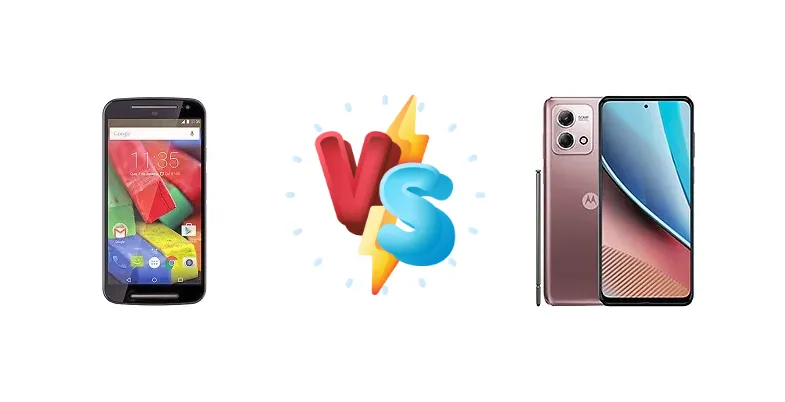
The Motorola Moto G series has long been a staple in the budget smartphone market. We're pitting two generations against each other: the classic Moto G 4G (2nd gen) and the more modern Moto G Stylus (2023). Can a decade of progress truly bridge the gap?
🏆 Quick Verdict
The Moto G Stylus (2023) is the clear winner. Its significantly faster processor, improved camera, larger display, and stylus functionality offer a vastly superior experience. While the Moto G 4G (2nd gen) holds nostalgic value, the Stylus provides modern features and performance at a competitive price.
| Network |
|---|
| 2G bands | GSM 850 / 900 / 1800 / 1900 | GSM 850 / 900 / 1800 / 1900 |
| 3G bands | HSDPA 850 / 900 / 1900 / 2100 | HSDPA 850 / 900 / 1700(AWS) / 1900 / 2100 |
| 4G bands | 1, 3, 7, 20 | 1, 2, 3, 4, 5, 7, 8, 12, 13, 14, 17, 25, 26, 29, 30, 38, 41, 66, 71 |
| Speed | HSPA 42.2/5.76 Mbps, LTE Cat3 100/50 Mbps | HSPA, LTE |
| Technology | GSM / HSPA / LTE | GSM / HSPA / LTE |
| Launch |
|---|
| Announced | 2015, March. Released 2015, March | 2023, May 02 |
| Status | Discontinued | Available. Released 2023, May 05 |
| Body |
|---|
| Build | - | Glass front, plastic frame, plastic back |
| Dimensions | 141.5 x 70.7 x 11 mm (5.57 x 2.78 x 0.43 in) | 162.9 x 74.1 x 9.2 mm (6.41 x 2.92 x 0.36 in) |
| SIM | Micro-SIM | Nano-SIM |
| Weight | 155 g (5.47 oz) | 195 g (6.88 oz) |
| | - | Stylus
Water-repellent design |
| Display |
|---|
| Protection | Corning Gorilla Glass 3 | - |
| Resolution | 720 x 1280 pixels, 16:9 ratio (~294 ppi density) | 720 x 1600 pixels, 20:9 ratio (~270 ppi density) |
| Size | 5.0 inches, 68.9 cm2 (~68.9% screen-to-body ratio) | 6.5 inches, 102.0 cm2 (~84.5% screen-to-body ratio) |
| Type | IPS LCD | IPS LCD, 90Hz |
| Platform |
|---|
| CPU | Quad-core 1.2 GHz Cortex-A7 | Octa-core (2x2.0 GHz Cortex-A75 & 6x1.8 GHz Cortex-A55) |
| Chipset | Qualcomm MSM8926 Snapdragon 400 (28 nm) | Mediatek MT6769 Helio G85 (12 nm) |
| GPU | Adreno 305 | Mali-G52 MC2 |
| OS | Android 5.0.2 (Lollipop) | Android 13, planned upgrade to Android 14 |
| Memory |
|---|
| Card slot | microSDHC (dedicated slot) | microSDXC (dedicated slot) |
| Internal | 8GB 1GB RAM | 64GB 4GB RAM |
| | eMMC 4.5 | - |
| Main Camera |
|---|
| Dual | - | 50 MP, f/1.8, (wide), 0.64µm, PDAF
2 MP (macro) |
| Features | LED flash, HDR, panorama | LED flash, HDR, panorama |
| Single | 8 MP, f/2.0, AF | - |
| Triple | - | 50 MP, f/1.8, (wide), 0.64µm, PDAF
2 MP, f/2.4, (macro) |
| Video | 720p@30fps, stereo sound rec., HDR | 1080p@30/60fps |
| Selfie camera |
|---|
| Features | - | HDR |
| Single | 2 MP | 8 MP, f/2.0, (wide), 1/4.0", 1.12µm |
| Video | - | 1080p@30fps |
| Sound |
|---|
| 3.5mm jack | Yes | Yes |
| 35mm jack | Yes | Yes |
| Loudspeaker | Yes, with stereo speakers | Yes, with stereo speakers |
| Comms |
|---|
| Bluetooth | 4.0, A2DP, LE, aptX | 5.0, A2DP, LE |
| NFC | No | No |
| Positioning | GPS | GPS, GLONASS, GALILEO |
| Radio | FM radio | No |
| USB | microUSB 2.0, OTG | USB Type-C 2.0 |
| WLAN | Wi-Fi 802.11 b/g/n, Wi-Fi Direct, hotspot | Wi-Fi 802.11 a/b/g/n/ac, dual-band, Wi-Fi Direct |
| Features |
|---|
| Sensors | Accelerometer, gyro, proximity, compass | Fingerprint (side-mounted), accelerometer, gyro, proximity, compass, barometer |
| Battery |
|---|
| Charging | - | 15W wired |
| Type | Li-Ion 2390 mAh, non-removable | Li-Po 5000 mAh |
| Misc |
|---|
| Colors | Black | Blue, Rose Gold |
| Models | XT1072 | - |
| Price | About 210 EUR | About 200 EUR |
Motorola Moto G 4G (2nd gen)
- Affordable
- Compact size
- Decent call quality
- Outdated processor
- Low-resolution display
- Poor camera quality
- Short battery life
Motorola Moto G Stylus (2023)
- Large display
- Stylus included
- Improved performance
- Good battery life
- Better camera
- Larger size may not suit everyone
- 15W charging is relatively slow
Display Comparison
The Moto G Stylus (2023) boasts a much larger 6.6-inch display compared to the Moto G 4G's 5-inch screen. The Stylus also features a higher resolution (1080 x 2400) and likely better color accuracy, offering a more immersive viewing experience. The older model's display is adequate for basic tasks but lacks the vibrancy and detail of its successor.
Camera Comparison
The Moto G Stylus (2023) features a significantly improved camera system, likely with higher resolution sensors and more advanced image processing. While specific megapixel counts vary, the Stylus generally offers better image quality, especially in low-light conditions. The Moto G 4G's camera is functional but produces noticeably inferior results.
Performance
Performance is where the difference is most striking. The Moto G Stylus (2023)'s Octa-core Helio G85 chipset and Cortex-A75 cores provide a substantial performance boost over the Moto G 4G's Quad-core Cortex-A7 processor. Expect smoother multitasking, faster app loading, and better gaming performance on the Stylus.
Battery Life
The Moto G Stylus (2023) typically includes a larger battery capacity (around 5000mAh) compared to the Moto G 4G (around 2470mAh), resulting in significantly longer battery life. Expect the Stylus to easily last a full day of moderate use, while the Moto G 4G may require more frequent charging.
Buying Guide
The Moto G 4G (2nd gen) is best suited for users seeking a basic, ultra-budget phone for calls, texts, and very light usage. The Moto G Stylus (2023) is ideal for students, note-takers, or anyone who wants a capable smartphone with a stylus, decent camera, and longer battery life without breaking the bank.
Frequently Asked Questions
❓ Is the Moto G 4G still usable in 2023?
Yes, it can still handle basic tasks like calls and texts, but its performance is severely limited compared to modern smartphones. Software updates are likely discontinued.
❓ Does the Moto G Stylus (2023) have 5G?
No, the 2023 Moto G Stylus is a 4G LTE device. There are other Moto G Stylus models with 5G connectivity.