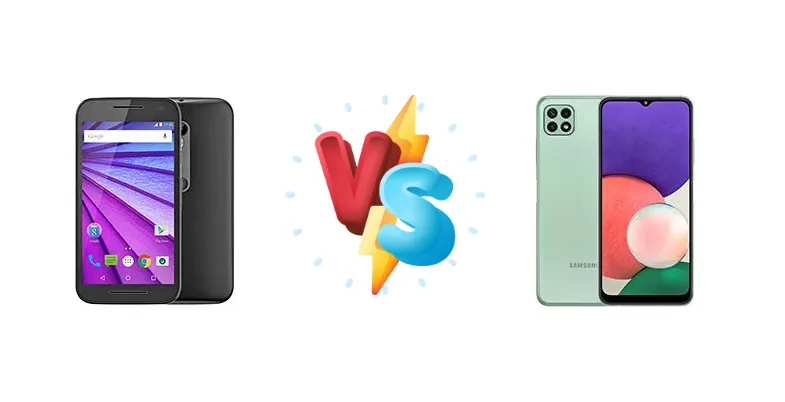
The budget smartphone market is fiercely competitive, offering incredible value for your money. Today, we're pitting two popular contenders against each other: the classic Motorola Moto G (3rd gen) and the newer Samsung Galaxy A22 5G. Let's dive into a detailed comparison to see which phone reigns supreme.
🏆 Quick Verdict
The Samsung Galaxy A22 5G is the clear winner. Its superior performance thanks to the Dimensity 700 chipset, brighter display, and significantly longer battery life outweigh the Moto G's impressive sunlight readability. It's a modern upgrade with 5G connectivity.
| Network |
|---|
| 2G bands | GSM 850 / 900 / 1800 / 1900 | GSM 850 / 900 / 1800 / 1900 |
| 3G bands | HSDPA 900 / 2100 - XT1541 | HSDPA 850 / 900 / 1900 / 2100 |
| 4G bands | 1, 3, 7, 8, 20 - XT1541 | 1, 2, 3, 5, 7, 8, 20, 28, 38, 40, 41 |
| 5G bands | - | 1, 3, 5, 7, 8, 20, 28, 38, 40, 41, 78, 79 SA/NSA/Sub6 |
| Speed | HSPA 42.2/5.76 Mbps, LTE Cat4 150/50 Mbps | HSPA, LTE, 5G |
| Technology | GSM / CDMA / HSPA / LTE | GSM / HSPA / LTE / 5G |
| | 2, 4, 5, 12, 17, 25, 26, 41 - XT1548 | - |
| Launch |
|---|
| Announced | 2015, July. Released 2015, July | 2021, June 03 |
| Status | Discontinued | Available. Released 2021, June 24 |
| Body |
|---|
| Build | Glass front (Gorilla Glass 3), plastic back, plastic frame | Glass front, plastic frame, plastic back |
| Dimensions | 142.1 x 72.4 x 11.6 mm (5.59 x 2.85 x 0.46 in) | 167.2 x 76.4 x 9 mm (6.58 x 3.01 x 0.35 in) |
| SIM | Micro-SIM | · Nano-SIM· Nano-SIM + Nano-SIM |
| Weight | 155 g (5.47 oz) | 203 g (7.16 oz) |
| | IPX7 water resistant up to 1 meter and 30 minutes | - |
| Display |
|---|
| Protection | Corning Gorilla Glass 3 | - |
| Resolution | 720 x 1280 pixels, 16:9 ratio (~294 ppi density) | 1080 x 2400 pixels, 20:9 ratio (~399 ppi density) |
| Size | 5.0 inches, 68.9 cm2 (~67.0% screen-to-body ratio) | 6.6 inches, 105.2 cm2 (~82.3% screen-to-body ratio) |
| Type | IPS LCD | TFT LCD, 90Hz |
| Platform |
|---|
| CPU | Quad-core 1.4 GHz Cortex-A53 | Octa-core (2x2.2 GHz Cortex-A76 & 6x2.0 GHz Cortex-A55) |
| Chipset | Qualcomm MSM8916 Snapdragon 410 (28 nm) | Mediatek Dimensity 700 (7 nm) |
| GPU | Adreno 306 | Mali-G57 MC2 |
| OS | Android 5.1.1 (Lollipop), upgradable to 6.0 (Marshmallow) | Android 11, upgradable to Android 13, One UI core 5 |
| Memory |
|---|
| Card slot | microSDHC (dedicated slot) | microSDXC (dedicated slot) |
| Internal | 8GB 1GB RAM, 16GB 2GB RAM | 64GB 4GB RAM, 128GB 4GB RAM, 128GB 6GB RAM, 128GB 8GB RAM |
| | eMMC 4.5 | - |
| Main Camera |
|---|
| Features | Dual-LED dual-tone flash, panorama | LED flash, panorama, HDR |
| Single | 13 MP, f/2.0, AF | 8 MP, f/2.0, (wide) |
| Triple | - | 48 MP, f/1.8, (wide), PDAF
5 MP, f/2.2, 115˚ (ultrawide), 1/5.0", 1.12µm
Auxiliary lens |
| Video | 1080p@30fps, HDR | 1152p@30fps |
| Selfie camera |
|---|
| Features | HDR | - |
| Single | 5 MP, f/2.2 | 8 MP, f/2.0, (wide) |
| Video | - | 1080p@30fps |
| Sound |
|---|
| 3.5mm jack | Yes | Yes |
| 35mm jack | Yes | Yes |
| Loudspeaker | Yes | Yes |
| Comms |
|---|
| Bluetooth | 4.0, A2DP, LE, aptX | 5.0, A2DP, LE |
| NFC | No | Yes (market/region dependent) |
| Positioning | GPS, GLONASS, BDS | GPS, GLONASS, GALILEO, BDS |
| Radio | FM radio | FM radio |
| USB | microUSB 2.0, OTG | USB Type-C 2.0 |
| WLAN | Wi-Fi 802.11 b/g/n, hotspot | Wi-Fi 802.11 a/b/g/n/ac, dual-band, Wi-Fi Direct |
| Features |
|---|
| Sensors | Accelerometer, proximity | Fingerprint (side-mounted), accelerometer, gyro, proximity, compass |
| Battery |
|---|
| Charging | - | 15W wired |
| Type | Li-Ion 2470 mAh, non-removable | Li-Po 5000 mAh |
| Misc |
|---|
| Colors | Black, White | Gray, White, Mint, Violet |
| Models | XT1541, XT1540, XT1548, Moto G3 | SM-A226B, SM-A226B/DS, SM-A226B/DSN, SM-A226BR, SM-A226BR/N, SM-A226L, SC-56B |
| Price | About 170 EUR | £ 92.00 / € 125.99 |
| SAR | 1.06 W/kg (head) 1.13 W/kg (body) | - |
| SAR EU | 0.68 W/kg (head) 0.60 W/kg (body) | 0.73 W/kg (head) 1.23 W/kg (body) |
| Tests |
|---|
| Audio quality |
Noise -91.5dB / Crosstalk -92.6dB | - |
| Battery life |
Endurance rating 76h
|
Endurance rating 118h
|
| Camera |
Photo / Video |
Photo / Video |
| Display |
Contrast ratio: 1009:1 (nominal), 2.026 (sunlight) |
Contrast ratio: 1631:1 (nominal) |
| Loudspeaker |
Voice 75dB / Noise 69dB / Ring 75dB
|
-28.5 LUFS (Average)
|
| Performance |
Basemark X: 1866 |
AnTuTu: 242155 (v8), 223188 (v9)
GeekBench: 6913 (v4.4), 1719 (v5.1)
GFXBench: 12fps (ES 3.1 onscreen) |
Motorola Moto G (3rd gen)
- Significantly better performance
- Brighter and higher contrast display
- Longer battery life
- 5G Connectivity
- Likely better camera system
- Potentially slightly higher price
Samsung Galaxy A22 5G
- Excellent sunlight readability
- Impressive battery endurance (though less than A22)
- Classic Motorola design
- Outdated chipset
- Lower display brightness
- Less versatile camera
- No 5G
Display Comparison
The Samsung Galaxy A22 5G boasts a significantly better display. While the Moto G 3rd gen has a respectable 1009:1 contrast ratio and excellent sunlight readability (2.026), the A22 5G’s 1631:1 contrast ratio and 385 nits of brightness offer a more vibrant and enjoyable viewing experience. The A22 5G likely has a higher resolution as well, contributing to sharper visuals.
Camera Comparison
Both phones offer 'Photo / Video' capabilities, but the Galaxy A22 5G likely has a more advanced camera system. While specific megapixel counts are missing, Samsung generally provides better image processing and features. The A22 5G likely has a more versatile camera setup with multiple lenses (wide, ultrawide, macro) compared to the Moto G's likely single lens.
Performance
Performance is where the Galaxy A22 5G truly shines. Its Mediatek Dimensity 700 chipset (7nm) and Octa-core CPU are a substantial upgrade over the Moto G’s Qualcomm Snapdragon 410 (28nm) and Quad-core CPU. Expect noticeably faster app loading, smoother multitasking, and better gaming performance on the A22 5G. The A22 5G's newer architecture also offers improved power efficiency.
Battery Life
The Galaxy A22 5G takes the lead in battery life, boasting an endurance rating of 118h compared to the Moto G 3rd gen's 76h. This translates to significantly longer usage between charges, making the A22 5G a more reliable choice for heavy users.
Buying Guide
The Motorola Moto G (3rd gen) is a good choice for users prioritizing extreme battery life and excellent sunlight visibility on a very tight budget. The Samsung Galaxy A22 5G is ideal for those seeking a smoother experience, 5G connectivity, a brighter display, and a more modern feature set, even at a slightly higher price point.
Frequently Asked Questions
❓ Is the Moto G 3rd gen still worth buying?
If you're on an extremely tight budget and prioritize sunlight readability and long battery life, the Moto G 3rd gen can still be a viable option. However, the Galaxy A22 5G offers a much more modern and capable experience.
❓ Does the Galaxy A22 5G support 5G?
Yes, as the name suggests, the Samsung Galaxy A22 5G supports 5G connectivity, offering faster download and upload speeds where available.