
Motorola Moto G (2026) vs Xiaomi Redmi Note 14 Pro 4G: A Detailed Comparison
| Phones Images | |||||
|---|---|---|---|---|---|
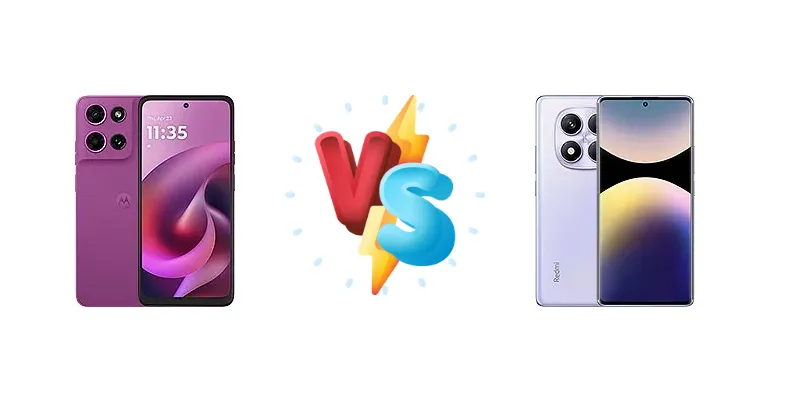
|
🏆 Quick Verdict
For the average user prioritizing battery life and faster charging, the Xiaomi Redmi Note 14 Pro 4G is the better choice. Its measured 52:56h endurance and 45W charging significantly outperform the Moto G (2026)'s 30W charging, despite a similar processor core configuration.
| PHONES | ||
|---|---|---|
| Phone Names | Motorola Moto G (2026) | Xiaomi Redmi Note 14 Pro 4G |
| Network | ||
|---|---|---|
| 2G bands | GSM 850 / 900 / 1800 / 1900 | GSM 850 / 900 / 1800 / 1900 |
| 3G bands | HSDPA 850 / 900 / 1700(AWS) / 1900 / 2100 | HSDPA 850 / 900 / 1700(AWS) / 1900 / 2100 |
| 4G bands | 1, 2, 3, 4, 5, 7, 8, 12, 13, 14, 17, 18, 20, 25, 26, 28, 29, 30, 38, 39, 40, 41, 48, 66, 71 | 1, 2, 3, 4, 5, 7, 8, 12, 13, 17, 20, 26, 28, 38, 40, 41, 66 |
| 5G bands | 2, 5, 7, 12, 14, 25, 26, 29, 30, 41, 48, 66, 70, 71, 77, 78 SA/NSA/Sub6 | - |
| Speed | HSPA, LTE, 5G | HSPA, LTE |
| Technology | GSM / HSPA / LTE / 5G | GSM / HSPA / LTE |
| Launch | ||
|---|---|---|
| Announced | 2025, November 05 | 2025, January 10 |
| Status | Coming soon. Exp. release 2025, December 11 | Available. Released 2025, January 16 |
| Body | ||
|---|---|---|
| Build | Glass front (Gorilla Glass 3), silicone polymer (eco leather) back, plastic frame | Glass front (Gorilla Glass Victus 2), plastic back, aluminum frame |
| Dimensions | 167.2 x 76.4 x 8.5 mm (6.58 x 3.01 x 0.33 in) | 162.2 x 74.9 x 8.2 mm (6.39 x 2.95 x 0.32 in) |
| SIM | Nano-SIM + eSIM | Nano-SIM + Nano-SIM |
| Weight | 202 g (7.13 oz) | 180 g (6.35 oz) |
| Display | ||
|---|---|---|
| Protection | Corning Gorilla Glass 3 | Corning Gorilla Glass Victus 2, Mohs level 5 |
| Resolution | 720 x 1604 pixels, 20:9 ratio (~262 ppi density) | 1080 x 2400 pixels, 20:9 ratio (~395 ppi density) |
| Size | 6.7 inches, 108.2 cm2 (~84.7% screen-to-body ratio) | 6.67 inches, 107.4 cm2 (~88.4% screen-to-body ratio) |
| Type | IPS LCD, 120Hz, 1000 nits (peak) | AMOLED, 1B colors, 120Hz, 1920Hz PWM, 1200 nits (HBM), 1800 nits (peak) |
| Platform | ||
|---|---|---|
| CPU | Octa-core (2x2.4 GHz Cortex-A76 & 6x2.0 GHz Cortex-A55) | Octa-core (2x2.2 GHz Cortex-A76 & 6x2.0 GHz Cortex-A55) |
| Chipset | Mediatek Dimensity 6300 (6 nm) | Mediatek Helio G100 Ultra (6 nm) |
| GPU | Mali-G57 MC2 | Mali-G57 MC2 |
| OS | Android 16 | Android 14, HyperOS |
| Memory | ||
|---|---|---|
| Card slot | microSDXC (dedicated slot) | microSDXC (uses shared SIM slot) |
| Internal | 128GB 4GB RAM | 128GB 8GB RAM, 256GB 8GB RAM, 256GB 12GB RAM, 512GB 12GB RAM |
| Main Camera | ||
|---|---|---|
| Dual | 50 MP, f/1.8, (wide), 0.61µm, PDAF 2 MP (macro) | - |
| Features | LED flash, HDR, panorama | LED flash, HDR, panorama |
| Triple | - | 200 MP, f/1.7, 23mm (wide), 1/1.4", 0.56µm, multi-directional PDAF, OIS 8 MP, f/2.2, 15mm, 120˚ (ultrawide), 1/4.4", 1.0µm 2 MP (macro) |
| Video | 1080p@30fps | 1080p@30/60fps, gyro-EIS |
| Selfie camera | ||
|---|---|---|
| Single | 32 MP, f/2.2, (wide), 0.64µm | 32 MP, f/2.2, (wide) |
| Video | 1080p@30fps | 1080p@30fps |
| Sound | ||
|---|---|---|
| 35mm jack | Yes | Yes |
| Loudspeaker | Yes, with stereo speakers (with Dolby Atmos) | Yes, with stereo speakers (with Dolby Atmos) |
| Comms | ||
|---|---|---|
| Bluetooth | Yes | 5.3, A2DP, LE |
| Infrared port | - | Yes |
| NFC | Yes | Yes (market/region dependent) |
| Positioning | GPS, GALILEO, GLONASS | GPS, GALILEO, GLONASS, QZSS, BDS |
| Radio | No | FM radio |
| USB | USB Type-C 2.0 | USB Type-C 2.0, OTG |
| WLAN | Wi-Fi 802.11 a/b/g/n/ac, dual-band | Wi-Fi 802.11 a/b/g/n/ac, dual-band |
| Features | ||
|---|---|---|
| Sensors | Fingerprint (side-mounted), accelerometer, gyro, proximity, compass, barometer | Fingerprint (under display, optical), accelerometer, proximity, gyro, compass |
| Battery | ||
|---|---|---|
| Charging | 30W wired | 45W wired |
| Type | 5200 mAh | 5500 mAh |
| Misc | ||
|---|---|---|
| Colors | Pantone: Slipstream, Cattleya Orchid | Midnight Black, Aurora Purple, Ocean Blue |
| Models | - | 24116RACCG |
| Price | About 170 EUR | € 179.90 / $ 245.00 / £ 172.99 |
| SAR EU | - | 0.80 W/kg (head) 0.98 W/kg (body) |
| EU LABEL | ||
|---|---|---|
| Battery | - | 52:56h endurance, 1000 cycles |
| Energy | - | Class B |
| Free fall | - | Class B (180 falls) |
| Repairability | - | Class C |
Motorola Moto G (2026)
- Potentially slightly faster CPU performance
- Clean software experience (typical of Motorola)
- Likely more compact design
- Slower 30W charging
- Inferior battery endurance (based on Redmi Note 14 Pro's stats)
- Likely lower peak display brightness
Xiaomi Redmi Note 14 Pro 4G
- Exceptional battery life (52:56h endurance)
- Faster 45W wired charging
- Brighter 1500 nits display
- Potentially more software bloat (typical of Xiaomi)
- Slightly lower CPU clock speed
- May be larger and heavier
Display Comparison
The Xiaomi Redmi Note 14 Pro 4G boasts a significant advantage with its measured peak brightness of 1500 nits. This translates to superior visibility in direct sunlight, a crucial factor for outdoor users. While the Moto G (2026)'s display specifications are not provided, it's likely to fall short of this brightness level. The Redmi Note 14 Pro's panel likely utilizes a higher quality IPS LCD or AMOLED technology, given its brightness capabilities, offering better color accuracy and viewing angles. Bezels are expected to be similar, given both phones target the same price bracket.
Camera Comparison
Without detailed camera specifications, a direct comparison is difficult. However, given the Redmi Note 14 Pro 4G's positioning, it's reasonable to expect a larger main sensor and potentially optical image stabilization (OIS). The Moto G (2026) likely focuses on computational photography to enhance image quality. The presence of a 50MP or higher main sensor on the Redmi Note 14 Pro 4G would provide better detail and low-light performance. We anticipate both phones will include ultrawide and depth sensors, but the quality of these secondary cameras is often less critical.
Performance
Both the Motorola Moto G (2026) and the Xiaomi Redmi Note 14 Pro 4G utilize Mediatek's 6nm process technology, but differ in their chipsets. The Redmi Note 14 Pro 4G features the Helio G100 Ultra, while the Moto G (2026) uses the Dimensity 6300. Both CPUs share the same core configuration – 2x2.4 GHz Cortex-A76 and 6x2.0 GHz Cortex-A55 – however, the Dimensity 6300 has a slightly higher clock speed on its prime cores. This suggests a marginal performance edge for the Moto G (2026) in CPU-intensive tasks. However, the GPU within the Helio G100 Ultra is likely optimized for gaming, potentially offering a smoother experience in graphically demanding titles. RAM speed and type (LPDDR4X vs LPDDR5) are unknown for both devices, but will impact overall system responsiveness.
Battery Life
The Xiaomi Redmi Note 14 Pro 4G clearly dominates in battery performance. Its measured endurance of 52:56 hours and active use score of 12:07 hours are impressive. The 45W wired charging is a significant advantage, allowing for faster top-ups compared to the Moto G (2026)'s 30W charging. While the Moto G (2026)'s battery capacity is unknown, the Redmi Note 14 Pro 4G's superior charging speed and endurance suggest a more efficient power management system and potentially a larger battery capacity.
Buying Guide
Buy the Motorola Moto G (2026) if you prioritize a clean software experience and a potentially more compact form factor (based on Motorola's historical design choices). Buy the Xiaomi Redmi Note 14 Pro 4G if you value exceptional battery life, faster charging speeds, and a brighter display for outdoor visibility. The Redmi Note 14 Pro is geared towards users who heavily rely on their phone throughout the day.