
Motorola Moto G (2026) vs vivo V30e: A Deep Dive into Mid-Range Performance
| Phones Images | |||||
|---|---|---|---|---|---|
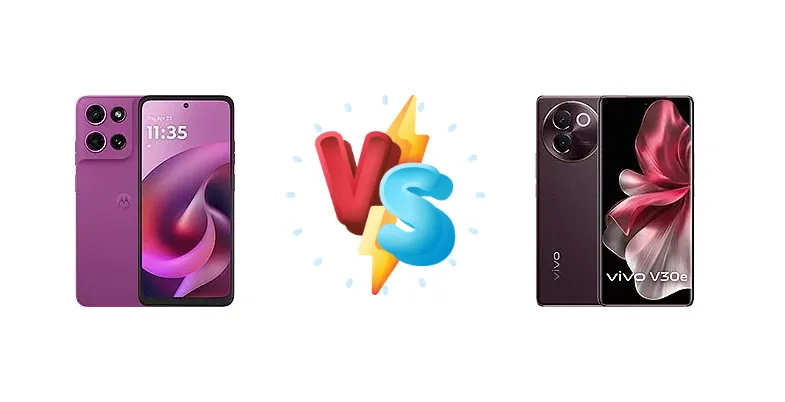
|
🏆 Quick Verdict
For the average user prioritizing efficiency and faster charging, the vivo V30e is the stronger contender. Its Snapdragon 6 Gen 1, built on a 4nm process, offers better power efficiency and potentially sustained performance compared to the Moto G (2026)'s Dimensity 6300. The 44W charging with Power Delivery is a significant advantage.
| PHONES | ||
|---|---|---|
| Phone Names | Motorola Moto G (2026) | vivo V30e |
| Network | ||
|---|---|---|
| 2G bands | GSM 850 / 900 / 1800 / 1900 | GSM 850 / 900 / 1800 / 1900 |
| 3G bands | HSDPA 850 / 900 / 1700(AWS) / 1900 / 2100 | HSDPA 850 / 900 / 1700(AWS) / 1900 / 2100 - Malaysia |
| 4G bands | 1, 2, 3, 4, 5, 7, 8, 12, 13, 14, 17, 18, 20, 25, 26, 28, 29, 30, 38, 39, 40, 41, 48, 66, 71 | 1, 2, 3, 4, 5, 7, 8, 18, 19, 20, 26, 28, 38, 39, 40, 41 - Malaysia |
| 5G bands | 2, 5, 7, 12, 14, 25, 26, 29, 30, 41, 48, 66, 70, 71, 77, 78 SA/NSA/Sub6 | 1, 3, 5, 7, 8, 20, 28, 38, 40, 41, 77, 78 SA/NSA - Malaysia |
| Speed | HSPA, LTE, 5G | HSPA, LTE, 5G |
| Technology | GSM / HSPA / LTE / 5G | GSM / HSPA / LTE / 5G |
| Launch | ||
|---|---|---|
| Announced | 2025, November 05 | 2024, May 02 |
| Status | Coming soon. Exp. release 2025, December 11 | Available. Released 2024, May 09 |
| Body | ||
|---|---|---|
| Build | Glass front (Gorilla Glass 3), silicone polymer (eco leather) back, plastic frame | Glass front, plastic frame, glass back or plastic back |
| Dimensions | 167.2 x 76.4 x 8.5 mm (6.58 x 3.01 x 0.33 in) | 164.4 x 74.8 x 7.7 mm (6.47 x 2.94 x 0.30 in) |
| SIM | Nano-SIM + eSIM | Nano-SIM + Nano-SIM |
| Weight | 202 g (7.13 oz) | 179 g or 188 g (6.31 oz) |
| Display | ||
|---|---|---|
| Protection | Corning Gorilla Glass 3 | Schott Xensation |
| Resolution | 720 x 1604 pixels, 20:9 ratio (~262 ppi density) | 1080 x 2400 pixels, 20:9 ratio (~388 ppi density) |
| Size | 6.7 inches, 108.2 cm2 (~84.7% screen-to-body ratio) | 6.78 inches, 111.0 cm2 (~90.3% screen-to-body ratio) |
| Type | IPS LCD, 120Hz, 1000 nits (peak) | AMOLED, 1B colors, 120Hz, 1300 nits (peak) |
| Platform | ||
|---|---|---|
| CPU | Octa-core (2x2.4 GHz Cortex-A76 & 6x2.0 GHz Cortex-A55) | Octa-core (4x2.2 GHz Cortex-A78 & 4x1.8 GHz Cortex-A55) |
| Chipset | Mediatek Dimensity 6300 (6 nm) | Qualcomm SM6450 Snapdragon 6 Gen 1 (4 nm) |
| GPU | Mali-G57 MC2 | Adreno 710 |
| OS | Android 16 | Android 14, Funtouch 14 |
| Memory | ||
|---|---|---|
| Card slot | microSDXC (dedicated slot) | microSDXC (uses shared SIM slot) |
| Internal | 128GB 4GB RAM | 128GB 8GB RAM, 256GB 8GB RAM, 256GB 12GB RAM |
| Main Camera | ||
|---|---|---|
| Dual | 50 MP, f/1.8, (wide), 0.61µm, PDAF 2 MP (macro) | 50 MP, f/1.8, 26mm (wide), 1/1.95", 0.8µm, PDAF, OIS (India only) 8 MP, f/2.2, 120˚ (ultrawide), 1/4.0", 1.12µm |
| Features | LED flash, HDR, panorama | Ring-LED flash, panorama, HDR |
| Video | 1080p@30fps | 4K@30fps, 1080p@30fps |
| Selfie camera | ||
|---|---|---|
| Single | 32 MP, f/2.2, (wide), 0.64µm | 50 MP, f/2.5, 25mm (wide), AF - India 32 MP, f/2.0, 24mm (wide) - Malaysia |
| Video | 1080p@30fps | 4K@30fps (India only), 1080p@30fps |
| Sound | ||
|---|---|---|
| 35mm jack | Yes | No |
| Loudspeaker | Yes, with stereo speakers (with Dolby Atmos) | Yes |
| Comms | ||
|---|---|---|
| Bluetooth | Yes | 5.1, A2DP, LE |
| NFC | Yes | Yes (market/region dependent) |
| Positioning | GPS, GALILEO, GLONASS | GPS, GLONASS, GALILEO, BDS, QZSS, NavIC |
| Radio | No | No |
| USB | USB Type-C 2.0 | USB Type-C 2.0, OTG |
| WLAN | Wi-Fi 802.11 a/b/g/n/ac, dual-band | Wi-Fi 802.11 a/b/g/n/ac, dual-band |
| Features | ||
|---|---|---|
| Sensors | Fingerprint (side-mounted), accelerometer, gyro, proximity, compass, barometer | Fingerprint (under display, optical), accelerometer, gyro, proximity, compass |
| Battery | ||
|---|---|---|
| Charging | 30W wired | 44W wired, PD Reverse wired |
| Type | 5200 mAh | Li-Ion 5500 mAh |
| Misc | ||
|---|---|---|
| Colors | Pantone: Slipstream, Cattleya Orchid | Velvet Red (Coco Brown), Silk Blue, Sky Mirror |
| Models | - | V2339 |
| Price | About 170 EUR | ₹ 23,999 |
Motorola Moto G (2026)
- Potentially lower price point
- Familiar Motorola software experience
- Decent performance for everyday tasks
- Less efficient chipset (6nm)
- Slower charging speed (30W)
- No reverse charging
vivo V30e
- More efficient chipset (4nm)
- Faster charging speed (44W with PD)
- Reverse wired charging capability
- Potentially higher price
- vivo’s Funtouch OS may not appeal to all users
- Performance gains may not be noticeable for basic tasks
Display Comparison
Display specifications are currently unavailable for both devices. However, given the market segment, we anticipate both will feature LCD or AMOLED panels with FHD+ resolution. The V30e, benefiting from vivo’s display expertise, may offer slightly better color accuracy and brightness. Bezels are likely to be comparable, focusing on maximizing screen real estate within the budget constraints.
Camera Comparison
Camera details are limited. Assuming both phones follow typical mid-range trends, the vivo V30e may have a slight edge due to Qualcomm’s image signal processor (ISP) capabilities within the Snapdragon 6 Gen 1. The ISP is crucial for image processing, noise reduction, and dynamic range. Without specific sensor details, it’s difficult to make a definitive judgment, but vivo’s history suggests a focus on computational photography, potentially resulting in more pleasing images in challenging lighting conditions. We expect both phones to include a primary camera, ultrawide, and potentially a depth or macro sensor, but the quality will heavily depend on the sensor size and aperture.
Performance
The core difference lies in the chipsets. The vivo V30e’s Qualcomm Snapdragon 6 Gen 1 (4nm) boasts a more modern architecture and fabrication process than the Motorola Moto G (2026)’s MediaTek Dimensity 6300 (6nm). The Snapdragon utilizes 4x Cortex-A78 cores clocked at 2.2 GHz, offering a performance advantage over the Moto G’s 2x Cortex-A76 cores at 2.4 GHz. While the Moto G’s cores have a slightly higher clock speed, the A78 architecture is more efficient and delivers better performance per clock cycle. The 4nm process of the Snapdragon further enhances efficiency, leading to less heat generation and potentially reduced throttling during demanding tasks. The V30e is likely to offer a smoother experience in graphically intensive games and multitasking.
Battery Life
The vivo V30e’s 44W wired charging with Power Delivery (PD) is a clear advantage over the Motorola Moto G (2026)’s 30W charging. This translates to significantly faster charging times – potentially reaching 50% charge in under 30 minutes compared to the Moto G’s longer timeframe. The inclusion of reverse wired charging on the V30e is a valuable feature for users who need to top up accessories or share power with friends. While battery capacity isn’t specified, the Snapdragon 6 Gen 1’s superior efficiency should result in comparable or even better battery life on the V30e despite potentially having a similar capacity to the Moto G.
Buying Guide
Buy the Motorola Moto G (2026) if you prioritize a potentially lower price point and a familiar Motorola software experience. It's a solid all-rounder for everyday tasks. Buy the vivo V30e if you value faster charging speeds, a more efficient processor for sustained workloads, and the convenience of reverse wired charging – making it ideal for users who frequently share power with friends or accessories.