
Moto G (2026) vs Samsung Galaxy A55: Which Mid-Range Phone Reigns Supreme?
| Phones Images | |||||
|---|---|---|---|---|---|
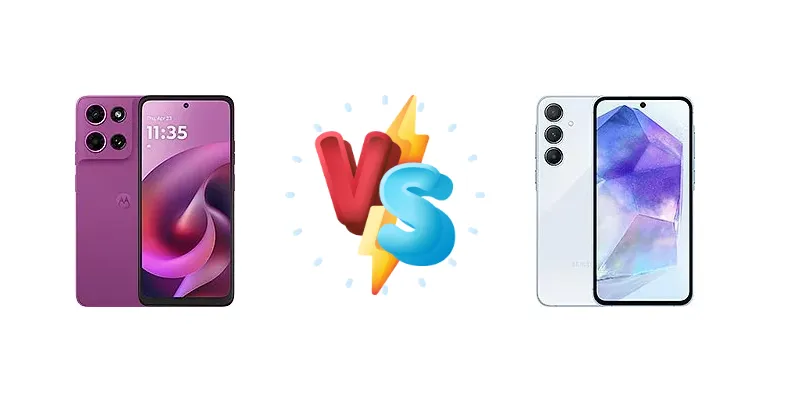
|
🏆 Quick Verdict
For the average user prioritizing sustained performance and a brighter display, the Samsung Galaxy A55 emerges as the winner. Its Exynos 1480, built on a 4nm process, delivers a noticeable performance edge and better thermal management, while the 1010 nit display provides superior outdoor visibility. However, the Moto G (2026) remains a compelling option for budget-conscious buyers.
| PHONES | ||
|---|---|---|
| Phone Names | Motorola Moto G (2026) | Samsung Galaxy A55 |
| Network | ||
|---|---|---|
| 2G bands | GSM 850 / 900 / 1800 / 1900 | GSM 850 / 900 / 1800 / 1900 |
| 3G bands | HSDPA 850 / 900 / 1700(AWS) / 1900 / 2100 | HSDPA 850 / 900 / 1700(AWS) / 1900 / 2100 |
| 4G bands | 1, 2, 3, 4, 5, 7, 8, 12, 13, 14, 17, 18, 20, 25, 26, 28, 29, 30, 38, 39, 40, 41, 48, 66, 71 | 1, 2, 3, 4, 5, 7, 8, 12, 17, 20, 25, 26, 28, 32, 38, 40, 41, 66 |
| 5G bands | 2, 5, 7, 12, 14, 25, 26, 29, 30, 41, 48, 66, 70, 71, 77, 78 SA/NSA/Sub6 | 1, 3, 5, 7, 8, 20, 28, 38, 40, 41, 66, 77, 78 SA/NSA/Sub6 |
| Speed | HSPA, LTE, 5G | HSPA, LTE, 5G |
| Technology | GSM / HSPA / LTE / 5G | GSM / HSPA / LTE / 5G |
| Launch | ||
|---|---|---|
| Announced | 2025, November 05 | 2024, March 11 |
| Status | Coming soon. Exp. release 2025, December 11 | Available. Released 2024, March 15 |
| Body | ||
|---|---|---|
| Build | Glass front (Gorilla Glass 3), silicone polymer (eco leather) back, plastic frame | Glass front (Gorilla Glass Victus+), glass back (Gorilla Glass), aluminum frame |
| Dimensions | 167.2 x 76.4 x 8.5 mm (6.58 x 3.01 x 0.33 in) | 161.1 x 77.4 x 8.2 mm (6.34 x 3.05 x 0.32 in) |
| SIM | Nano-SIM + eSIM | · Nano-SIM· Nano-SIM + eSIM· Nano-SIM + Nano-SIM· Nano-SIM + Nano-SIM + eSIM (max 2 at a time) |
| Weight | 202 g (7.13 oz) | 213 g (7.51 oz) |
| Display | ||
|---|---|---|
| Protection | Corning Gorilla Glass 3 | Corning Gorilla Glass Victus+ |
| Resolution | 720 x 1604 pixels, 20:9 ratio (~262 ppi density) | 1080 x 2340 pixels, 19.5:9 ratio (~390 ppi density) |
| Size | 6.7 inches, 108.2 cm2 (~84.7% screen-to-body ratio) | 6.6 inches, 106.9 cm2 (~85.8% screen-to-body ratio) |
| Type | IPS LCD, 120Hz, 1000 nits (peak) | Super AMOLED, 120Hz, HDR10+, 1000 nits (HBM) |
| Platform | ||
|---|---|---|
| CPU | Octa-core (2x2.4 GHz Cortex-A76 & 6x2.0 GHz Cortex-A55) | Octa-core (4x2.75 GHz Cortex-A78 & 4x2.0 GHz Cortex-A55) |
| Chipset | Mediatek Dimensity 6300 (6 nm) | Exynos 1480 (4 nm) |
| GPU | Mali-G57 MC2 | Xclipse 530 |
| OS | Android 16 | Android 14, up to 4 major Android upgrades, One UI 6.1 |
| Memory | ||
|---|---|---|
| Card slot | microSDXC (dedicated slot) | microSDXC (uses shared SIM slot) |
| Internal | 128GB 4GB RAM | 128GB 6GB RAM, 128GB 8GB RAM, 256GB 6GB RAM, 256GB 8GB RAM, 256GB 12GB RAM |
| Main Camera | ||
|---|---|---|
| Dual | 50 MP, f/1.8, (wide), 0.61µm, PDAF 2 MP (macro) | - |
| Features | LED flash, HDR, panorama | LED flash, panorama, HDR |
| Triple | - | 50 MP, f/1.8, (wide), 1/1.56", 1.0µm, PDAF, OIS 12 MP, f/2.2, 123˚ (ultrawide), 1/3.06", 1.12µm 5 MP (macro) |
| Video | 1080p@30fps | 4K@30fps, 1080p@30/60fps, gyro-EIS |
| Selfie camera | ||
|---|---|---|
| Single | 32 MP, f/2.2, (wide), 0.64µm | 32 MP, f/2.2, 26mm (wide), 1/2.74", 0.8µm |
| Video | 1080p@30fps | 4K@30fps, 1080p@30/60fps |
| Sound | ||
|---|---|---|
| 35mm jack | Yes | No |
| Loudspeaker | Yes, with stereo speakers (with Dolby Atmos) | Yes, with stereo speakers |
| Comms | ||
|---|---|---|
| Bluetooth | Yes | 5.3, A2DP, LE |
| NFC | Yes | Yes (market/region dependent) |
| Positioning | GPS, GALILEO, GLONASS | GPS, GALILEO, GLONASS, BDS, QZSS |
| Radio | No | No |
| USB | USB Type-C 2.0 | USB Type-C 2.0, OTG |
| WLAN | Wi-Fi 802.11 a/b/g/n/ac, dual-band | Wi-Fi 802.11 a/b/g/n/ac/6, dual-band, Wi-Fi Direct |
| Features | ||
|---|---|---|
| Sensors | Fingerprint (side-mounted), accelerometer, gyro, proximity, compass, barometer | Fingerprint (under display, optical), accelerometer, gyro, compass |
| Battery | ||
|---|---|---|
| Charging | 30W wired | 25W wired |
| Type | 5200 mAh | Li-Ion 5000 mAh |
| Misc | ||
|---|---|---|
| Colors | Pantone: Slipstream, Cattleya Orchid | Iceblue, Lilac, Navy, Lemon |
| Models | - | SM-A556V, SM-A556B, SM-A556B/DS, SM-A556E, SM-A556E/DS, SM-A5560 |
| Price | About 170 EUR | $ 324.99 / £ 251.50 / € 319.99 / ₹ 23,998 |
| SAR EU | - | 0.68 W/kg (head) 1.04 W/kg (body) |
Motorola Moto G (2026)
- Potentially lower price point
- 30W fast charging
- Reliable Motorola software experience
- Less powerful chipset (Dimensity 6300)
- Likely lower display brightness
- Potentially weaker camera performance
Samsung Galaxy A55
- More powerful chipset (Exynos 1480)
- Brighter, higher-quality display (1010 nits)
- Excellent battery life (13:27h active use)
- Higher price
- 25W charging (may not be significantly faster than 30W)
- Samsung's One UI can be divisive
Display Comparison
The Samsung Galaxy A55 boasts a significantly brighter display, reaching a measured 1010 nits, making it far more usable in direct sunlight compared to the Moto G (2026) (brightness data unavailable, but typically lower in this segment). While both likely utilize AMOLED panels, the A55’s higher peak brightness is a key advantage. We expect the A55 to have a higher contrast ratio and potentially better color accuracy, though this requires further testing. The Moto G (2026) may compensate with a higher refresh rate, but this is unconfirmed. Bezels are expected to be similar, with Samsung generally offering slightly more refined designs.
Camera Comparison
Without detailed camera specs, it’s difficult to make a definitive judgment. However, Samsung typically prioritizes camera performance in its A-series, suggesting the A55 will likely have a more sophisticated image processing pipeline and potentially larger sensor sizes. The Moto G (2026) will likely focus on providing a functional camera experience, but may fall short in low-light conditions and dynamic range. We anticipate the A55 to offer better video stabilization and potentially 4K recording capabilities, while the Moto G (2026) may be limited to 1080p. The presence of Optical Image Stabilization (OIS) on the A55 would be a significant advantage.
Performance
The core difference lies in the chipsets. The Samsung Galaxy A55’s Exynos 1480 (4nm) utilizes a more modern CPU architecture – Cortex-A78 cores – compared to the Moto G (2026)’s Dimensity 6300 (6nm) which uses Cortex-A76 cores. This translates to a performance advantage for the A55 in CPU-intensive tasks. The 4nm fabrication process of the Exynos 1480 also contributes to better power efficiency and reduced thermal throttling under sustained load. While both feature Cortex-A55 efficiency cores, the A55’s faster A78 cores will provide a more responsive experience in gaming and multitasking. The Moto G (2026) will be adequate for everyday use, but the A55 offers a more future-proofed experience.
Battery Life
The Samsung Galaxy A55 demonstrates impressive battery life, achieving 13 hours and 27 minutes of active use. While the Moto G (2026)’s battery capacity is unknown, the Exynos 1480’s 4nm efficiency gives the A55 a clear advantage. The A55 supports 25W wired charging, while the Moto G (2026) supports 30W. However, faster charging wattage doesn’t always translate to quicker charging times; Samsung’s charging optimization may provide a comparable or even faster 0-100% charge time despite the lower wattage.
Buying Guide
Buy the Motorola Moto G (2026) if you need a reliable, affordable smartphone for everyday tasks and light gaming, and prioritize value over raw power. Buy the Samsung Galaxy A55 if you prefer a smoother, more responsive experience, especially for demanding applications and enjoy a brighter, more vibrant display, and are willing to spend a bit more.