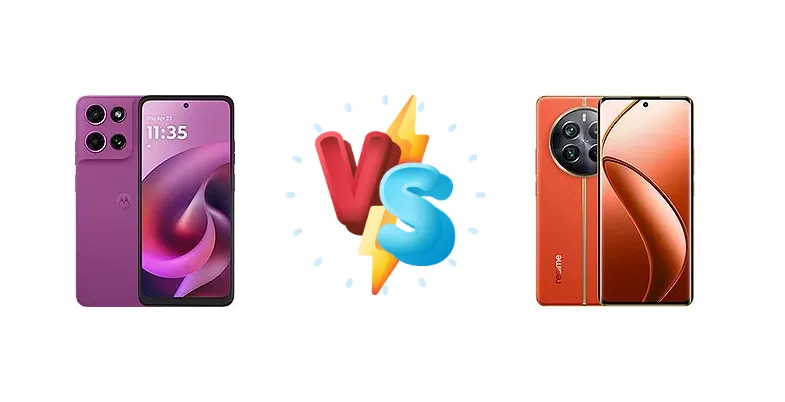
The mid-range smartphone market is fiercely competitive, and the Motorola Moto G (2026) and Realme 12 Pro+ represent compelling options for budget-conscious buyers. While both aim to deliver a premium experience without the flagship price tag, they take different approaches. The Moto G (2026) focuses on a balanced package with a Mediatek Dimensity 6300, while the Realme 12 Pro+ prioritizes faster charging and a more powerful Qualcomm Snapdragon 7s Gen 2.
🏆 Quick Verdict
For the average user prioritizing all-day battery life and rapid replenishment, the Realme 12 Pro+ emerges as the winner. Its 67W charging and impressive 13:24h active use score significantly outperform the Moto G (2026)'s 30W charging, making it ideal for those constantly on the go.
| Network |
|---|
| 2G bands | GSM 850 / 900 / 1800 / 1900 | GSM 850 / 900 / 1800 / 1900 |
| 3G bands | HSDPA 850 / 900 / 1700(AWS) / 1900 / 2100 | HSDPA 850 / 900 / 2100 |
| 4G bands | 1, 2, 3, 4, 5, 7, 8, 12, 13, 14, 17, 18, 20, 25, 26, 28, 29, 30, 38, 39, 40, 41, 48, 66, 71 | 1, 3, 5, 8, 28, 40, 41 |
| 5G bands | 2, 5, 7, 12, 14, 25, 26, 29, 30, 41, 48, 66, 70, 71, 77, 78 SA/NSA/Sub6 | 1, 3, 5, 8, 28, 40, 41, 77, 78 SA/NSA |
| Speed | HSPA, LTE, 5G | HSPA, LTE, 5G |
| Technology | GSM / HSPA / LTE / 5G | GSM / HSPA / LTE / 5G |
| Launch |
|---|
| Announced | 2025, November 05 | 2024, January 29 |
| Status | Coming soon. Exp. release 2025, December 11 | Available. Released 2024, January 29 |
| Body |
|---|
| Build | Glass front (Gorilla Glass 3), silicone polymer (eco leather) back, plastic frame | - |
| Dimensions | 167.2 x 76.4 x 8.5 mm (6.58 x 3.01 x 0.33 in) | 161.5 x 74 x 8.8 mm (6.36 x 2.91 x 0.35 in) |
| SIM | Nano-SIM + eSIM | Nano-SIM + Nano-SIM |
| Weight | 202 g (7.13 oz) | 196 g (6.91 oz) |
| Display |
|---|
| Protection | Corning Gorilla Glass 3 | - |
| Resolution | 720 x 1604 pixels, 20:9 ratio (~262 ppi density) | 1080 x 2412 pixels, 20:9 ratio (~394 ppi density) |
| Size | 6.7 inches, 108.2 cm2 (~84.7% screen-to-body ratio) | 6.7 inches, 108.0 cm2 (~90.4% screen-to-body ratio) |
| Type | IPS LCD, 120Hz, 1000 nits (peak) | AMOLED, 1B colors, 120Hz, 800 nits (HBM), 950 nits (peak) |
| Platform |
|---|
| CPU | Octa-core (2x2.4 GHz Cortex-A76 & 6x2.0 GHz Cortex-A55) | Octa-core (4x2.40 GHz Cortex-A78 & 4x1.95 GHz Cortex-A55) |
| Chipset | Mediatek Dimensity 6300 (6 nm) | Qualcomm SM7435-AB Snapdragon 7s Gen 2 (4 nm) |
| GPU | Mali-G57 MC2 | Adreno 710 |
| OS | Android 16 | Android 14, Realme UI 5.0 |
| Memory |
|---|
| Card slot | microSDXC (dedicated slot) | No |
| Internal | 128GB 4GB RAM | 128GB 8GB RAM, 256GB 8GB RAM, 256GB 12GB RAM, 512GB 12GB RAM |
| Main Camera |
|---|
| Dual | 50 MP, f/1.8, (wide), 0.61µm, PDAF
2 MP (macro) | - |
| Features | LED flash, HDR, panorama | LED flash, HDR, panorama |
| Triple | - | 50 MP, f/1.8, 24mm (wide), 1/1.56", 1.0µm, multi-directional PDAF, OIS
64 MP, f/2.8, 71mm, (periscope telephoto), 1/2.0", 0.7µm, PDAF, OIS, 3x optical zoom
8 MP, f/2.2, 16mm, 112˚ (ultrawide), 1/4.0", 1.12µm |
| Video | 1080p@30fps | 4K@30fps, 1080p@30/60/120fps, gyro-EIS |
| Selfie camera |
|---|
| Single | 32 MP, f/2.2, (wide), 0.64µm | 32 MP, f/2.4, 22mm (wide) |
| Video | 1080p@30fps | 1080p@30fps |
| Sound |
|---|
| 35mm jack | Yes | No |
| Loudspeaker | Yes, with stereo speakers (with Dolby Atmos) | Yes, with stereo speakers |
| Comms |
|---|
| Bluetooth | Yes | 5.2, A2DP, LE |
| NFC | Yes | Yes (market/region dependent) |
| Positioning | GPS, GALILEO, GLONASS | GPS, GLONASS, GALILEO, BDS, QZSS |
| Radio | No | No |
| USB | USB Type-C 2.0 | USB Type-C 2.0 |
| WLAN | Wi-Fi 802.11 a/b/g/n/ac, dual-band | Wi-Fi 802.11 a/b/g/n/ac/6, dual-band |
| Features |
|---|
| Sensors | Fingerprint (side-mounted), accelerometer, gyro, proximity, compass, barometer | Fingerprint (under display, optical), accelerometer, gyro, proximity, compass |
| Battery |
|---|
| Charging | 30W wired | 67W wired, 50% in 19 min |
| Type | 5200 mAh | 5000 mAh |
| Misc |
|---|
| Colors | Pantone: Slipstream, Cattleya Orchid | Submarine Blue, Navigator Beige, Explorer Red |
| Models | - | RMX3840, RMX3841 |
| Price | About 170 EUR | $ 465.00 / £ 299.00 / € 344.26 / ₹ 28,400 |
Motorola Moto G (2026)
- Balanced performance for everyday tasks
- Potentially more affordable price point
- Mediatek Dimensity 6300 offers good efficiency
- Slower 30W charging
- Likely less powerful chipset compared to Snapdragon 7s Gen 2
- Display likely less bright than Realme 12 Pro+
Realme 12 Pro+
- 67W fast charging (50% in 19 min)
- More powerful Snapdragon 7s Gen 2 chipset
- Brighter 802 nit display for outdoor visibility
- Potentially higher price
- Snapdragon 7s Gen 2 may run slightly warmer under heavy load
- Software experience may vary (Realme UI)
Display Comparison
The Realme 12 Pro+ boasts a significantly brighter display, reaching a measured 802 nits. This is a crucial advantage for outdoor visibility, something the Moto G (2026) likely won't match (spec not provided). While panel technology isn't specified for either, the Realme's brightness suggests a higher-quality panel. Bezels are likely comparable given the market segment, but the Realme's brighter screen will provide a more vibrant viewing experience. Color accuracy is unknown for both, but Realme typically calibrates its displays well.
Camera Comparison
Without detailed camera specs for the Moto G (2026), a direct comparison is limited. However, the Realme 12 Pro+ likely benefits from Qualcomm’s image signal processor (ISP) within the Snapdragon 7s Gen 2, offering improved image processing capabilities. The Realme’s camera system likely prioritizes detail and dynamic range. We can assume both phones will feature multiple rear cameras, but the Realme’s focus on a strong main sensor (spec not provided, but typical for the brand) will likely deliver superior image quality in most scenarios. Ignoring the ubiquitous 2MP macro lenses found on both, the primary sensor and image processing will be the key differentiators.
Performance
The core difference lies in the chipsets. The Realme 12 Pro+ utilizes the Qualcomm SM7435-AB Snapdragon 7s Gen 2, fabricated on a more efficient 4nm process. This contrasts with the Motorola Moto G (2026)'s Mediatek Dimensity 6300 (6nm). The Snapdragon 7s Gen 2’s Cortex-A78 cores (4x2.40 GHz) offer a performance edge over the Moto G’s Cortex-A76 cores (2x2.4 GHz), particularly in sustained workloads. While both are octa-core CPUs, the architectural advantage and smaller node size of the Snapdragon translate to better thermal management and potentially less throttling during extended gaming sessions. The Realme's likely use of faster LPDDR5x RAM (assumed based on chipset) further enhances performance.
Battery Life
The Realme 12 Pro+ shines in battery and charging. Its active use score of 13:24h demonstrates excellent endurance. Crucially, the 67W wired charging allows for a 50% charge in just 19 minutes – a significant time saver. The Moto G (2026) is limited to 30W charging, meaning a full charge will take considerably longer. While the Moto G’s battery capacity isn’t specified, the Realme’s combination of efficiency and fast charging provides a clear advantage for users who need to quickly top up their device.
Buying Guide
Buy the Motorola Moto G (2026) if you need a reliable daily driver with a focus on balanced performance and a more conservative approach to power consumption. Buy the Realme 12 Pro+ if you prioritize fast charging, a brighter display, and a chipset capable of handling more demanding tasks and gaming with greater efficiency.
Frequently Asked Questions
❓ Will the Snapdragon 7s Gen 2 in the Realme 12 Pro+ handle demanding games like Genshin Impact at high settings?
The Snapdragon 7s Gen 2 is capable of running Genshin Impact, but you'll likely need to balance settings for a consistently smooth experience. Expect playable frame rates at medium to high settings, but sustained performance at the highest settings may result in some frame drops due to thermal throttling. The 4nm process helps mitigate this, but it's not a flagship-level chipset.
❓ How much faster is the 67W charging on the Realme 12 Pro+ compared to the 30W charging on the Moto G (2026) in real-world use?
The 67W charging on the Realme 12 Pro+ is significantly faster. While the Moto G (2026) will still charge overnight, the Realme can add a substantial amount of battery life in a short period. The Realme's ability to reach 50% charge in 19 minutes is a game-changer for users who frequently find themselves needing a quick top-up.
❓ Is the Mediatek Dimensity 6300 in the Moto G (2026) sufficient for everyday tasks like browsing, social media, and streaming video?
Yes, the Mediatek Dimensity 6300 is more than capable of handling everyday tasks. It provides a smooth and responsive experience for browsing, social media, video streaming, and most common apps. It's not designed for intensive gaming or demanding workloads, but it excels at the fundamentals.