
Motorola Moto G (2026) vs OnePlus Nord 4: A Deep Dive into Mid-Range Contenders
| Phones Images | |||||
|---|---|---|---|---|---|
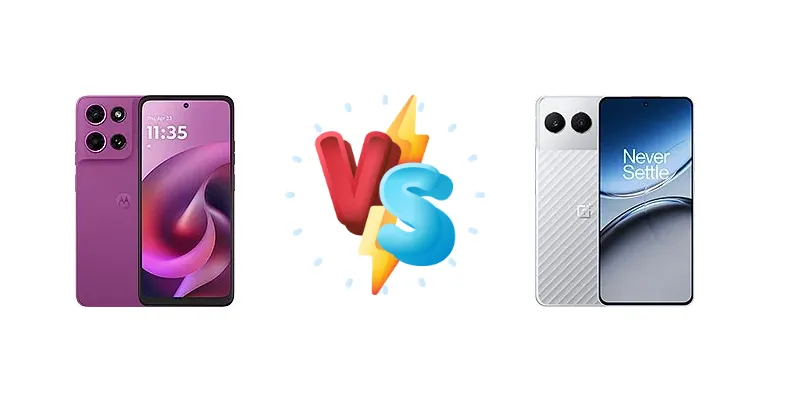
|
🏆 Quick Verdict
For the average user prioritizing all-day battery life and blazing-fast charging, the OnePlus Nord 4 emerges as the clear winner. Its Snapdragon 7+ Gen 3 chipset and 100W charging significantly outperform the Moto G (2026)'s Dimensity 6300 and 30W charging, despite the Moto G's potentially lower price.
| PHONES | ||
|---|---|---|
| Phone Names | Motorola Moto G (2026) | OnePlus Nord 4 |
| Network | ||
|---|---|---|
| 2G bands | GSM 850 / 900 / 1800 / 1900 | GSM 850 / 900 / 1800 / 1900 |
| 3G bands | HSDPA 850 / 900 / 1700(AWS) / 1900 / 2100 | HSDPA 800 / 850 / 900 / 1700(AWS) / 1800 / 1900 / 2100 - International |
| 4G bands | 1, 2, 3, 4, 5, 7, 8, 12, 13, 14, 17, 18, 20, 25, 26, 28, 29, 30, 38, 39, 40, 41, 48, 66, 71 | 1, 2, 3, 4, 5, 7, 8, 12, 17, 18, 19, 20, 26, 28, 38, 39, 40, 41, 66 - International |
| 5G bands | 2, 5, 7, 12, 14, 25, 26, 29, 30, 41, 48, 66, 70, 71, 77, 78 SA/NSA/Sub6 | 1, 2, 3, 5, 7, 8, 12, 20, 28, 38, 40, 41, 66, 77, 78 SA/NSA - International |
| Speed | HSPA, LTE, 5G | HSPA, LTE, 5G |
| Technology | GSM / HSPA / LTE / 5G | GSM / HSPA / LTE / 5G |
| Launch | ||
|---|---|---|
| Announced | 2025, November 05 | 2024, July 16 |
| Status | Coming soon. Exp. release 2025, December 11 | Available. Released 2024, August 08 |
| Body | ||
|---|---|---|
| Build | Glass front (Gorilla Glass 3), silicone polymer (eco leather) back, plastic frame | Glass front, aluminum back, aluminum frame |
| Dimensions | 167.2 x 76.4 x 8.5 mm (6.58 x 3.01 x 0.33 in) | 162.6 x 75 x 8 mm (6.40 x 2.95 x 0.31 in) |
| SIM | Nano-SIM + eSIM | Nano-SIM + Nano-SIM |
| Weight | 202 g (7.13 oz) | 199.5 g (7.05 oz) |
| Display | ||
|---|---|---|
| Protection | Corning Gorilla Glass 3 | - |
| Resolution | 720 x 1604 pixels, 20:9 ratio (~262 ppi density) | 1240 x 2772 pixels, 20:9 ratio (~450 ppi density) |
| Size | 6.7 inches, 108.2 cm2 (~84.7% screen-to-body ratio) | 6.74 inches, 109.7 cm2 (~90.0% screen-to-body ratio) |
| Type | IPS LCD, 120Hz, 1000 nits (peak) | Fluid AMOLED, 1B colors, 120Hz, HDR10+, 2150 nits (peak) |
| Platform | ||
|---|---|---|
| CPU | Octa-core (2x2.4 GHz Cortex-A76 & 6x2.0 GHz Cortex-A55) | Octa-core (1x2.8 GHz Cortex-X4 & 4x2.6 GHz Cortex-A720 & 3x1.9 GHz Cortex-A520) |
| Chipset | Mediatek Dimensity 6300 (6 nm) | Qualcomm SM7675 Snapdragon 7+ Gen 3 (4 nm) |
| GPU | Mali-G57 MC2 | Adreno 732 |
| OS | Android 16 | Android 14, up to 4 major Android upgrades, OxygenOS 15 |
| Memory | ||
|---|---|---|
| Card slot | microSDXC (dedicated slot) | No |
| Internal | 128GB 4GB RAM | 128GB 8GB RAM, 256GB 8GB RAM, 256GB 12GB RAM, 512GB 16GB RAM |
| Main Camera | ||
|---|---|---|
| Dual | 50 MP, f/1.8, (wide), 0.61µm, PDAF 2 MP (macro) | 50 MP, f/1.8, 25mm (wide), 1/1.95", 0.8µm, PDAF, OIS 8 MP, f/2.2, 112˚ (ultrawide), 1/4.0", 1.12µm |
| Features | LED flash, HDR, panorama | Dual-LED flash, HDR, panorama |
| Video | 1080p@30fps | 4K@30/60fps, 1080p@30/60/120fps, gyro-EIS |
| Selfie camera | ||
|---|---|---|
| Features | - | Panorama |
| Single | 32 MP, f/2.2, (wide), 0.64µm | 16 MP, f/2.4, 24mm (wide), 1.0µm |
| Video | 1080p@30fps | 1080p@30fps |
| Sound | ||
|---|---|---|
| 35mm jack | Yes | No |
| Loudspeaker | Yes, with stereo speakers (with Dolby Atmos) | Yes, with stereo speakers |
| Comms | ||
|---|---|---|
| Bluetooth | Yes | 5.4, A2DP, LE, aptX HD, LHDC |
| Infrared port | - | Yes |
| NFC | Yes | Yes |
| Positioning | GPS, GALILEO, GLONASS | GPS, GALILEO, GLONASS, BDS, QZSS |
| Radio | No | No |
| USB | USB Type-C 2.0 | USB Type-C 2.0 |
| WLAN | Wi-Fi 802.11 a/b/g/n/ac, dual-band | Wi-Fi 802.11 a/b/g/n/ac/6, dual-band, Wi-Fi Direct |
| Features | ||
|---|---|---|
| Sensors | Fingerprint (side-mounted), accelerometer, gyro, proximity, compass, barometer | Fingerprint (under display, optical), accelerometer, gyro, proximity, compass |
| Battery | ||
|---|---|---|
| Charging | 30W wired | 100W wired, PPS, 100% in 28 min |
| Type | 5200 mAh | 5500 mAh |
| Misc | ||
|---|---|---|
| Colors | Pantone: Slipstream, Cattleya Orchid | Obsidian Midnight, Mercurial Silver, Oasis Green |
| Models | - | CPH2663, CPH2661 |
| Price | About 170 EUR | € 410.27 / £ 423.17 |
| SAR | - | 1.18 W/kg (head) 1.06 W/kg (body) |
Motorola Moto G (2026)
- Potentially more affordable price point
- Reliable Mediatek Dimensity 6300 chipset for everyday tasks
- Motorola's clean software experience
- Slower 30W charging
- Less powerful chipset compared to the Snapdragon 7+ Gen 3
- Likely lower display brightness and quality
OnePlus Nord 4
- Blazing-fast 100W charging with PPS
- Powerful Snapdragon 7+ Gen 3 chipset for smooth performance
- Bright and vibrant display with 1163 nits peak brightness
- Potentially higher price tag
- OxygenOS may include more pre-installed apps
- Larger size and weight compared to the Moto G (2026) - assumption based on Nord series history
Display Comparison
The OnePlus Nord 4 boasts a significantly brighter display, reaching a measured peak of 1163 nits. This translates to superior visibility in direct sunlight compared to the Moto G (2026), which lacks specified brightness data and likely falls behind. While both likely utilize OLED panels, the Nord 4’s higher brightness and potential for higher refresh rates (based on OnePlus’s typical offerings) provide a more vibrant and responsive visual experience. The absence of LTPO specification for either phone suggests neither will have adaptive refresh rates for maximum power saving.
Camera Comparison
Without detailed camera specifications for the Moto G (2026), a direct comparison is limited. However, the OnePlus Nord 4 is expected to feature a more sophisticated camera system, leveraging Qualcomm’s image signal processor (ISP) within the Snapdragon 7+ Gen 3. This ISP enables features like improved low-light performance, faster image processing, and potentially better video stabilization. The absence of information regarding OIS on the Moto G (2026) suggests it may lack this feature, further widening the gap in image quality, particularly in challenging conditions. We anticipate the Nord 4 will offer a more versatile and higher-quality camera experience.
Performance
The core difference lies in the chipsets. The OnePlus Nord 4’s Qualcomm SM7675 Snapdragon 7+ Gen 3 (4nm) is a substantial upgrade over the Motorola Moto G (2026)’s Mediatek Dimensity 6300 (6nm). The Snapdragon 7+ Gen 3 features a Cortex-X4 prime core clocked at 2.8 GHz, alongside Cortex-A720 performance cores, offering a significant leap in CPU and GPU performance. The 4nm process node of the Snapdragon is more efficient, leading to better thermal management and sustained performance during demanding tasks like gaming. The Dimensity 6300, while capable, relies on older Cortex-A76 and A55 cores and a less efficient 6nm process, resulting in lower peak performance and potentially more throttling.
Battery Life
The OnePlus Nord 4 shines in battery and charging. Its active use score of 14:41h demonstrates excellent battery life, likely due to the efficient Snapdragon 7+ Gen 3 chipset. Crucially, the 100W wired charging with PPS support allows for a full charge in just 28 minutes – a game-changer for users who need to quickly top up their battery. The Moto G (2026) offers a more modest 30W charging, resulting in significantly longer charging times. While battery capacity isn’t specified for either device, the Nord 4’s superior charging speed and efficient chipset effectively mitigate any potential capacity disadvantage.
Buying Guide
Buy the Motorola Moto G (2026) if you need a reliable, everyday smartphone with a focus on affordability and are willing to compromise on peak performance and charging speed. Buy the OnePlus Nord 4 if you prioritize a smoother user experience, faster app loading times, extended battery life, and the convenience of incredibly rapid 100W charging – making it ideal for power users and those constantly on the go.