
Nothing Phone (3) vs. Motorola Moto G (2026): A Deep Dive into Performance and Value
| Phones Images | |||||
|---|---|---|---|---|---|
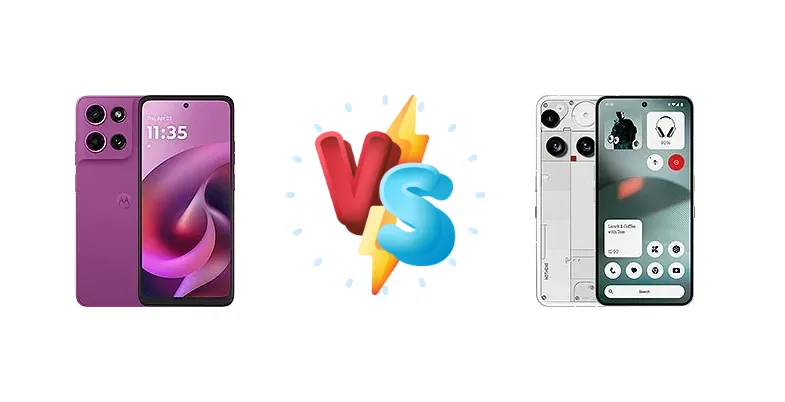
|
🏆 Quick Verdict
For users prioritizing raw performance and future-proofing, the Nothing Phone (3) is the clear winner thanks to its Snapdragon 8s Gen 4. However, the Motorola Moto G (2026) provides a compelling value proposition for everyday users who don't require top-tier processing power, offering a balanced experience at a potentially lower cost.
| PHONES | ||
|---|---|---|
| Phone Names | Motorola Moto G (2026) | Nothing Phone (3) |
| Network | ||
|---|---|---|
| 2G bands | GSM 850 / 900 / 1800 / 1900 | GSM 850 / 900 / 1800 / 1900 |
| 3G bands | HSDPA 850 / 900 / 1700(AWS) / 1900 / 2100 | HSDPA 800 / 850 / 900 / 1700(AWS) / 1900 / 2100 |
| 4G bands | 1, 2, 3, 4, 5, 7, 8, 12, 13, 14, 17, 18, 20, 25, 26, 28, 29, 30, 38, 39, 40, 41, 48, 66, 71 | 1, 2, 3, 4, 6, 7, 8, 12, 17, 18, 19, 20, 25, 26, 28, 30, 34, 38, 39, 40, 41, 42, 48, 66, 71 LTE |
| 5G bands | 2, 5, 7, 12, 14, 25, 26, 29, 30, 41, 48, 66, 70, 71, 77, 78 SA/NSA/Sub6 | 1, 2, 3, 5, 7, 8, 12, 20, 25, 28, 30, 38, 40, 41, 48, 66, 71, 77, 78 SA/NSA |
| Speed | HSPA, LTE, 5G | HSPA, LTE, 5G |
| Technology | GSM / HSPA / LTE / 5G | GSM / HSPA / LTE / 5G |
| Launch | ||
|---|---|---|
| Announced | 2025, November 05 | 2025, July 02 |
| Status | Coming soon. Exp. release 2025, December 11 | Available. Released 2025, July 15 |
| Body | ||
|---|---|---|
| Build | Glass front (Gorilla Glass 3), silicone polymer (eco leather) back, plastic frame | Glass front (Gorilla Glass 7i), glass back (Gorilla Glass Victus), aluminum frame |
| Dimensions | 167.2 x 76.4 x 8.5 mm (6.58 x 3.01 x 0.33 in) | 160.6 x 75.6 x 9 mm (6.32 x 2.98 x 0.35 in) |
| SIM | Nano-SIM + eSIM | Nano-SIM + Nano-SIM + eSIM (max 2 at a time) |
| Weight | 202 g (7.13 oz) | 218 g (7.69 oz) |
| Display | ||
|---|---|---|
| Protection | Corning Gorilla Glass 3 | Corning Gorilla Glass 7i, Mohs level 5 |
| Resolution | 720 x 1604 pixels, 20:9 ratio (~262 ppi density) | 1260 x 2800 pixels, 20:9 ratio (~460 ppi density) |
| Size | 6.7 inches, 108.2 cm2 (~84.7% screen-to-body ratio) | 6.67 inches, 107.4 cm2 (~88.5% screen-to-body ratio) |
| Type | IPS LCD, 120Hz, 1000 nits (peak) | OLED, 1B colors, 120Hz, 960Hz PWM, HDR10+, 4500 nits (peak) |
| Platform | ||
|---|---|---|
| CPU | Octa-core (2x2.4 GHz Cortex-A76 & 6x2.0 GHz Cortex-A55) | Octa-core (1x3.21 GHz Cortex-X4 & 3x3.0 GHz Cortex-A720 & 2x2.8 GHz Cortex-A720 & 2x2.0 GHz Cortex-A720) |
| Chipset | Mediatek Dimensity 6300 (6 nm) | Qualcomm SM8735 Snapdragon 8s Gen 4 (4 nm) |
| GPU | Mali-G57 MC2 | Adreno 825 |
| OS | Android 16 | Android 15, upgradable to Android 16, Nothing OS 4.0, up to 5 major Android upgrades |
| Memory | ||
|---|---|---|
| Card slot | microSDXC (dedicated slot) | No |
| Internal | 128GB 4GB RAM | 256GB 12GB RAM, 512GB 16GB RAM |
| Main Camera | ||
|---|---|---|
| Dual | 50 MP, f/1.8, (wide), 0.61µm, PDAF 2 MP (macro) | - |
| Features | LED flash, HDR, panorama | LED flash, panorama, HDR |
| Triple | - | 50 MP, f/1.7, 24mm (wide), 1/1.3", PDAF, OIS 50 MP, f/2.7, (periscope telephoto), 1/2.75", PDAF, 3x optical zoom. OIS 50 MP, f/2.2, 114˚ (ultrawide), 1/2.76" |
| Video | 1080p@30fps | 4K@30/60fps, 1080p@30/60fps, gyro-EIS, OIS |
| Selfie camera | ||
|---|---|---|
| Features | - | HDR |
| Single | 32 MP, f/2.2, (wide), 0.64µm | 50 MP, f/2.2, (wide), 1/2.76" |
| Video | 1080p@30fps | 4K@60fps, 1080p@60fps |
| Sound | ||
|---|---|---|
| 35mm jack | Yes | No |
| Loudspeaker | Yes, with stereo speakers (with Dolby Atmos) | Yes, with stereo speakers |
| Comms | ||
|---|---|---|
| Bluetooth | Yes | 6.0, A2DP, LE |
| NFC | Yes | Yes |
| Positioning | GPS, GALILEO, GLONASS | GPS (L1+L5), GLONASS, BDS, GALILEO, QZSS, NavIC, SBAS |
| Radio | No | No |
| USB | USB Type-C 2.0 | USB Type-C 2.0, OTG |
| WLAN | Wi-Fi 802.11 a/b/g/n/ac, dual-band | Wi-Fi 802.11 a/b/g/n/ac/6/7, tri-band, Wi-Fi Direct |
| Features | ||
|---|---|---|
| Sensors | Fingerprint (side-mounted), accelerometer, gyro, proximity, compass, barometer | Fingerprint (under display, optical), accelerometer, proximity, gyro, compass |
| Battery | ||
|---|---|---|
| Charging | 30W wired | 65W wired, PD3.0, PPS, QC4 15W wireless 7.5W reverse charging 5W reverse wireless |
| Type | 5200 mAh | Market-dependent versions:· Si/C 5150 mAh - International model· Si/C 5500 mAh - India model |
| Misc | ||
|---|---|---|
| Colors | Pantone: Slipstream, Cattleya Orchid | White, Black |
| Models | - | A024 |
| Price | About 170 EUR | $ 639.00 / £ 699.00 / € 538.99 / ₹ 49,999 |
| EU LABEL | ||
|---|---|---|
| Battery | - | 56:23h endurance, 1400 cycles |
| Energy | - | Class A |
| Free fall | - | Class C (90 falls) |
| Repairability | - | Class C |
Motorola Moto G (2026)
- Excellent value for money
- Reliable Mediatek Dimensity 6300 performance for everyday tasks
- Potentially longer software support from Motorola
- Less powerful processor compared to the Snapdragon 8s Gen 4
- Likely lower display brightness and quality
- Slower charging speeds
Nothing Phone (3)
- Flagship-level performance with Snapdragon 8s Gen 4
- Superior display brightness and clarity
- Versatile charging options (65W wired, 15W wireless, reverse charging)
- Higher price point
- Potential for thermal throttling under heavy load (though mitigated by 4nm process)
- Nothing OS may not appeal to all users
Display Comparison
The Nothing Phone (3) significantly outshines the Moto G (2026) in display technology, boasting a peak brightness of 1507 nits. While the Moto G (2026)'s display specs are absent, it's reasonable to assume a lower peak brightness. This difference translates to superior visibility in direct sunlight for the Nothing Phone (3). The absence of LTPO technology in either device suggests both will likely rely on adaptive refresh rates, but the Nothing Phone (3)'s brighter panel will offer a more vibrant and engaging viewing experience.
Camera Comparison
Without specific camera details for the Moto G (2026), a direct comparison is limited. However, the Nothing Phone (3) is likely to benefit from Qualcomm’s image signal processor (ISP) integrated within the Snapdragon 8s Gen 4, offering improved image processing capabilities. The focus should be on the main sensor size and aperture for both devices, as these are key determinants of low-light performance. The absence of information regarding OIS on either device makes it difficult to assess image stabilization capabilities.
Performance
The core difference lies in the chipsets: the Nothing Phone (3) utilizes the Qualcomm SM8735 Snapdragon 8s Gen 4 (4nm) while the Moto G (2026) features the Mediatek Dimensity 6300 (6nm). The Snapdragon 8s Gen 4’s 4nm process offers superior power efficiency and thermal performance compared to the Dimensity 6300’s 6nm node, meaning less throttling during sustained workloads. The Snapdragon’s CPU configuration – a 1x3.21 GHz Cortex-X4 prime core alongside three Cortex-A720 cores – provides a substantial performance advantage over the Moto G’s 2x2.4 GHz Cortex-A76 and 6x2.0 GHz Cortex-A55 setup. This translates to faster app loading times, smoother multitasking, and a better gaming experience on the Nothing Phone (3).
Battery Life
The Nothing Phone (3) demonstrates impressive battery endurance with a measured 56:23h endurance and a 12:56h active use score. While the Moto G (2026)'s battery capacity is unknown, the Nothing Phone (3)'s superior efficiency, coupled with its 65W wired charging (supporting PD3.0, PPS, and QC4), 15W wireless charging, and even reverse charging capabilities (7.5W wired, 5W wireless), provides a significant advantage. The Moto G (2026)'s 30W wired charging is respectable, but it won't match the speed and versatility of the Nothing Phone (3)'s charging ecosystem.
Buying Guide
Buy the Motorola Moto G (2026) if you need a reliable daily driver with good battery life and don't plan on intensive gaming or demanding tasks. It's ideal for users who prioritize affordability and a smooth, consistent experience. Buy the Nothing Phone (3) if you demand faster processing speeds, enjoy mobile gaming, and appreciate advanced charging capabilities like wireless and reverse wireless charging. It's geared towards power users and those who want a phone that can handle anything they throw at it.