
Motorola Moto G (2025) vs. Motorola Edge (2024): A Detailed Comparison
| Phones Images | |||||
|---|---|---|---|---|---|
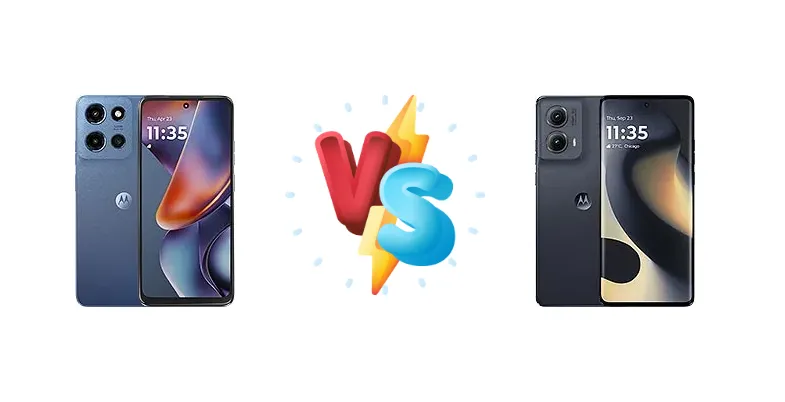
|
🏆 Quick Verdict
For the average user prioritizing value and efficient daily performance, the Motorola Edge (2024) emerges as the stronger choice. Its Snapdragon 7s Gen 2 chipset, built on a more efficient 4nm process, offers a noticeable performance advantage and superior thermal management, coupled with the convenience of 68W wired and 15W wireless charging.
| PHONES | ||
|---|---|---|
| Phone Names | Motorola Moto G (2025) | Motorola Edge (2024) |
| Network | ||
|---|---|---|
| 2G bands | GSM 850 / 900 / 1800 / 1900 | GSM 850 / 900 / 1800 / 1900 |
| 3G bands | HSDPA 850 / 900 / 1700(AWS) / 1900 / 2100 | HSDPA 850 / 900 / 1700(AWS) / 1900 / 2100 |
| 4G bands | 1, 2, 3, 4, 5, 7, 8, 12, 13, 14, 17, 18, 20, 25, 26, 28, 29, 30, 38, 39, 40, 41, 48, 66, 71 | 1, 2, 3, 4, 5, 7, 8, 12, 13, 14, 17, 18, 19, 20, 25, 26, 29, 30, 38, 39, 40, 41, 48, 66, 71 |
| 5G bands | 2, 5, 7, 12, 14, 25, 26, 29, 30, 41, 48, 66, 70, 71, 77, 78 SA/NSA/Sub6 | 1, 2, 3, 5, 7, 12, 14, 20, 25, 26, 29, 30, 38, 40, 41, 48, 66, 70, 71, 77, 78 SA/NSA/Sub6 |
| Speed | HSPA, LTE, 5G | HSPA, LTE, 5G |
| Technology | GSM / HSPA / LTE / 5G | GSM / HSPA / LTE / 5G |
| Launch | ||
|---|---|---|
| Announced | 2025, January 14 | 2024, June 04 |
| Status | Available. Released 2025, January 30 | Available. Released 2024, June 20 |
| Body | ||
|---|---|---|
| Build | Glass front (Gorilla Glass 3), silicone polymer (eco leather) back, plastic frame | Glass front, aluminum frame, silicone polymer back (eco leather) |
| Dimensions | 167.1 x 76.3 x 8.2 mm (6.58 x 3.00 x 0.32 in) | 159.6 x 72 x 8.1 mm (6.28 x 2.83 x 0.32 in) |
| SIM | Nano-SIM + eSIM | Nano-SIM + eSIM |
| Weight | 193 g (6.81 oz) | 174 g (6.14 oz) |
| Display | ||
|---|---|---|
| Protection | Corning Gorilla Glass 3 | Corning Gorilla Glass 3 |
| Resolution | 720 x 1604 pixels, 20:9 ratio (~262 ppi density) | 1080 x 2400 pixels, 20:9 ratio (~402 ppi density) |
| Size | 6.7 inches, 108.2 cm2 (~84.9% screen-to-body ratio) | 6.6 inches, 103.6 cm2 (~90.2% screen-to-body ratio) |
| Type | IPS LCD, 120Hz | P-OLED, 1B colors, 144Hz, 1300 nits (peak) |
| Platform | ||
|---|---|---|
| CPU | Octa-core (2x2.4 GHz Cortex-A76 & 6x2.0 GHz Cortex-A55) | Octa-core (4x2.40 GHz Cortex-A78 & 4x1.95 GHz Cortex-A55) |
| Chipset | Mediatek Dimensity 6300 (6 nm) | Qualcomm SM7435-AB Snapdragon 7s Gen 2 (4 nm) |
| GPU | Mali-G57 MC2 | Adreno 710 |
| OS | Android 15, up to 2 major Android upgrades | Android 14 |
| Memory | ||
|---|---|---|
| Card slot | microSDXC (dedicated slot) | No |
| Internal | 64GB 4GB RAM, 128GB 4GB RAM | 256GB 8GB RAM |
| Main Camera | ||
|---|---|---|
| Dual | 50 MP, f/1.8, (wide), 0.61µm, PDAF, OIS 2 MP (macro) | 50 MP, f/1.8, (wide), 1/1.5", 1.0µm, multi-directional PDAF, OIS 13 MP, f/2.2, 120˚ (ultrawide), 1.12µm, AF |
| Features | LED flash, HDR, panorama | Dual-LED flash, HDR, panorama |
| Video | 1080p@30fps | 4K@30fps, 1080p@30/60fps, HDR, gyro-EIS |
| Selfie camera | ||
|---|---|---|
| Features | - | HDR |
| Single | 16 MP, f/2.4, (wide), 1.0µm | 32 MP, f/2.4, (wide), 0.7µm, AF |
| Video | 1080p@30fps | 1080p@30fps |
| Sound | ||
|---|---|---|
| 35mm jack | Yes | No |
| Loudspeaker | Yes, with stereo speakers (with Dolby Atmos) | Yes, with stereo speakers |
| Comms | ||
|---|---|---|
| Bluetooth | Yes | 5.2, A2DP, LE |
| NFC | Yes | Yes |
| Positioning | GPS, GALILEO, GLONASS | GPS, GLONASS, GALILEO |
| Radio | Unspecified | No |
| USB | USB Type-C 2.0 | USB Type-C 3.1, DisplayPort 1.4 |
| WLAN | Wi-Fi 802.11 a/b/g/n/ac, dual-band | Wi-Fi 802.11 a/b/g/n/ac/6e, tri-band, Wi-Fi Direct |
| Features | ||
|---|---|---|
| Sensors | Fingerprint (side-mounted), accelerometer, gyro, proximity, compass, barometer | Fingerprint (under display, optical), accelerometer, gyro, proximity, compass |
| Battery | ||
|---|---|---|
| Charging | 30W wired | 68W wired 15W wireless |
| Type | 5000 mAh | 5000 mAh |
| Misc | ||
|---|---|---|
| Colors | Forest Gray, Sapphire Blue | Black |
| Models | XT2513V, T2513-1 | XT2405V, XT-2405V |
| Price | $ 149.99 | $ 186.72 / C$ 254.99 |
Motorola Moto G (2025)
- More affordable price point
- Decent performance for everyday tasks
- Reliable Motorola software experience
- Less powerful chipset compared to the Edge
- Slower charging speeds
- No wireless charging
Motorola Edge (2024)
- More powerful and efficient Snapdragon 7s Gen 2 chipset
- Faster 68W wired and 15W wireless charging
- Likely superior camera performance
- Higher price tag
- May not be significantly faster for basic tasks
- Potential for more bloatware (typical for Motorola)
Display Comparison
While display specifications are not provided, the Edge (2024) is likely to feature a higher quality panel given its positioning. The Moto G series traditionally focuses on cost optimization, potentially resulting in a lower peak brightness and color accuracy. Expect the Edge to have a more refined viewing experience, potentially with a higher refresh rate as well.
Camera Comparison
Without detailed camera specs, it's difficult to make a definitive judgment. However, the Edge (2024), being a higher-tier device, is expected to have a more capable primary sensor and potentially optical image stabilization (OIS). The Dimensity 6300 in the Moto G (2025) will likely pair with a more modest camera setup, focusing on providing acceptable image quality in good lighting conditions. Expect the Edge to excel in low-light photography and video recording.
Performance
The core difference lies in the chipsets. The Motorola Edge (2024) utilizes the Qualcomm SM7435-AB Snapdragon 7s Gen 2 (4nm), featuring four Cortex-A78 cores clocked at 2.40 GHz. This contrasts with the Moto G (2025)'s Mediatek Dimensity 6300 (6nm) with two Cortex-A76 cores at 2.4 GHz. The Snapdragon 7s Gen 2’s 4nm fabrication process provides a significant efficiency advantage, translating to less heat generation under sustained load and potentially longer battery life. The Cortex-A78 cores in the Snapdragon also offer a performance uplift over the A76 cores in the Dimensity 6300, particularly in demanding applications. This means the Edge (2024) will handle graphically intensive games and multitasking more smoothly.
Battery Life
The Motorola Edge (2024) boasts a significant charging advantage with 68W wired charging and 15W wireless charging. This allows for a much faster 0-100% charge compared to the Moto G (2025)'s 30W wired charging. While battery capacity isn't specified, the faster charging of the Edge mitigates any potential disadvantage from a slightly smaller battery. The addition of wireless charging on the Edge is a convenience feature absent on the Moto G (2025).
Buying Guide
Buy the Motorola Moto G (2025) if you need a reliable smartphone for basic tasks like calling, texting, social media, and light web browsing, and are on a strict budget. Buy the Motorola Edge (2024) if you prioritize smoother multitasking, occasional gaming, faster charging speeds, and the added convenience of wireless charging, even at a slightly higher price point.