
Motorola Moto G (2024) vs Nothing Phone (2a) Plus: A Detailed Performance and Value Showdown
| Phones Images | |||||
|---|---|---|---|---|---|
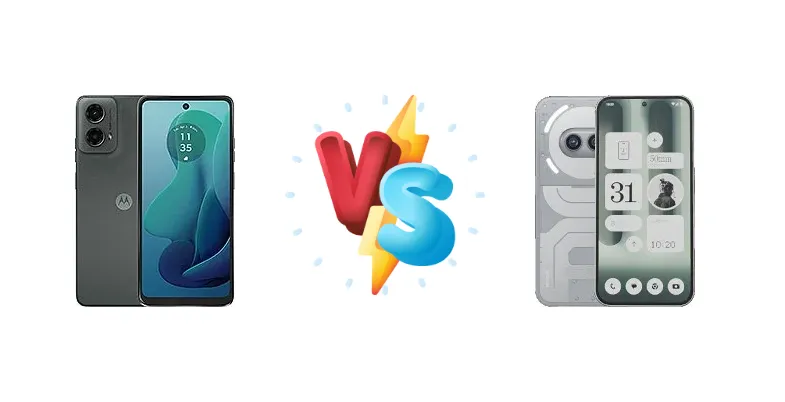
|
🏆 Quick Verdict
For the average user prioritizing sustained performance and faster charging, the Nothing Phone (2a) Plus emerges as the stronger contender. Its Mediatek Dimensity 7350 Pro chipset and 50W charging significantly outperform the Moto G (2024)'s Snapdragon 4 Gen 1 and 18W charging, justifying the potential price difference.
| PHONES | ||
|---|---|---|
| Phone Names | Motorola Moto G (2024) | Nothing Phone (2a) Plus |
| Network | ||
|---|---|---|
| 2G bands | GSM 850 / 900 / 1800 / 1900 | GSM 850 / 900 / 1800 / 1900 |
| 3G bands | HSDPA 850 / 900 / 1700(AWS) / 1900 / 2100 | HSDPA 800 / 850 / 900 / 1700(AWS) / 1900 / 2100 |
| 4G bands | 1, 2, 3, 4, 5, 7, 8, 12, 13, 14, 17, 18, 20, 25, 26, 28, 29, 30, 38, 39, 40, 41, 48, 66, 71 | 1, 3, 4, 5, 7, 8, 18, 19, 20, 26, 28, 38, 39, 40, 41, 42, 66 |
| 5G bands | 2, 5, 7, 12, 14, 25, 26, 29, 30, 41, 48, 66, 70, 71, 77, 78 SA/NSA | 1, 3, 5, 7, 8, 20, 28, 38, 40, 41, 66, 77, 78 SA/NSA |
| Speed | HSPA, LTE, 5G | HSPA, LTE, 5G |
| Technology | GSM / HSPA / LTE / 5G | GSM / HSPA / LTE / 5G |
| Launch | ||
|---|---|---|
| Announced | 2024, March 12 | 2024, July 31 |
| Status | Available. Released 2024, March 21 | Available. Released 2024, August 03 |
| Body | ||
|---|---|---|
| Build | Glass front, silicone polymer back (eco leather), plastic frame | Glass front (Gorilla Glass 5), plastic frame, plastic back |
| Dimensions | 164.4 x 75 x 8.2 mm (6.47 x 2.95 x 0.32 in) | 161.7 x 76.3 x 8.5 mm (6.37 x 3.00 x 0.33 in) |
| SIM | Nano-SIM + eSIM | Nano-SIM + Nano-SIM |
| Weight | 194 g (6.84 oz) | 190 g (6.70 oz) |
| Display | ||
|---|---|---|
| Protection | - | Corning Gorilla Glass 5 |
| Resolution | 720 x 1612 pixels, 20:9 ratio (~267 ppi density) | 1080 x 2412 pixels, 20:9 ratio (~395 ppi density) |
| Size | 6.6 inches, 104.6 cm2 (~84.9% screen-to-body ratio) | 6.7 inches, 107.5 cm2 (~87.1% screen-to-body ratio) |
| Type | IPS LCD, 120Hz | AMOLED, 1B colors, 120Hz, 2160Hz PWM, HDR10+, 700 nits (typ), 1100 nits (HBM), 1300 nits (peak) |
| Platform | ||
|---|---|---|
| CPU | Octa-core (2x2.0 GHz Cortex-A78 & 6x1.8 GHz Cortex-A55) | Octa-core (2x3.0 GHz Cortex-A715 & 6x 2.0 GHz Cortex-A510) |
| Chipset | Qualcomm SM4375 Snapdragon 4 Gen 1 (6 nm) | Mediatek Dimensity 7350 Pro (4 nm) |
| GPU | Adreno 619 | Mali-G610 MC4 |
| OS | Android 14 | Android 14, up to 3 major Android upgrades, Nothing OS 3.0 |
| Memory | ||
|---|---|---|
| Card slot | microSDXC (dedicated slot) | No |
| Internal | 128GB 4GB RAM | 256GB 8GB RAM, 256GB 12GB RAM |
| Main Camera | ||
|---|---|---|
| Dual | 50 MP, f/1.8, (wide), 0.64µm, PDAF 2 MP (macro) | 50 MP, f/1.9, 24mm (wide), 1/1.57", 1.0µm, PDAF, OIS 50 MP, f/2.2, 114˚ (ultrawide), 1/2.76", 0.64µm |
| Features | LED flash, HDR, panorama | LED flash, panorama, HDR |
| Video | 1080p@30fps | 4K@30fps, 1080p@60/120fps, gyro-EIS |
| Selfie camera | ||
|---|---|---|
| Features | HDR | HDR |
| Single | 8 MP, f/2.0, (wide), 1/4.0", 1.12µm | 50 MP, f/2.2, (wide), 1/2.76" |
| Video | 1080p@30fps | 4K@30fps |
| Sound | ||
|---|---|---|
| 35mm jack | Yes | No |
| Loudspeaker | Yes, with stereo speakers | Yes, with stereo speakers |
| Comms | ||
|---|---|---|
| Bluetooth | 5.1, A2DP, LE | 5.3, A2DP, LE |
| NFC | Yes | Yes, 360˚ |
| Positioning | GPS, GLONASS, GALILEO | GPS, GALILEO, GLONASS, BDS, QZSS |
| Radio | No | No |
| USB | USB Type-C 2.0 | USB Type-C 2.0, OTG |
| WLAN | Wi-Fi 802.11 a/b/g/n/ac, dual-band | Wi-Fi 802.11 a/b/g/n/ac/6, dual-band, Wi-Fi Direct |
| Features | ||
|---|---|---|
| Sensors | Fingerprint (side-mounted), accelerometer, gyro, proximity, compass, barometer | Fingerprint (under display, optical), accelerometer, gyro, proximity, compass |
| Battery | ||
|---|---|---|
| Charging | 18W wired | 50W wired, 50% in 21 min, 100% in 56 min |
| Type | 5000 mAh | 5000 mAh |
| Misc | ||
|---|---|---|
| Colors | Sage Green | Black, Grey |
| Models | XT2417-4, XT2417-1 | A142P |
| Price | $ 59.03 | € 269.90 / ₹ 22,599 |
Motorola Moto G (2024)
- More affordable price point
- Reliable Qualcomm chipset
- Clean Android experience (typically)
- Slower charging speed (18W)
- Less powerful processor
- Likely lower display brightness
Nothing Phone (2a) Plus
- Faster Dimensity 7350 Pro processor
- Significantly faster 50W charging
- Brighter and potentially higher-quality display
- Higher price tag
- Nothing OS may not appeal to all users
- Potential for software quirks
Display Comparison
The Nothing Phone (2a) Plus boasts a significantly brighter display, reaching a measured peak of 1097 nits, compared to an assumed lower peak brightness on the Moto G (2024) given its market positioning. This brightness advantage translates to better outdoor visibility. While panel technology isn't specified for the Moto G (2024), the Nothing Phone (2a) Plus likely utilizes an AMOLED panel, offering superior contrast and color accuracy. Bezels are expected to be comparable, but the Nothing Phone (2a) Plus's design language may offer a more immersive viewing experience.
Camera Comparison
Without detailed camera specs for the Moto G (2024), a direct comparison is limited. However, the Nothing Phone (2a) Plus is expected to feature a more sophisticated camera system, likely with a larger main sensor and improved image processing capabilities. The aperture and OIS (Optical Image Stabilization) presence on the Nothing Phone (2a) Plus will be crucial for low-light photography, areas where the Moto G (2024) is likely to struggle. The inclusion of a 2MP macro camera on either device is largely a marketing tactic, offering minimal practical benefit to most users.
Performance
The core difference lies in the chipsets. The Nothing Phone (2a) Plus’s Mediatek Dimensity 7350 Pro, built on a 4nm process, offers a substantial performance leap over the Motorola Moto G (2024)’s Snapdragon 4 Gen 1 (6nm). The Dimensity 7350 Pro’s CPU configuration – 2x3.0 GHz Cortex-A715 and 6x2.0 GHz Cortex-A510 – is demonstrably faster than the Moto G’s 2x2.0 GHz Cortex-A78 & 6x1.8 GHz Cortex-A55. This translates to quicker app launches, smoother multitasking, and better performance in graphically intensive games. The 4nm node also contributes to improved thermal efficiency, potentially reducing throttling during extended gaming sessions. While RAM specifications are missing for both, the Dimensity 7350 Pro benefits from faster memory controllers, further enhancing performance.
Battery Life
The Nothing Phone (2a) Plus shines in battery and charging. Its active use score of 16:34h indicates excellent battery life, likely due to the efficient Dimensity 7350 Pro chipset. Crucially, the 50W wired charging – reaching 50% in 21 minutes and 100% in 56 minutes – is a significant advantage over the Moto G (2024)’s slower 18W charging. While the Moto G (2024)'s battery capacity isn't specified, the faster charging of the Nothing Phone (2a) Plus mitigates any potential capacity disadvantage.
Buying Guide
Buy the Motorola Moto G (2024) if you need a reliable, affordable smartphone for basic tasks like calling, texting, and light social media use, and aren't concerned with demanding gaming or rapid charging. Buy the Nothing Phone (2a) Plus if you prioritize a smoother user experience, faster app loading times, longer battery life under load, and the convenience of significantly quicker charging speeds – even if it means spending a bit more.