
Motorola Moto G (2024) vs. Honor X9b: A Deep Dive into Budget Smartphone Performance
| Phones Images | |||||
|---|---|---|---|---|---|
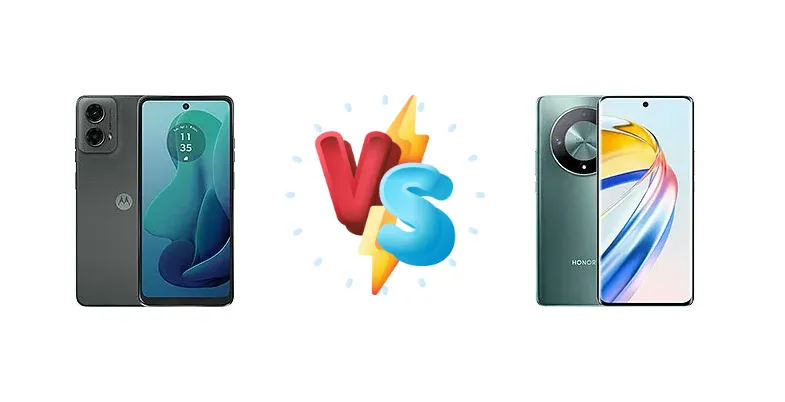
|
🏆 Quick Verdict
For the average user prioritizing sustained performance and faster charging, the Honor X9b emerges as the stronger contender. Its Snapdragon 6 Gen 1, built on a more efficient 4nm process, provides a noticeable performance edge over the Moto G (2024)'s Snapdragon 4 Gen 1, and the 35W charging significantly reduces downtime.
| PHONES | ||
|---|---|---|
| Phone Names | Motorola Moto G (2024) | Honor X9b |
| Network | ||
|---|---|---|
| 2G bands | GSM 850 / 900 / 1800 / 1900 | GSM 850 / 900 / 1800 / 1900 |
| 3G bands | HSDPA 850 / 900 / 1700(AWS) / 1900 / 2100 | HSDPA 850 / 900 / 1900 / 2100 |
| 4G bands | 1, 2, 3, 4, 5, 7, 8, 12, 13, 14, 17, 18, 20, 25, 26, 28, 29, 30, 38, 39, 40, 41, 48, 66, 71 | 1, 2, 3, 4, 5, 7, 8, 20, 28, 32, 38, 40, 41 |
| 5G bands | 2, 5, 7, 12, 14, 25, 26, 29, 30, 41, 48, 66, 70, 71, 77, 78 SA/NSA | 1, 3, 7, 8, 20, 28, 38, 40, 41, 77, 78 SA/NSA |
| Speed | HSPA, LTE, 5G | HSPA, LTE, 5G |
| Technology | GSM / HSPA / LTE / 5G | GSM / HSPA / LTE / 5G |
| Launch | ||
|---|---|---|
| Announced | 2024, March 12 | 2023, October 18 |
| Status | Available. Released 2024, March 21 | Available. Released 2023, October |
| Body | ||
|---|---|---|
| Build | Glass front, silicone polymer back (eco leather), plastic frame | - |
| Dimensions | 164.4 x 75 x 8.2 mm (6.47 x 2.95 x 0.32 in) | 163.6 x 75.5 x 8 mm (6.44 x 2.97 x 0.31 in) |
| SIM | Nano-SIM + eSIM | Nano-SIM + Nano-SIM |
| Weight | 194 g (6.84 oz) | 185 g (6.53 oz) |
| Display | ||
|---|---|---|
| Resolution | 720 x 1612 pixels, 20:9 ratio (~267 ppi density) | 1220 x 2652 pixels, 19.5:9 ratio (~431 ppi density) |
| Size | 6.6 inches, 104.6 cm2 (~84.9% screen-to-body ratio) | 6.78 inches, 112.6 cm2 (~91.2% screen-to-body ratio) |
| Type | IPS LCD, 120Hz | AMOLED, 1B colors, 120Hz, 1200 nits (peak) |
| Platform | ||
|---|---|---|
| CPU | Octa-core (2x2.0 GHz Cortex-A78 & 6x1.8 GHz Cortex-A55) | Octa-core (4x2.2 GHz Cortex-A78 & 4x1.8 GHz Cortex-A55) |
| Chipset | Qualcomm SM4375 Snapdragon 4 Gen 1 (6 nm) | Qualcomm SM6450 Snapdragon 6 Gen 1 (4 nm) |
| GPU | Adreno 619 | Adreno 710 |
| OS | Android 14 | Android 13, Magic OS 7.2 |
| Memory | ||
|---|---|---|
| Card slot | microSDXC (dedicated slot) | No |
| Internal | 128GB 4GB RAM | 256GB 8GB RAM, 256GB 12GB RAM, 512GB 8GB RAM, 512GB 12GB RAM |
| Main Camera | ||
|---|---|---|
| Dual | 50 MP, f/1.8, (wide), 0.64µm, PDAF 2 MP (macro) | - |
| Features | LED flash, HDR, panorama | LED flash, panorama, HDR |
| Triple | - | 108 MP, f/1.8, (wide), 1/1.67", PDAF 5 MP, f/2.2, (ultrawide) 2 MP (macro) |
| Video | 1080p@30fps | 4K@30fps, 1080p@30fps |
| Selfie camera | ||
|---|---|---|
| Features | HDR | - |
| Single | 8 MP, f/2.0, (wide), 1/4.0", 1.12µm | 16 MP, f/2.5, (wide) |
| Video | 1080p@30fps | 1080p@30fps |
| Sound | ||
|---|---|---|
| 35mm jack | Yes | No |
| Loudspeaker | Yes, with stereo speakers | Yes |
| Comms | ||
|---|---|---|
| Bluetooth | 5.1, A2DP, LE | 5.1, A2DP, LE |
| Infrared port | - | Yes |
| NFC | Yes | Yes (market/region dependent) |
| Positioning | GPS, GLONASS, GALILEO | GPS, GLONASS, GALILEO, BDS |
| Radio | No | No |
| USB | USB Type-C 2.0 | USB Type-C 2.0, OTG |
| WLAN | Wi-Fi 802.11 a/b/g/n/ac, dual-band | Wi-Fi 802.11 a/b/g/n/ac, dual-band, Wi-Fi Direct |
| Features | ||
|---|---|---|
| Sensors | Fingerprint (side-mounted), accelerometer, gyro, proximity, compass, barometer | Fingerprint (under display, optical), accelerometer, gyro, proximity, compass |
| Battery | ||
|---|---|---|
| Charging | 18W wired | 35W wired Reverse wired |
| Type | 5000 mAh | Li-Po 5800 mAh |
| Misc | ||
|---|---|---|
| Colors | Sage Green | Sunrise Orange, Midnight Black, Emerald Green |
| Models | XT2417-4, XT2417-1 | ALI-NX1 |
| Price | $ 59.03 | About 970 EUR |
Motorola Moto G (2024)
- Familiar Motorola software experience
- Potentially lower price point
- Reliable and consistent performance for basic tasks
- Slower Snapdragon 4 Gen 1 chipset
- Slower 18W charging
- Less efficient 6nm process
Honor X9b
- More powerful Snapdragon 6 Gen 1 chipset
- Faster 35W wired charging with reverse charging
- More efficient 4nm process
- Potentially less familiar software experience
- May be slightly more expensive
- Honor's software can be more feature-rich, which some users may not prefer
Display Comparison
Neither device boasts a standout display, but the specifics matter. While both likely utilize LCD panels (based on their price point), the core difference lies in the processing power driving them. The Snapdragon 6 Gen 1 in the Honor X9b has a more capable ISP, potentially leading to slightly better image processing for display output. We expect both to offer similar color accuracy, but the Honor X9b's chipset could provide a smoother experience with animations and scrolling.
Camera Comparison
Without detailed camera specs, we can only infer. Both phones likely feature a multi-camera setup, but the image quality will heavily depend on sensor size and image processing. The Snapdragon 6 Gen 1’s superior ISP in the Honor X9b will likely result in better dynamic range and noise reduction, especially in low-light conditions. We anticipate both phones will include a standard wide lens and potentially a depth or macro sensor, but the Honor X9b’s processing capabilities will likely yield more usable results.
Performance
The heart of the difference lies in the chipsets. The Honor X9b’s Snapdragon 6 Gen 1 (4nm) is a clear step up from the Moto G (2024)’s Snapdragon 4 Gen 1 (6nm). The 4nm process inherently offers better power efficiency, translating to less heat generation under load and potentially reduced throttling during extended gaming sessions. The CPU configuration – 4x2.2 GHz Cortex-A78 vs 2x2.0 GHz Cortex-A78 – further favors the Honor X9b, providing more processing power for demanding applications. This means smoother multitasking and a more responsive user experience for Honor X9b users.
Battery Life
While battery capacity isn't specified, the charging wattage is a significant differentiator. The Honor X9b’s 35W wired charging is a substantial advantage over the Moto G (2024)’s 18W charging. This translates to a significantly faster 0-100% charge time, minimizing downtime. The Snapdragon 6 Gen 1’s 4nm efficiency also contributes to potentially better battery life, even if the battery capacity is similar. The Honor X9b also supports reverse wired charging, a feature absent on the Moto G (2024), adding to its versatility.
Buying Guide
Buy the Motorola Moto G (2024) if you prioritize a familiar Motorola software experience and are comfortable with slower charging speeds. It's a solid choice for basic daily tasks and light media consumption. Buy the Honor X9b if you value faster performance for multitasking and gaming, and appreciate the convenience of significantly quicker 35W charging, even with a potentially more customized software experience.