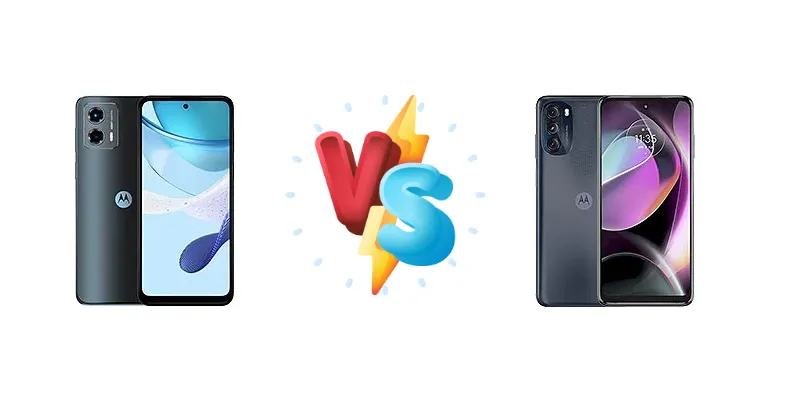
The Motorola Moto G series consistently delivers excellent value in the budget smartphone market. But with annual updates, choosing between the latest and previous generation can be tricky. This comprehensive comparison pits the Moto G (2023) against the Moto G (2022) to help you decide which one is right for you.
🏆 Quick Verdict
The Moto G (2023) edges out the 2022 model thanks to its more efficient chipset, slightly faster charging, and improved overall performance. While the 2022 offers good value, the 2023 provides a noticeable upgrade for a relatively small price difference.
| Network |
|---|
| 2G bands | GSM 850 / 900 / 1800 / 1900 | GSM 850 / 900 / 1800 / 1900 |
| 3G bands | HSDPA 850 / 900 / 1700(AWS) / 1900 / 2100 | HSDPA 850 / 900 / 1700(AWS) / 1900 / 2100 |
| 4G bands | 1, 2, 3, 4, 5, 7, 8, 12, 13, 14, 17, 18, 20, 25, 26, 29, 30, 38, 39, 40, 41, 48, 66, 71 | LTE |
| 5G bands | 2, 5, 7, 12, 14, 25, 26, 29, 30, 41, 48, 66, 70, 71, 78 SA/NSA | SA/NSA |
| Speed | HSPA, LTE, 5G | HSPA, LTE, 5G |
| Technology | GSM / HSPA / LTE / 5G | GSM / HSPA / LTE / 5G |
| Launch |
|---|
| Announced | 2023, May 02 | 2022, April 22 |
| Status | Available. Released 2023, May 25 | Available. Released 2022, May 19 |
| Body |
|---|
| Build | Glass front, plastic frame, plastic back | Glass front, plastic frame, plastic back |
| Dimensions | 164 x 75 x 8.4 mm (6.46 x 2.95 x 0.33 in) | 165.4 x 75.8 x 9.4 mm (6.51 x 2.98 x 0.37 in) |
| SIM | Nano-SIM | Nano-SIM |
| Weight | 189 g (6.67 oz) | 204 g (7.20 oz) |
| | Water-repellent design | Water-repellent design |
| Display |
|---|
| Resolution | 720 x 1600 pixels, 20:9 ratio (~270 ppi density) | 720 x 1600 pixels, 20:9 ratio (~270 ppi density) |
| Size | 6.5 inches, 102.0 cm2 (~82.9% screen-to-body ratio) | 6.5 inches, 102.0 cm2 (~81.4% screen-to-body ratio) |
| Type | IPS LCD, 120Hz | IPS LCD, 90Hz |
| Platform |
|---|
| CPU | Octa-core (2x2.2 GHz Kryo 460 & 6x1.8 GHz Kryo 460) | Octa-core (2x2.2 GHz Cortex-A76 & 6x2.0 GHz Cortex-A55) |
| Chipset | Qualcomm SM4350-AC Snapdragon 480+ 5G (8 nm) | Mediatek Dimensity 700 (7 nm) |
| GPU | Adreno 619 | Mali-G57 MC2 |
| OS | Android 13, planned upgrade to Android 14 | Android 12, planned upgrade to Android 13 |
| Memory |
|---|
| Card slot | microSDXC (dedicated slot) | microSDXC (dedicated slot) |
| Internal | 64GB 4GB RAM, 128GB 4GB RAM | 64GB 4GB RAM, 256GB 6GB RAM |
| Main Camera |
|---|
| Dual | 48 MP, f/1.7, (wide), 0.8µm, PDAF
2 MP (macro) | - |
| Features | LED flash, HDR, panorama | LED flash, HDR, panorama |
| Triple | - | 50 MP, f/1.8, 26mm (wide), 0.64µm, PDAF
2 MP (macro)
Auxiliary lens |
| Video | 1080p@30fps | 1080p@30fps |
| Selfie camera |
|---|
| Features | HDR | HDR |
| Single | 8 MP, f/2.0, (wide), 1/4.0", 1.12µm | 13 MP, f/2.2, (wide), 1.12µm |
| Video | 1080p@30fps | 1080p@30fps |
| Sound |
|---|
| 3.5mm jack | Yes | Yes |
| 35mm jack | Yes | Yes |
| Loudspeaker | Yes, with stereo speakers | Yes |
| Comms |
|---|
| Bluetooth | 5.1, A2DP, LE | 5.1, A2DP, LE |
| NFC | No | No |
| Positioning | GPS, GLONASS, GALILEO, BDS | GPS, GLONASS |
| Radio | No | No |
| USB | USB Type-C 2.0 | USB Type-C 2.0 |
| WLAN | Wi-Fi 802.11 a/b/g/n/ac, dual-band | Wi-Fi 802.11 a/b/g/n/ac, dual-band, Wi-Fi Direct |
| Features |
|---|
| Sensors | Fingerprint (side-mounted), accelerometer, gyro, proximity, compass | Fingerprint (side-mounted), accelerometer, gyro, proximity, compass, barometer |
| Battery |
|---|
| Charging | 15W wired | 10W wired |
| Type | Li-Po 5000 mAh | Li-Po 5000 mAh |
| Misc |
|---|
| Colors | Ink Blue | Moonlight Gray |
| Models | XT2313 | XT2213, XT2213-3 |
| Price | $ 56.55 | $ 65.00 |
Motorola Moto G (2023)
- More efficient Snapdragon 480+ chipset
- Faster 15W charging
- Potentially improved camera performance
- Slightly better battery life
- May be slightly more expensive than the 2022
- Design is similar to previous models
Motorola Moto G (2022)
- More affordable
- Reliable performance for everyday tasks
- Large 5000mAh battery
- Decent camera for the price
- Less efficient Dimensity 700 chipset
- Slower 10W charging
- Potentially less impressive camera quality
Display Comparison
Both phones feature a similar 6.5-inch display, likely an IPS LCD panel. However, the Moto G (2023) may offer slightly improved brightness and color accuracy due to advancements in panel technology. Expect a resolution of 1080 x 2400 pixels on both, providing a sharp and clear viewing experience.
Camera Comparison
The Moto G (2023) likely features a 50MP main camera, potentially with improved image processing algorithms. The 2022 also has a 50MP main camera, but the 2023's newer hardware and software should result in better low-light performance and more detailed photos. Both likely include ultrawide and macro lenses.
Performance
The Snapdragon 480+ in the Moto G (2023) is generally more efficient and offers a performance boost over the Dimensity 700 in the 2022 model. Expect smoother multitasking, faster app loading times, and a more responsive user interface on the 2023. While neither is a powerhouse, the 2023 handles everyday tasks with greater ease.
Battery Life
Both phones are expected to have a 5000mAh battery, providing all-day battery life. However, the Moto G (2023)'s more efficient chipset should translate to slightly better battery endurance. The 2023 also supports 15W charging, a step up from the 2022's 10W charging, reducing charging times.
Buying Guide
The Moto G (2023) is ideal for users seeking a smoother, more responsive experience and faster charging. It's a great choice for everyday tasks, social media, and light gaming. The Moto G (2022) remains a solid option for budget-conscious buyers who prioritize affordability and a reliable, albeit slightly less powerful, device.
Frequently Asked Questions
❓ Is the Moto G (2023) worth the upgrade from the Moto G (2022)?
If you prioritize performance and faster charging, the Moto G (2023) is a worthwhile upgrade. However, if you're on a tight budget and the 2022 meets your needs, it remains a solid choice.
❓ What is the difference in performance between the Snapdragon 480+ and the Dimensity 700?
The Snapdragon 480+ generally offers better efficiency and slightly improved performance, particularly in graphics-intensive tasks. Both chipsets are suitable for everyday use, but the 480+ provides a more responsive experience.