
Motorola Moto G (2023) vs. Edge (2023): Which Motorola Phone Wins?
| Phones Images | |||||
|---|---|---|---|---|---|
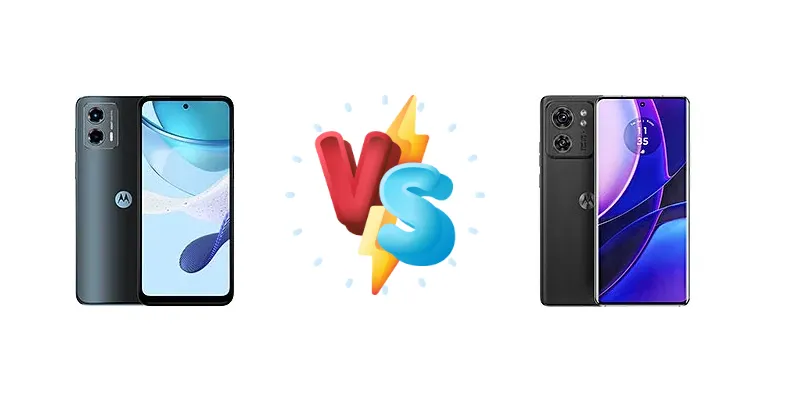
|
🏆 Quick Verdict
For the average user prioritizing affordability and basic 5G connectivity, the Motorola Moto G (2023) is the better choice. However, the Motorola Edge (2023) justifies its higher price with significantly faster 68W charging and a more powerful Dimensity 7030 chipset, benefiting users who demand quicker top-ups and smoother multitasking.
| PHONES | ||
|---|---|---|
| Phone Names | Motorola Moto G (2023) | Motorola Edge (2023) |
| Network | ||
|---|---|---|
| 2G bands | GSM 850 / 900 / 1800 / 1900 | GSM 850 / 900 / 1800 / 1900 |
| 3G bands | HSDPA 850 / 900 / 1700(AWS) / 1900 / 2100 | HSDPA 850 / 900 / 1700(AWS) / 1900 / 2100 |
| 4G bands | 1, 2, 3, 4, 5, 7, 8, 12, 13, 14, 17, 18, 20, 25, 26, 29, 30, 38, 39, 40, 41, 48, 66, 71 | 1, 2, 3, 4, 5, 7, 8, 12, 13, 14, 17, 18, 19, 20, 25, 26, 29, 30, 38, 39, 40, 41, 48, 66, 71 |
| 5G bands | 2, 5, 7, 12, 14, 25, 26, 29, 30, 41, 48, 66, 70, 71, 78 SA/NSA | 1, 2, 3, 5, 7, 12, 14, 20, 25, 26, 29, 30, 38, 40, 41, 48, 66, 70, 71, 77, 78 SA/NSA/Sub6 |
| Speed | HSPA, LTE, 5G | HSPA, LTE, 5G |
| Technology | GSM / HSPA / LTE / 5G | GSM / HSPA / LTE / 5G |
| Launch | ||
|---|---|---|
| Announced | 2023, May 02 | 2023, October 11 |
| Status | Available. Released 2023, May 25 | Available. Released 2023, October 11 |
| Body | ||
|---|---|---|
| Build | Glass front, plastic frame, plastic back | Glass front, aluminum frame, silicone polymer back (eco leather) |
| Dimensions | 164 x 75 x 8.4 mm (6.46 x 2.95 x 0.33 in) | 158.4 x 72 x 7.6 mm (6.24 x 2.83 x 0.30 in) |
| SIM | Nano-SIM | Nano-SIM + eSIM |
| Weight | 189 g (6.67 oz) | 168 g (5.93 oz) |
| Water-repellent design | - | |
| Display | ||
|---|---|---|
| Resolution | 720 x 1600 pixels, 20:9 ratio (~270 ppi density) | 1080 x 2400 pixels, 20:9 ratio (~402 ppi density) |
| Size | 6.5 inches, 102.0 cm2 (~82.9% screen-to-body ratio) | 6.6 inches, 103.6 cm2 (~90.8% screen-to-body ratio) |
| Type | IPS LCD, 120Hz | P-OLED, 1B colors, 144Hz, HDR10+, 1200 nits (peak) |
| Platform | ||
|---|---|---|
| CPU | Octa-core (2x2.2 GHz Kryo 460 & 6x1.8 GHz Kryo 460) | Octa-core (2x2.5 GHz Cortex-A78 & 6x2.0 GHz Cortex-A55) |
| Chipset | Qualcomm SM4350-AC Snapdragon 480+ 5G (8 nm) | MediaTek Dimensity 7030 (6 nm) |
| GPU | Adreno 619 | Mali-G610 MC3 |
| OS | Android 13, planned upgrade to Android 14 | Android 13, planned upgrade to Android 14 |
| Memory | ||
|---|---|---|
| Card slot | microSDXC (dedicated slot) | No |
| Internal | 64GB 4GB RAM, 128GB 4GB RAM | 256GB 8GB RAM |
| Main Camera | ||
|---|---|---|
| Dual | 48 MP, f/1.7, (wide), 0.8µm, PDAF 2 MP (macro) | 50 MP, f/1.4, (wide), 1/1.5", 1.0µm, multi-directional PDAF, OIS 13 MP, f/2.2, 120˚ (ultrawide), 1.12µm, AF |
| Features | LED flash, HDR, panorama | Dual-LED flash, HDR, panorama |
| Video | 1080p@30fps | 4K@30fps, 1080p@30/60fps, HDR, gyro-EIS |
| Selfie camera | ||
|---|---|---|
| Features | HDR | HDR |
| Single | 8 MP, f/2.0, (wide), 1/4.0", 1.12µm | 32 MP, f/2.4, (wide), 0.8µm |
| Video | 1080p@30fps | 4K@30fps, 1080p@30fps |
| Sound | ||
|---|---|---|
| 3.5mm jack | Yes | - |
| 35mm jack | Yes | No |
| Loudspeaker | Yes, with stereo speakers | Yes, with stereo speakers |
| Comms | ||
|---|---|---|
| Bluetooth | 5.1, A2DP, LE | 5.2, A2DP, LE |
| NFC | No | Yes |
| Positioning | GPS, GLONASS, GALILEO, BDS | GPS, GLONASS, GALILEO |
| Radio | No | No |
| USB | USB Type-C 2.0 | USB Type-C 2.0 |
| WLAN | Wi-Fi 802.11 a/b/g/n/ac, dual-band | Wi-Fi 802.11 a/b/g/n/ac/6e/k/v/r, tri-band, Wi-Fi Direct |
| Features | ||
|---|---|---|
| Sensors | Fingerprint (side-mounted), accelerometer, gyro, proximity, compass | Fingerprint (under display, optical), accelerometer, gyro, proximity, compass, barometer |
| Battery | ||
|---|---|---|
| Charging | 15W wired | 68W wired 15W wireless |
| Type | Li-Po 5000 mAh | Li-Po 4400 mAh |
| Misc | ||
|---|---|---|
| Colors | Ink Blue | Eclipse Black |
| Models | XT2313 | - |
| Price | $ 56.55 | $ 189.95 |
Motorola Moto G (2023)
- Significantly more affordable
- 5G connectivity at a budget price
- Acceptable performance for basic tasks
- Slow 15W charging
- Less powerful processor
- Likely limited gaming capabilities
Motorola Edge (2023)
- 68W wired and 15W wireless charging
- More powerful MediaTek Dimensity 7030 chipset
- Smoother multitasking and app performance
- Higher price point
- May not justify the cost for basic users
- Potential for thermal throttling under sustained load
Display Comparison
While both devices likely feature LCD panels given their price points, detailed display specs are unavailable. The focus here is on performance. The Moto G (2023) will likely prioritize maximizing screen-on time, while the Edge (2023) may offer slightly better color accuracy due to its higher tier positioning. Bezels are expected to be comparable, reflecting the budget-conscious nature of both devices.
Camera Comparison
Without detailed camera specs, it's difficult to make a definitive judgment. However, the Edge (2023) is likely to feature a more capable main sensor, benefiting from its higher price bracket. Motorola often prioritizes software processing, so image quality will depend heavily on algorithms. The presence of 68W charging suggests a focus on all-day usability, implying a need for a decent camera to capture those moments. The Moto G (2023) will likely suffice for casual photography, but won't compete in low-light conditions.
Performance
The core difference lies in the chipsets. The Motorola Edge (2023) utilizes the MediaTek Dimensity 7030, fabricated on a more efficient 6nm process compared to the Moto G (2023)'s Snapdragon 480+ 5G (8nm). This translates to better power efficiency and sustained performance. The Dimensity 7030’s Cortex-A78 cores (2x2.5 GHz) offer a significant architectural advantage over the Kryo 460 cores (2x2.2 GHz) in the Snapdragon 480+, resulting in faster app loading and smoother multitasking. The Snapdragon 480+ is adequate for basic tasks, but will struggle with graphically intensive games. The Edge's chipset will provide a noticeably more responsive experience.
Battery Life
The Motorola Edge (2023) boasts a significant advantage with its 68W wired charging, capable of rapidly replenishing the battery. The Moto G (2023)'s 15W charging is comparatively slow. While battery capacity isn't specified, the Edge's faster charging mitigates the impact of a potentially smaller battery. Users who frequently find themselves needing a quick top-up will greatly benefit from the Edge's charging speed. The Edge also adds 15W wireless charging, a feature absent on the Moto G (2023).
Buying Guide
Buy the Motorola Moto G (2023) if you need a reliable, budget-friendly 5G smartphone for everyday tasks like browsing, social media, and light communication. Buy the Motorola Edge (2023) if you prioritize fast charging, smoother performance for demanding apps, and are willing to spend more for a more refined user experience.