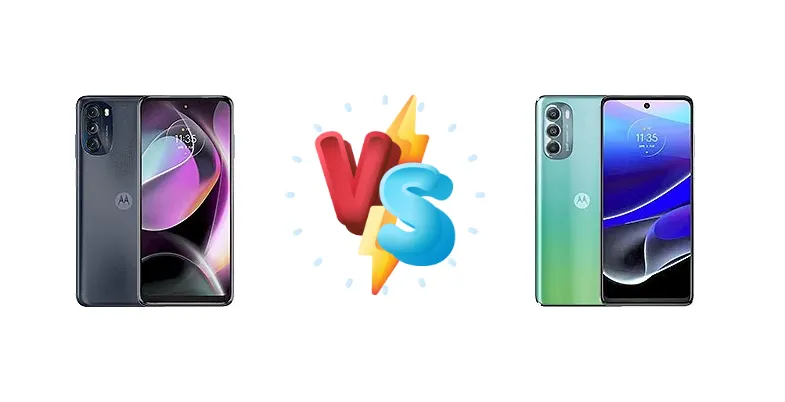
Motorola's Moto G series consistently delivers excellent value in the budget smartphone market. The Moto G (2022) and Moto G Stylus 5G (2022) are two compelling options, but which one reigns supreme? This detailed comparison will help you make an informed decision.
🏆 Quick Verdict
The Moto G Stylus 5G (2022) edges out the standard Moto G (2022) thanks to its 5G connectivity, slightly more powerful chipset, faster charging (QC3), and the inclusion of a stylus. However, the standard Moto G might offer a slightly better display experience depending on the specific panel used.
| Network |
|---|
| 2G bands | GSM 850 / 900 / 1800 / 1900 | GSM 850 / 900 / 1800 / 1900 |
| 3G bands | HSDPA 850 / 900 / 1700(AWS) / 1900 / 2100 | HSDPA 850 / 900 / 1700(AWS) / 1900 / 2100 |
| 4G bands | LTE | 1, 2, 3, 4, 5, 7, 8, 12, 13, 17, 18, 19, 20, 25, 26, 28, 29, 30, 38, 39, 40, 41, 48, 66, 71 - USA |
| 5G bands | SA/NSA | 1, 2, 5, 12, 14, 24, 26, 29, 30, 41, 48, 66, 70, 71, 77, 78 SA/NSA - USA |
| Speed | HSPA, LTE, 5G | HSPA, LTE, 5G |
| Technology | GSM / HSPA / LTE / 5G | GSM / HSPA / LTE / 5G |
| Launch |
|---|
| Announced | 2022, April 22 | 2022, April 22 |
| Status | Available. Released 2022, May 19 | Available. Released 2022, April 27 |
| Body |
|---|
| Build | Glass front, plastic frame, plastic back | Glass front, plastic frame, plastic back |
| Dimensions | 165.4 x 75.8 x 9.4 mm (6.51 x 2.98 x 0.37 in) | 168.9 x 75.8 x 9.3 mm (6.65 x 2.98 x 0.37 in) |
| SIM | Nano-SIM | Nano-SIM |
| Weight | 204 g (7.20 oz) | 215 g (7.58 oz) |
| | Water-repellent design | Stylus
Water-repellent design |
| Display |
|---|
| Resolution | 720 x 1600 pixels, 20:9 ratio (~270 ppi density) | 1080 x 2460 pixels (~395 ppi density) |
| Size | 6.5 inches, 102.0 cm2 (~81.4% screen-to-body ratio) | 6.8 inches, 109.8 cm2 (~85.8% screen-to-body ratio) |
| Type | IPS LCD, 90Hz | IPS LCD, 120Hz |
| Platform |
|---|
| CPU | Octa-core (2x2.2 GHz Cortex-A76 & 6x2.0 GHz Cortex-A55) | Octa-core (2x2.2 GHz Kryo 660 Gold & 6x1.7 GHz Kryo 660 Silver) |
| Chipset | Mediatek Dimensity 700 (7 nm) | Qualcomm SM6375 Snapdragon 695 5G (6 nm) |
| GPU | Mali-G57 MC2 | Adreno 619 |
| OS | Android 12, planned upgrade to Android 13 | Android 12, planned upgrade to Android 13 |
| Memory |
|---|
| Card slot | microSDXC (dedicated slot) | microSDXC (dedicated slot) |
| Internal | 64GB 4GB RAM, 256GB 6GB RAM | 128GB 4GB RAM, 128GB 6GB RAM, 128GB 8GB RAM, 256GB 8GB RAM |
| Main Camera |
|---|
| Features | LED flash, HDR, panorama | LED flash, HDR, panorama |
| Triple | 50 MP, f/1.8, 26mm (wide), 0.64µm, PDAF
2 MP (macro)
Auxiliary lens | 50 MP, f/1.9, 26mm (wide), 0.64µm, PDAF, OIS
8 MP, f/2.2, 118˚ (ultrawide), 1/4.0, 1.12µm
Auxiliary lens |
| Video | 1080p@30fps | 1080p@30/60fps; gyro-EIS |
| Selfie camera |
|---|
| Features | HDR | HDR |
| Single | 13 MP, f/2.2, (wide), 1.12µm | 16 MP, f/2.2, (wide), 1/3.06", 1.0µm |
| Video | 1080p@30fps | 1080p@30fps |
| Sound |
|---|
| 3.5mm jack | Yes | Yes |
| 35mm jack | Yes | Yes |
| Loudspeaker | Yes | Yes |
| Comms |
|---|
| Bluetooth | 5.1, A2DP, LE | 5.1, A2DP, LE |
| NFC | No | Yes |
| Positioning | GPS, GLONASS | GPS, GLONASS, BDS, GALILEO |
| Radio | No | FM radio |
| USB | USB Type-C 2.0 | USB Type-C 2.0 |
| WLAN | Wi-Fi 802.11 a/b/g/n/ac, dual-band, Wi-Fi Direct | Wi-Fi 802.11 a/b/g/n/ac, dual-band, Wi-Fi Direct |
| Features |
|---|
| Sensors | Fingerprint (side-mounted), accelerometer, gyro, proximity, compass, barometer | Fingerprint (side-mounted), accelerometer, gyro, proximity |
| Battery |
|---|
| Charging | 10W wired | 10W wired, QC3 |
| Type | Li-Po 5000 mAh | Li-Po 5000 mAh |
| Misc |
|---|
| Colors | Moonlight Gray | Steel Blue, Seafoam Green |
| Models | XT2213, XT2213-3 | XT2215, XT2215-1, XT2215-2, XT2215-3, XT2215-4 |
| Price | $ 65.00 | $ 66.60 |
Motorola Moto G (2022)
- Clean Android experience
- Potentially better display quality
- Compact design
- Good value
- Slower charging
- Less powerful chipset
- No 5G connectivity
- Stylus absent
Motorola Moto G Stylus 5G (2022)
- 5G connectivity
- Stylus included
- Faster charging (QC3)
- More powerful chipset
- Larger battery (typically)
- Potentially slightly lower display quality
- Larger size
- Can be slightly more expensive
Display Comparison
Both phones feature a 6.5-inch display, but the Moto G (2022) *may* have a slightly better panel (potentially higher brightness and color accuracy) depending on the specific variant. The Stylus 5G prioritizes screen size over absolute display quality. Resolution is generally FHD+ on both.
Camera Comparison
The Moto G Stylus 5G typically features a higher resolution main camera (50MP vs. 50MP on the standard Moto G, though sensor size and image processing differ). Both offer decent camera performance for the price, but the Stylus 5G often produces slightly more detailed images, especially in good lighting. Both have ultrawide and macro lenses.
Performance
The Snapdragon 695 5G in the Stylus 5G offers a noticeable performance boost over the Dimensity 700 in the standard Moto G. While both are capable for everyday tasks, the Stylus 5G handles more demanding apps and games with greater ease. The 6nm process of the Snapdragon also contributes to better power efficiency.
Battery Life
The Moto G Stylus 5G generally boasts a larger battery capacity (5000mAh vs. 5000mAh on the standard Moto G), and the inclusion of Quick Charge 3.0 allows for faster charging speeds compared to the standard Moto G's 10W charging.
Buying Guide
The Motorola Moto G (2022) is ideal for users prioritizing a clean Android experience, a potentially better display, and a slightly more compact form factor. The Motorola Moto G Stylus 5G (2022) is perfect for those who want 5G connectivity, a stylus for note-taking and drawing, and a larger battery.
Frequently Asked Questions
❓ Does the Moto G Stylus 5G's stylus require charging?
No, the stylus is passive and does not require charging. It's a simple, convenient tool for note-taking and drawing.
❓ Is 5G connectivity important for me?
If you live in an area with good 5G coverage and want faster download and streaming speeds, then 5G connectivity is a significant advantage. Otherwise, 4G LTE is still perfectly adequate for most users.