
Motorola Moto E7 vs Nokia G20: A Deep Dive into Budget Smartphone Performance
| Phones Images | |||||
|---|---|---|---|---|---|
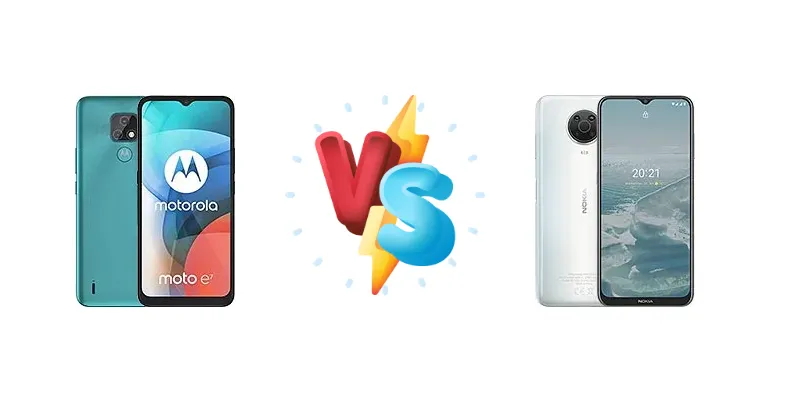
|
🏆 Quick Verdict
For most users, the Nokia G20 edges out the Moto E7. While both share the same 10W charging, the G20’s Helio G35 chipset, with its slightly higher clocked CPU cores, provides a noticeable performance boost in everyday tasks and light multitasking, making it the better all-rounder.
| PHONES | ||
|---|---|---|
| Phone Names | Motorola Moto E7 | Nokia G20 |
| Network | ||
|---|---|---|
| 2G bands | GSM 850 / 900 / 1800 / 1900 | GSM 850 / 900 / 1800 / 1900 |
| 3G bands | HSDPA 850 / 900 / 1900 / 2100 - Europe, Asia | HSDPA 850 / 900 / 1900 / 2100 - International |
| 4G bands | 1, 3, 5, 7, 8, 20, 38, 40, 41 - Europe | 1, 3, 5, 7, 8, 20, 28, 38, 40, 41 - International |
| Speed | HSPA 42.2/5.76 Mbps, LTE Cat4 150/50 Mbps | HSPA 42.2/5.76 Mbps, LTE Cat4 150/50 Mbps |
| Technology | GSM / HSPA / LTE | GSM / HSPA / LTE |
| 1, 2, 3, 5, 7, 8, 18, 19, 20, 26, 28, 38, 40, 41 - Asia | 1, 2, 3, 4, 5, 7, 8, 12, 17, 28, 66 - LATAM | |
| Launch | ||
|---|---|---|
| Announced | 2020, November 24. Released 2020, December 09 | 2021, April 08 |
| Status | Discontinued | Available. Released 2021, May 17 |
| Body | ||
|---|---|---|
| Build | Glass front, plastic frame, plastic back | - |
| Dimensions | 164.9 x 75.7 x 8.9 mm (6.49 x 2.98 x 0.35 in) | 164.9 x 76 x 9.2 mm (6.49 x 2.99 x 0.36 in) |
| SIM | Nano-SIM + Nano-SIM | · Nano-SIM· Nano-SIM + Nano-SIM |
| Weight | 180 g (6.35 oz) | 197 g (6.95 oz) |
| Water-repellent coating | Splash protection | |
| Display | ||
|---|---|---|
| Resolution | 720 x 1600 pixels, 20:9 ratio (~269 ppi density) | 720 x 1600 pixels, 20:9 ratio (~269 ppi density) |
| Size | 6.5 inches, 102.8 cm2 (~82.3% screen-to-body ratio) | 6.52 inches, 102.6 cm2 (~81.9% screen-to-body ratio) |
| Type | IPS LCD | IPS LCD |
| Platform | ||
|---|---|---|
| CPU | Octa-core (4x2.0 GHz Cortex-A53 & 4x1.5 GHz Cortex-A53) | Octa-core (4x2.3 GHz Cortex-A53 & 4x1.8 GHz Cortex-A53) |
| Chipset | Mediatek MT6762G Helio G25 (12 nm) | Mediatek MT6765G Helio G35 (12 nm) |
| GPU | PowerVR GE8320 | PowerVR GE8320 |
| OS | Android 10 | Android 11, upgradable to Android 13 |
| Memory | ||
|---|---|---|
| Card slot | microSDXC (uses shared SIM slot) | microSDXC (dedicated slot) |
| Internal | 32GB 2GB RAM, 64GB 2GB RAM, 64GB 4GB RAM | 64GB 4GB RAM, 128GB 4GB RAM |
| eMMC 5.1 | - | |
| Main Camera | ||
|---|---|---|
| Dual | 48 MP, f/1.7, 26mm (wide), 1/2.0", 0.8µm, PDAF 2 MP (macro) | - |
| Features | LED flash, HDR, panorama | LED flash, HDR, panorama |
| Quad | - | 48 MP, f/1.8, (wide), PDAF 5 MP, (ultrawide) 2 MP (macro) Auxiliary lens |
| Single | - | 8 MP, (wide) |
| Video | 1080p@30fps | 1080p@30fps |
| Selfie camera | ||
|---|---|---|
| Features | HDR | - |
| Single | 5 MP, f/2.2 | 8 MP, (wide) |
| Video | 1080p@30fps | 1080p@30fps |
| Sound | ||
|---|---|---|
| 3.5mm jack | Yes | Yes |
| 35mm jack | Yes | Yes |
| Loudspeaker | Yes | Yes |
| Comms | ||
|---|---|---|
| Bluetooth | 5.0, A2DP, LE | 5.0, A2DP, LE |
| NFC | No | Yes (market/region dependent) |
| Positioning | GPS, GLONASS, GALILEO | GPS, GLONASS, BDS |
| Radio | FM radio | FM radio |
| USB | USB Type-C 2.0 | USB Type-C 2.0, OTG |
| WLAN | Wi-Fi 802.11 b/g/n | Wi-Fi 802.11 b/g/n |
| Features | ||
|---|---|---|
| Sensors | Fingerprint (rear-mounted), accelerometer, proximity | Fingerprint (side-mounted), accelerometer, gyro, proximity |
| Battery | ||
|---|---|---|
| Charging | 10W wired | 10W wired |
| Type | Li-Po 4000 mAh | Li-Po 5050 mAh |
| Misc | ||
|---|---|---|
| Colors | Mineral Gray, Aqua Blue, Satin Coral | Glacier, Night |
| Models | - | TA-1336, TA-1343, TA-1347, TA-1372, TA-1365 |
| Price | About 110 EUR | About 90 EUR |
| SAR | - | 1.01 W/kg (head) 1.02 W/kg (body) |
| SAR EU | - | 0.49 W/kg (head) 1.13 W/kg (body) |
Motorola Moto E7
- Potentially more compact design.
- Established Motorola brand recognition.
- Likely lower initial price point.
- Less powerful Helio G25 chipset.
- Slower CPU clock speeds.
- Potentially shorter software support.
Nokia G20
- More powerful Helio G35 chipset.
- Faster CPU clock speeds for improved performance.
- Nokia’s commitment to Android updates.
- Potentially larger form factor.
- May be slightly more expensive.
- Still limited by 10W charging.
Display Comparison
Neither device boasts a standout display. Both likely utilize LCD panels, typical for this price point. The focus here isn't on visual fidelity, but on basic usability. Without specific display specs, we can assume similar levels of brightness and color accuracy. Bezels are likely substantial on both, maximizing screen real estate within a budget.
Camera Comparison
Camera performance is likely to be similar, and not a strong point for either device. Both will likely feature a primary camera alongside basic auxiliary lenses (often 2MP macro or depth sensors, which we'll largely ignore due to their limited utility). The image processing capabilities of the Helio G35 *might* offer a slight edge in dynamic range, but don't expect flagship-level results. Low-light performance will be a challenge for both.
Performance
The core difference lies in the chipsets. The Moto E7 features the Mediatek MT6762G Helio G25, while the Nokia G20 uses the MT6765G Helio G35. Both are 12nm chips, indicating similar power efficiency. However, the G35’s CPU configuration – 4x2.3 GHz Cortex-A53 & 4x1.8 GHz Cortex-A53 – offers a clock speed advantage over the E7’s 4x2.0 GHz Cortex-A53 & 4x1.5 GHz Cortex-A53. This translates to snappier app launches and smoother performance in less demanding applications. While neither chip is a gaming powerhouse, the G35 will handle basic games slightly better. The RAM configuration (not specified) will also play a role, but the chipset difference is the primary performance differentiator.
Battery Life
Both phones are equipped with 10W wired charging, a significant limitation in today’s market. Battery capacity isn’t specified, but given the target market, we can assume capacities around 5000mAh. The slightly more efficient Helio G35 in the Nokia G20 *could* translate to marginally longer battery life, but the difference will likely be minimal. Expect a full charge to take well over two hours with the included charger.
Buying Guide
Buy the Motorola Moto E7 if you prioritize a slightly more compact form factor and are primarily focused on extremely basic smartphone functions like calls, texts, and light social media. Buy the Nokia G20 if you value a bit more processing power for smoother app switching, slightly better multitasking, and a potentially longer software support lifecycle, given Nokia’s commitment to updates.