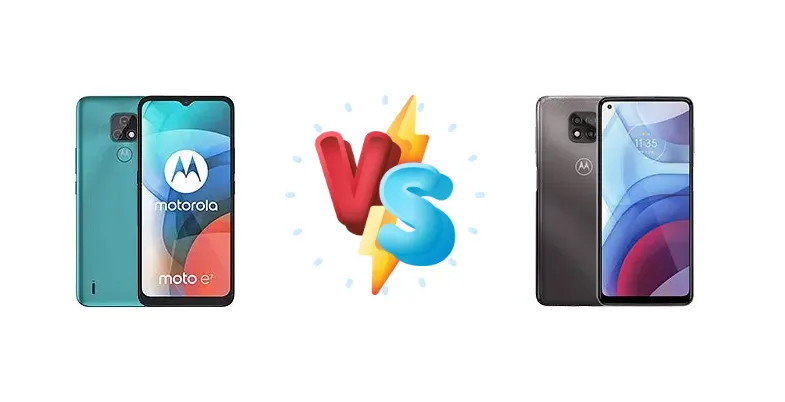
Motorola’s budget lineup often presents a difficult choice: prioritize battery life and affordability, or step up to a more capable processor. The Moto G Power (2021) and Moto E7 represent these two approaches, offering distinct experiences within a similar price bracket. This comparison dissects their core components to determine which phone delivers the best value for your money.
🏆 Quick Verdict
For most users, the Motorola Moto G Power (2021) is the superior choice. Its Snapdragon 662 chipset provides a noticeable performance boost over the Moto E7’s Helio G25, translating to smoother multitasking and a more responsive user experience. While the E7 offers a lower entry price, the G Power’s improved processing power and faster charging justify the slight premium.
| Network |
|---|
| 2G bands | GSM 850 / 900 / 1800 / 1900 | GSM 850 / 900 / 1800 / 1900 |
| 3G bands | HSDPA 850 / 900 / 1900 / 2100 - Europe, Asia | HSDPA 850 / 900 / 1700(AWS) / 1900 / 2100 |
| 4G bands | 1, 3, 5, 7, 8, 20, 38, 40, 41 - Europe | 1, 2, 3, 4, 5, 7, 8, 12, 13, 14, 17, 25, 26, 29, 30, 38, 41, 66, 71 |
| Speed | HSPA 42.2/5.76 Mbps, LTE Cat4 150/50 Mbps | HSPA, LTE |
| Technology | GSM / HSPA / LTE | GSM / CDMA / HSPA / EVDO / LTE |
| | 1, 2, 3, 5, 7, 8, 18, 19, 20, 26, 28, 38, 40, 41 - Asia | CDMA2000 1xEV-DO |
| Launch |
|---|
| Announced | 2020, November 24. Released 2020, December 09 | 2021, January 08 |
| Status | Discontinued | Available. Released 2021, January 14 |
| Body |
|---|
| Build | Glass front, plastic frame, plastic back | Glass front, plastic back, plastic frame |
| Dimensions | 164.9 x 75.7 x 8.9 mm (6.49 x 2.98 x 0.35 in) | 165.3 x 75.9 x 9.5 mm (6.51 x 2.99 x 0.37 in) |
| SIM | Nano-SIM + Nano-SIM | Nano-SIM |
| Weight | 180 g (6.35 oz) | 206.5 g (7.30 oz) |
| | Water-repellent coating | Water-repellent coating |
| Display |
|---|
| Resolution | 720 x 1600 pixels, 20:9 ratio (~269 ppi density) | 720 x 1600 pixels, 20:9 ratio (~266 ppi density) |
| Size | 6.5 inches, 102.8 cm2 (~82.3% screen-to-body ratio) | 6.6 inches, 105.2 cm2 (~83.8% screen-to-body ratio) |
| Type | IPS LCD | IPS LCD |
| Platform |
|---|
| CPU | Octa-core (4x2.0 GHz Cortex-A53 & 4x1.5 GHz Cortex-A53) | Octa-core (4x2.0 GHz Kryo 260 Gold & 4x1.8 GHz Kryo 260 Silver) |
| Chipset | Mediatek MT6762G Helio G25 (12 nm) | Qualcomm SM6115 Snapdragon 662 (11 nm) |
| GPU | PowerVR GE8320 | Adreno 610 |
| OS | Android 10 | Android 10 |
| Memory |
|---|
| Card slot | microSDXC (uses shared SIM slot) | microSDXC (dedicated slot) |
| Internal | 32GB 2GB RAM, 64GB 2GB RAM, 64GB 4GB RAM | 32GB 3GB RAM, 64GB 4GB RAM |
| | eMMC 5.1 | eMMC 5.1 |
| Main Camera |
|---|
| Dual | 48 MP, f/1.7, 26mm (wide), 1/2.0", 0.8µm, PDAF
2 MP (macro) | - |
| Features | LED flash, HDR, panorama | LED flash, HDR, panorama |
| Triple | - | 48 MP, f/1.7, (wide), 1/2.0", 0.8µm, PDAF
2 MP (macro)
Auxiliary lens |
| Video | 1080p@30fps | 1080p@30/60fps, gyro-EIS |
| Selfie camera |
|---|
| Features | HDR | HDR |
| Single | 5 MP, f/2.2 | 8 MP, f/2.0, 1.12µm |
| Video | 1080p@30fps | 1080p@30fps, gyro-EIS |
| Sound |
|---|
| 3.5mm jack | Yes | Yes |
| 35mm jack | Yes | Yes |
| Loudspeaker | Yes | Yes |
| Comms |
|---|
| Bluetooth | 5.0, A2DP, LE | 5.0, A2DP, LE |
| NFC | No | No |
| Positioning | GPS, GLONASS, GALILEO | GPS, GLONASS, GALILEO |
| Radio | FM radio | FM radio |
| USB | USB Type-C 2.0 | USB Type-C 2.0 |
| WLAN | Wi-Fi 802.11 b/g/n | Wi-Fi 802.11 a/b/g/n/ac, dual-band, Wi-Fi Direct |
| Features |
|---|
| Sensors | Fingerprint (rear-mounted), accelerometer, proximity | Fingerprint (side-mounted), accelerometer, gyro, proximity, compass, barometer |
| Battery |
|---|
| Charging | 10W wired | 15W wired |
| Type | Li-Po 4000 mAh | Li-Po 5000 mAh |
| Misc |
|---|
| Colors | Mineral Gray, Aqua Blue, Satin Coral | Flash Gray, Polar Silver |
| Price | About 110 EUR | About 60 EUR |
Motorola Moto E7
- Lower price point makes it very accessible.
- Functional for basic smartphone tasks.
- Potentially longer battery life due to less demanding processor.
- Significantly slower performance compared to the G Power.
- Slower 10W charging.
- Likely inferior camera performance.
Motorola Moto G Power (2021)
- Faster and more responsive performance with Snapdragon 662.
- Faster 15W charging.
- Potentially better camera quality.
- More efficient processor for longer sustained use.
- Slightly higher price.
- May not offer dramatically longer battery life than the E7.
Display Comparison
Both devices likely feature LCD panels, typical for this price segment. However, detailed display specs like resolution and brightness are not provided. The focus here is on internal processing. The lack of information prevents a detailed comparison of visual quality, but it's safe to assume neither will compete with higher-end OLED displays. Bezels are likely comparable, prioritizing cost-effectiveness over premium aesthetics.
Camera Comparison
Without detailed sensor information, a direct camera comparison is difficult. However, Motorola’s marketing typically focuses on megapixel count rather than sensor size. It’s reasonable to assume the Moto G Power (2021) has a larger primary sensor, offering better low-light performance and dynamic range. The presence of image stabilization (OIS) on the G Power, if equipped, would further enhance image quality. The E7 likely relies heavily on software processing to compensate for a smaller sensor. The inclusion of 2MP macro lenses on both devices is largely a marketing tactic, offering limited practical benefit.
Performance
The core difference lies in the chipsets. The Moto G Power (2021) utilizes the Qualcomm Snapdragon 662 (11nm), built on a more efficient manufacturing process than the Moto E7’s MediaTek Helio G25 (12nm). This 11nm process allows the Snapdragon 662 to deliver more performance per watt, resulting in better sustained performance and potentially lower temperatures. While both CPUs feature octa-core configurations, the Snapdragon’s Kryo 260 Gold cores (2.0 GHz) are architecturally more advanced than the Cortex-A53 cores (2.0 GHz) in the Helio G25, leading to superior single-core performance. The G Power’s CPU also has slightly slower efficiency cores (1.8 GHz vs 1.5 GHz), but the overall architectural advantage of the Snapdragon outweighs this.
Battery Life
The Moto G Power (2021) and Moto E7 both prioritize battery life, but approach it differently. While specific battery capacities aren’t provided, the G Power’s 15W charging significantly outperforms the E7’s 10W charging. This means the G Power can replenish its battery faster, reducing downtime. The Snapdragon 662’s improved efficiency also contributes to better battery life during active use, even if the E7 has a slightly larger battery capacity. The faster charging is a key advantage for users who need to quickly top up their phone.
Buying Guide
Buy the Motorola Moto E7 if you absolutely need the lowest possible price and your smartphone usage is limited to basic tasks like calls, texts, and light social media. It’s a functional device for minimalists. Buy the Motorola Moto G Power (2021) if you value a smoother, more responsive experience, enjoy occasional gaming, or frequently use demanding apps. The Snapdragon 662 offers a significant performance upgrade that enhances everyday usability.
Frequently Asked Questions
❓ Will the Moto E7 struggle with multitasking or demanding apps?
Yes, the MediaTek Helio G25 is a budget-focused chipset. While it can handle basic tasks like calls, texts, and social media, it will likely exhibit lag and slowdowns when running multiple apps simultaneously or playing graphically intensive games. The Moto G Power (2021) with its Snapdragon 662 is significantly better suited for these tasks.
❓ How long will it take to fully charge each phone?
With 10W charging, the Moto E7 will likely take over 3 hours to fully charge from 0%. The Moto G Power (2021)'s 15W charging will reduce this time to approximately 2-2.5 hours, offering a much faster top-up when you're short on time.
❓ Is the Snapdragon 662 in the Moto G Power (2021) capable of playing popular mobile games?
The Snapdragon 662 is capable of playing many popular mobile games, but you’ll likely need to lower the graphics settings for smoother performance in more demanding titles like PUBG or Call of Duty: Mobile. The Helio G25 in the Moto E7 will struggle with these games even on the lowest settings.