
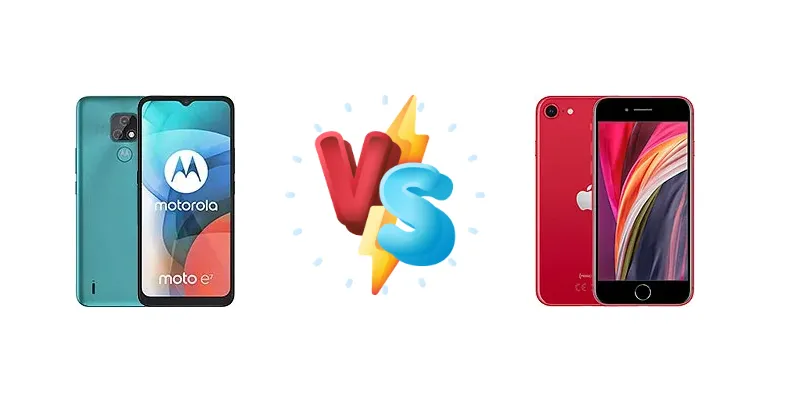
iPhone SE (2020) vs. Motorola Moto E7: A Detailed Comparison
| Phones Images | |||||
|---|---|---|---|---|---|
|
🏆 Quick Verdict
For most users, the Apple iPhone SE (2020) is the superior choice. While the Moto E7 offers a lower price point, the iPhone SE’s significantly faster A13 Bionic chip, brighter display, and long-term software support justify the price difference, providing a smoother and more future-proof experience.
| PHONES | ||
|---|---|---|
| Phone Names | Motorola Moto E7 | Apple iPhone SE (2020) |
| Network | ||
|---|---|---|
| 2G bands | GSM 850 / 900 / 1800 / 1900 | GSM 850 / 900 / 1800 / 1900 |
| 3G bands | HSDPA 850 / 900 / 1900 / 2100 - Europe, Asia | HSDPA 850 / 900 / 1700(AWS) / 1900 / 2100 |
| 4G bands | 1, 3, 5, 7, 8, 20, 38, 40, 41 - Europe | 1, 2, 3, 4, 5, 7, 8, 11, 12, 13, 17, 18, 19, 20, 21, 25, 26, 28, 29, 30, 32, 34, 38, 39, 40, 41, 42, 46, 48, 66 - A2296 |
| Speed | HSPA 42.2/5.76 Mbps, LTE Cat4 150/50 Mbps | HSPA 42.2/5.76 Mbps, LTE (5CA) Cat16 1024/150 Mbps, EV-DO Rev.A 3.1 Mbps |
| Technology | GSM / HSPA / LTE | GSM / CDMA / HSPA / EVDO / LTE |
| 1, 2, 3, 5, 7, 8, 18, 19, 20, 26, 28, 38, 40, 41 - Asia | 1, 2, 3, 4, 5, 7, 8, 12, 13, 14, 17, 18, 19, 20, 25, 26, 29, 30, 34, 38, 39, 40, 41, 42, 46, 48, 66, 71 - A2275, A2298 | |
| Launch | ||
|---|---|---|
| Announced | 2020, November 24. Released 2020, December 09 | 2020, April 15 |
| Status | Discontinued | Available. Released 2020, April 24 |
| Body | ||
|---|---|---|
| Build | Glass front, plastic frame, plastic back | Glass front, glass back, aluminum frame |
| Dimensions | 164.9 x 75.7 x 8.9 mm (6.49 x 2.98 x 0.35 in) | 138.4 x 67.3 x 7.3 mm (5.45 x 2.65 x 0.29 in) |
| SIM | Nano-SIM + Nano-SIM | Nano-SIM + eSIM |
| Weight | 180 g (6.35 oz) | 148 g (5.22 oz) |
| Water-repellent coating | IP67 dust/water resistant (up to 1m for 30 min) Apple Pay (Visa, MasterCard, AMEX certified) | |
| Display | ||
|---|---|---|
| Protection | - | Ion-strengthened glass |
| Resolution | 720 x 1600 pixels, 20:9 ratio (~269 ppi density) | 750 x 1334 pixels, 16:9 ratio (~326 ppi density) |
| Size | 6.5 inches, 102.8 cm2 (~82.3% screen-to-body ratio) | 4.7 inches, 60.9 cm2 (~65.4% screen-to-body ratio) |
| Type | IPS LCD | Retina IPS LCD, 625 nits (typ) |
| Platform | ||
|---|---|---|
| CPU | Octa-core (4x2.0 GHz Cortex-A53 & 4x1.5 GHz Cortex-A53) | Hexa-core (2x2.65 GHz Lightning + 4x1.8 GHz Thunder) |
| Chipset | Mediatek MT6762G Helio G25 (12 nm) | Apple A13 Bionic (7 nm+) |
| GPU | PowerVR GE8320 | Apple GPU (4-core graphics) |
| OS | Android 10 | iOS 13, upgradable to iOS 26.1 |
| Memory | ||
|---|---|---|
| Card slot | microSDXC (uses shared SIM slot) | No |
| Internal | 32GB 2GB RAM, 64GB 2GB RAM, 64GB 4GB RAM | 64GB 3GB RAM, 128GB 3GB RAM, 256GB 3GB RAM |
| eMMC 5.1 | NVMe | |
| Main Camera | ||
|---|---|---|
| Dual | 48 MP, f/1.7, 26mm (wide), 1/2.0", 0.8µm, PDAF 2 MP (macro) | - |
| Features | LED flash, HDR, panorama | Quad-LED dual-tone flash, HDR, panorama |
| Single | - | 12 MP, f/1.8 (wide), PDAF, OIS |
| Video | 1080p@30fps | 4K@24/30/60fps, 1080p@30/60/120/240fps, HDR, OIS, stereo sound rec. |
| Selfie camera | ||
|---|---|---|
| Features | HDR | HDR |
| Single | 5 MP, f/2.2 | 7 MP, f/2.2 |
| Video | 1080p@30fps | 1080p@30fps; gyro-EIS |
| Sound | ||
|---|---|---|
| 3.5mm jack | Yes | No |
| 35mm jack | Yes | No |
| Loudspeaker | Yes | Yes, with stereo speakers |
| Comms | ||
|---|---|---|
| Bluetooth | 5.0, A2DP, LE | 5.0, A2DP, LE |
| NFC | No | Yes |
| Positioning | GPS, GLONASS, GALILEO | GPS, GLONASS |
| Radio | FM radio | No |
| USB | USB Type-C 2.0 | Lightning, USB 2.0 |
| WLAN | Wi-Fi 802.11 b/g/n | Wi-Fi 802.11 a/b/g/n/ac/6, dual-band, hotspot |
| Features | ||
|---|---|---|
| Sensors | Fingerprint (rear-mounted), accelerometer, proximity | Fingerprint (front-mounted), accelerometer, proximity, gyro, compass, barometer |
| Battery | ||
|---|---|---|
| Charging | 10W wired | 18W wired, 50% in 30 min 7.5W wireless (Qi) |
| Type | Li-Po 4000 mAh | Li-Ion 1821 mAh (6.91 Wh) |
| Misc | ||
|---|---|---|
| Colors | Mineral Gray, Aqua Blue, Satin Coral | Black, White, Red |
| Models | - | A2275, A2296, A2298, iPhone12,8 |
| Price | About 110 EUR | $ 120.00 / C$ 165.75 / £ 99.95 / € 130.89 |
| SAR | - | 1.17 W/kg (head) 1.16 W/kg (body) |
| SAR EU | - | 0.98 W/kg (head) 0.99 W/kg (body) |
| Tests | ||
|---|---|---|
| Battery life | - | Endurance rating 59h |
| Camera | - | Photo / Video |
| Display | - | Contrast ratio: 1544:1 (nominal) |
| Loudspeaker | - | -24.1 LUFS (Very good) |
| Performance | - | AnTuTu: 462253 (v8) GeekBench: 3237 (v5.1) |
Motorola Moto E7
- Significantly faster processor (A13 Bionic)
- Brighter and more vibrant display
- Long-term software support (iOS updates)
- Higher price point
- Smaller screen size
Apple iPhone SE (2020)
- More affordable price
- Larger screen size
- Expandable storage (likely via microSD)
- Slower processor (Helio G25)
- Slower charging speed
- Limited software updates
Display Comparison
The iPhone SE (2020) boasts a significantly brighter display, reaching 670 nits, compared to the Moto E7’s unspecified brightness. This makes the iPhone SE far more usable outdoors. Both displays share a 1544:1 contrast ratio, suggesting similar color reproduction quality, but the iPhone’s higher peak brightness is a clear advantage. The Moto E7’s larger screen size will appeal to those who consume a lot of video, but the iPhone SE’s smaller size makes it more pocketable and easier to use one-handed.
Camera Comparison
Both devices offer photo and video capabilities, but details are limited. The iPhone SE (2020) benefits from Apple’s renowned image processing pipeline, delivering consistently good results. While sensor size and aperture are unknown for both, the iPhone’s processing algorithms are likely to outperform the Moto E7’s. The Moto E7’s camera is likely focused on basic functionality, while the iPhone SE offers features like Portrait mode and Smart HDR. The lack of detail regarding the Moto E7’s camera suggests it’s not a primary selling point.
Performance
The performance gap between these two devices is substantial. The iPhone SE (2020) is powered by the Apple A13 Bionic, a 7nm+ chip with a hexa-core CPU, while the Moto E7 utilizes the Mediatek MT6762G Helio G25, a 12nm chip with an octa-core CPU. The A13 Bionic’s architecture – 2x2.65 GHz Lightning cores and 4x1.8 GHz Thunder cores – is far more efficient and powerful than the Moto E7’s Cortex-A53 configuration. This translates to significantly faster app loading times, smoother multitasking, and a better gaming experience on the iPhone SE. The 7nm process node of the A13 also contributes to better thermal management, reducing throttling under sustained load.
Battery Life
Both phones achieve an endurance rating of 59 hours, suggesting similar real-world battery life despite the Moto E7’s unspecified battery capacity. However, the iPhone SE (2020) offers significantly faster charging: 18W wired charging with 50% charge in 30 minutes, and 7.5W wireless charging (Qi). The Moto E7 is limited to 10W wired charging, meaning a much slower recharge time. While battery life is comparable, the iPhone SE’s charging speed provides a more convenient user experience.
Buying Guide
Buy the Motorola Moto E7 if you prioritize absolute affordability and a larger screen size for media consumption, and are comfortable with a basic Android experience. Buy the Apple iPhone SE (2020) if you value performance, a premium user experience with iOS, long-term software updates, and a more compact form factor, even if it means paying a premium.