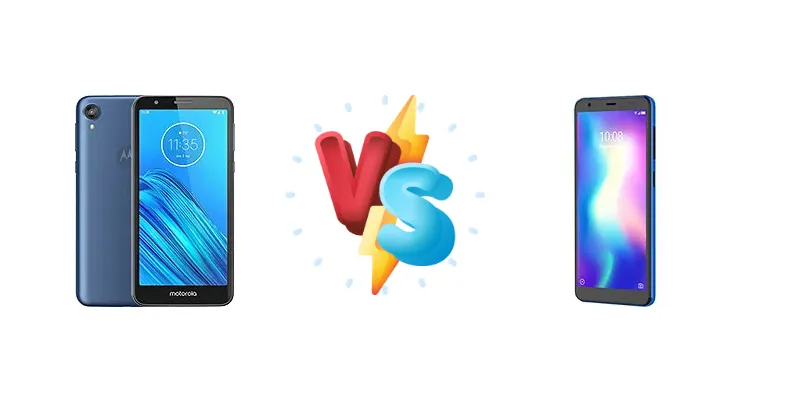
The Motorola Moto E6 and ZTE Blade A5 (2019) represent the extreme end of the smartphone price spectrum. Both aim to deliver essential smartphone functionality at a minimal cost, but they achieve this with significantly different hardware. This comparison dissects the core differences between the Qualcomm Snapdragon 435-powered Moto E6 and the Unisoc SC9863A-equipped ZTE Blade A5, focusing on real-world performance implications.
🏆 Quick Verdict
For the average user prioritizing consistent, if modest, performance, the Motorola Moto E6 is the better choice. While the ZTE Blade A5’s CPU clock speeds appear higher on paper, the Snapdragon 435’s more efficient Cortex-A53 architecture and Qualcomm’s software optimizations deliver a smoother overall experience.
| Network |
|---|
| 2G bands | GSM 850 / 900 / 1800 / 1900 | GSM 850 / 900 / 1800 / 1900 |
| 3G bands | HSDPA 850 / 900 / 1700(AWS) / 1900 / 2100 | HSDPA 850 / 900 / 2100 |
| 4G bands | 2, 4, 5, 12, 13, 25, 26, 41, 66, 71 | 1, 3, 5, 7, 8, 38 |
| Speed | HSPA 42.2/5.76 Mbps, LTE (2CA) Cat7 300/50 Mbps | HSPA 42.2/5.76 Mbps, LTE Cat4 150/50 Mbps |
| Technology | GSM / CDMA / HSPA / EVDO / LTE | GSM / HSPA / LTE |
| | CDMA2000 1xEV-DO - Verizon | - |
| Launch |
|---|
| Announced | 2019, July. Released 2019, August | 2019, May. Released 2019, May |
| Status | Discontinued | Discontinued |
| Body |
|---|
| Build | - | Glass front, plastic back, plastic frame |
| Dimensions | 149.7 x 72.3 x 8.6 mm (5.89 x 2.85 x 0.34 in) | 145.8 x 70 x 9.6 mm (5.74 x 2.76 x 0.38 in) |
| SIM | · Nano-SIM· Nano-SIM + Nano-SIM | Nano-SIM + Nano-SIM |
| Weight | 159 g (5.61 oz) | 157 g (5.54 oz) |
| | Splash resistant | - |
| Display |
|---|
| Resolution | 720 x 1440 pixels, 18:9 ratio (~296 ppi density) | 720 x 1440 pixels, 18:9 ratio (~295 ppi density) |
| Size | 5.5 inches, 76.5 cm2 (~70.7% screen-to-body ratio) | 5.45 inches, 76.7 cm2 (~75.1% screen-to-body ratio) |
| Type | IPS LCD | IPS LCD |
| Platform |
|---|
| CPU | Octa-core 1.4 GHz Cortex-A53 | Octa-core (4x1.6 GHz Cortex-A55 & 4x1.2 GHz Cortex-A55) |
| Chipset | Qualcomm SDM435 Snapdragon 435 (28 nm) | Unisoc SC9863A (28 nm) |
| GPU | Adreno 505 | IMG8322 |
| OS | Android 9.0 (Pie) | Android 9.0 (Pie) |
| Memory |
|---|
| Card slot | microSDXC (dedicated slot) | microSDXC (dedicated slot) |
| Internal | 16GB 2GB RAM | 16GB 2GB RAM |
| | eMMC 5.1 | - |
| Main Camera |
|---|
| Features | LED flash, HDR, panorama | LED flash, HDR |
| Single | 13 MP, f/2.0, 1/3.1", 1.12µm, PDAF | 13 MP, f/2.0, AF |
| Video | 1080p@30fps | 1080p@30fps |
| Selfie camera |
|---|
| Features | HDR | - |
| Single | 5 MP, f/2.0, 1/5.0", 1.12µm | 8 MP, f/2.4 |
| Sound |
|---|
| 3.5mm jack | Yes | Yes |
| 35mm jack | Yes | Yes |
| Loudspeaker | Yes | Yes |
| Comms |
|---|
| Bluetooth | 4.2, A2DP, LE | 4.2, A2DP, LE |
| NFC | No | No |
| Positioning | GPS, GLONASS, BDS | GPS, GLONASS |
| Radio | FM radio | FM radio |
| USB | microUSB 2.0 | microUSB 2.0 |
| WLAN | Wi-Fi 802.11 b/g/n, Wi-Fi Direct or Wi-Fi 802.11 a/b/g/n | Wi-Fi 802.11 b/g/n, Wi-Fi Direct |
| Features |
|---|
| Sensors | Accelerometer, proximity, compass | Accelerometer, proximity |
| Battery |
|---|
| Type | Li-Ion 3000 mAh, removable | Li-Ion 2600 mAh, non-removable |
| Misc |
|---|
| Colors | Starry Black, Navy Blue | Black, Blue |
| Models | XT2005-3, XT2005-1, XT2005DL | - |
| Price | About 130 EUR | About 80 EUR |
| SAR | 1.16 W/kg (head) 1.43 W/kg (body) | - |
Motorola Moto E6
- Proven Snapdragon 435 chipset offers reliable performance.
- Qualcomm’s software optimization provides a smoother user experience.
- Potentially better camera image processing.
- Lower CPU clock speeds compared to the ZTE Blade A5.
- May lack the latest software features.
ZTE Blade A5 (2019)
- Higher CPU clock speeds potentially benefit multitasking.
- More modern Cortex-A55 CPU architecture.
- Potentially lower power consumption at idle.
- Unisoc chipset may have less software support.
- Performance may be less consistent than the Snapdragon 435.
Display Comparison
Neither device boasts a standout display. Given the context of these phones, display specs are likely similar – 720p resolution and IPS LCD panels are expected. The key difference will be color calibration and brightness, which are not specified. However, the focus here is on performance, so display analysis is limited by available data. Expect both to be adequate for basic viewing but not ideal for outdoor use.
Camera Comparison
Camera performance is unlikely to be a differentiating factor on either device. Both will likely feature basic camera setups with limited low-light capabilities. Without specific sensor details, it’s difficult to make a definitive statement. However, Qualcomm’s image signal processor (ISP) within the Snapdragon 435 generally provides better image processing than Unisoc’s offerings at this price point, potentially resulting in slightly better image quality in favorable conditions. Any 2MP macro or depth sensors on either device should be considered marketing features rather than substantial improvements to image quality.
Performance
The core of the difference lies in the chipsets. The Motorola Moto E6 utilizes the Qualcomm Snapdragon 435, built on a 28nm process and featuring an octa-core 1.4 GHz Cortex-A53 CPU. The ZTE Blade A5 (2019) employs the Unisoc SC9863A, also on 28nm, but with a more complex octa-core configuration: 4x1.6 GHz Cortex-A55 cores and 4x1.2 GHz Cortex-A55 cores. While the Blade A5 has higher peak clock speeds, the Cortex-A55 architecture, while newer, doesn’t offer a significant performance leap over the A53 at these clock speeds. The Snapdragon 435 benefits from Qualcomm’s years of optimization and a more mature software ecosystem, leading to better sustained performance and potentially smoother multitasking. The A55 cores in the Blade A5 are likely to be more power efficient at lower loads, but the overall system performance will likely be less consistent.
Battery Life
Battery capacity is not specified, but both phones likely feature batteries in the 3000-4000 mAh range. Charging wattage is also unknown. The Snapdragon 435’s efficiency advantage may translate to slightly longer battery life in real-world usage, especially under sustained load. Without knowing charging speeds, it’s impossible to determine which phone offers a faster 0-100% charge time. The efficiency of the Unisoc chip at idle may offset some of the Snapdragon's advantage.
Buying Guide
Buy the Motorola Moto E6 if you need a reliably functional smartphone for basic tasks like calling, texting, and light social media use, and value a proven chipset with established software support. Buy the ZTE Blade A5 (2019) if you prioritize potentially faster multi-tasking due to its octa-core configuration, and are comfortable with a less-established processor brand and potentially less frequent software updates.
Frequently Asked Questions
❓ Will the ZTE Blade A5 (2019) struggle with demanding apps like PUBG Mobile?
Yes, both phones will struggle with graphically intensive games like PUBG Mobile. The Snapdragon 435 and Unisoc SC9863A are entry-level chipsets and lack the graphical horsepower for smooth gameplay at high settings. Expect low frame rates and significant lag, even on the lowest settings.
❓ Is the difference in CPU clock speeds between the Moto E6 and Blade A5 noticeable in everyday use?
While the ZTE Blade A5 has higher clock speeds, the difference in everyday use will likely be minimal. The Snapdragon 435’s optimized architecture and software integration provide a more consistent and smoother experience, which is more noticeable than raw clock speed. You might see a slight improvement in app loading times on the Blade A5, but it won't be dramatic.
❓ Which phone is likely to receive more software updates?
The Motorola Moto E6 is more likely to receive at least some software updates. Motorola has a better track record of providing updates, even for budget devices, compared to ZTE. Unisoc chipsets often receive less support from manufacturers, potentially leaving the Blade A5 with an older version of Android for longer.