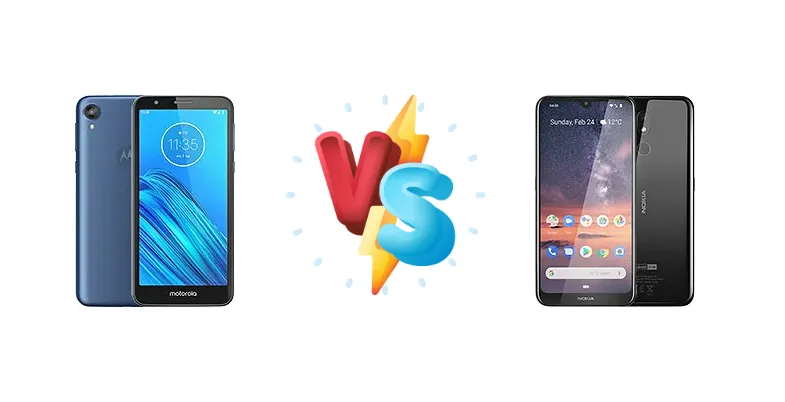
The Motorola Moto E6 and Nokia 3.2 represent the extreme end of the smartphone price spectrum. Both aim to deliver essential functionality at a minimal cost, but they achieve this through different approaches to hardware. This comparison dissects their core components – specifically the Qualcomm Snapdragon 435 and 429 chipsets – to determine which device offers the best experience for the price-conscious consumer.
🏆 Quick Verdict
For the average user prioritizing sustained performance, the Motorola Moto E6 emerges as the slightly better choice. While the Nokia 3.2 benefits from a more efficient 12nm process, the Moto E6’s octa-core CPU and slightly higher clock speeds translate to a more responsive experience in multi-tasking and moderately demanding applications.
| Network |
|---|
| 2G bands | GSM 850 / 900 / 1800 / 1900 | GSM 850 / 900 / 1800 / 1900 |
| 3G bands | HSDPA 850 / 900 / 1700(AWS) / 1900 / 2100 | HSDPA 850 / 900 / 2100 |
| 4G bands | 2, 4, 5, 12, 13, 25, 26, 41, 66, 71 | 1, 3, 5, 7, 8, 20, 28, 38, 40 - EMEA, APAC, MENA |
| Speed | HSPA 42.2/5.76 Mbps, LTE (2CA) Cat7 300/50 Mbps | HSPA 42.2/5.76 Mbps, LTE Cat4 150/50 Mbps |
| Technology | GSM / CDMA / HSPA / EVDO / LTE | GSM / HSPA / LTE |
| | CDMA2000 1xEV-DO - Verizon | 1, 3, 5, 8, 40, 41 - India |
| Launch |
|---|
| Announced | 2019, July. Released 2019, August | 2019, February 24. Released 2019, May 22 |
| Status | Discontinued | Discontinued |
| Body |
|---|
| Build | - | Glass front, plastic back, plastic frame |
| Dimensions | 149.7 x 72.3 x 8.6 mm (5.89 x 2.85 x 0.34 in) | 159.4 x 76.2 x 8.6 mm (6.28 x 3.00 x 0.34 in) |
| SIM | · Nano-SIM· Nano-SIM + Nano-SIM | Nano-SIM + Nano-SIM |
| Weight | 159 g (5.61 oz) | 181 g (6.38 oz) |
| | Splash resistant | - |
| Display |
|---|
| Resolution | 720 x 1440 pixels, 18:9 ratio (~296 ppi density) | 720 x 1520 pixels, 19:9 ratio (~269 ppi density) |
| Size | 5.5 inches, 76.5 cm2 (~70.7% screen-to-body ratio) | 6.26 inches, 97.8 cm2 (~80.5% screen-to-body ratio) |
| Type | IPS LCD | IPS LCD |
| Platform |
|---|
| CPU | Octa-core 1.4 GHz Cortex-A53 | Quad-core 1.8 GHz Cortex-A53 |
| Chipset | Qualcomm SDM435 Snapdragon 435 (28 nm) | Qualcomm SDM429 Snapdragon 429 (12 nm) |
| GPU | Adreno 505 | Adreno 504 |
| OS | Android 9.0 (Pie) | Android 9.0 (Pie), upgradable to Android 11, Android One |
| Memory |
|---|
| Card slot | microSDXC (dedicated slot) | microSDXC (dedicated slot) |
| Internal | 16GB 2GB RAM | 16GB 2GB RAM, 32GB 3GB RAM, 64GB 3GB RAM |
| | eMMC 5.1 | eMMC 5.1 |
| Main Camera |
|---|
| Features | LED flash, HDR, panorama | LED flash |
| Single | 13 MP, f/2.0, 1/3.1", 1.12µm, PDAF | 13 MP, f/2.2, 1/3.1", 1.12µm, AF |
| Video | 1080p@30fps | 1080p@30fps |
| Selfie camera |
|---|
| Features | HDR | - |
| Single | 5 MP, f/2.0, 1/5.0", 1.12µm | 5 MP, f/2.2, 27mm (wide), 1/5.0", 1.12µm |
| Sound |
|---|
| 3.5mm jack | Yes | Yes |
| 35mm jack | Yes | Yes |
| Loudspeaker | Yes | Yes |
| Comms |
|---|
| Bluetooth | 4.2, A2DP, LE | 4.2, A2DP, LE, aptX |
| NFC | No | No |
| Positioning | GPS, GLONASS, BDS | GPS, GLONASS, BDS |
| Radio | FM radio | FM radio |
| USB | microUSB 2.0 | microUSB 2.0, OTG |
| WLAN | Wi-Fi 802.11 b/g/n, Wi-Fi Direct or Wi-Fi 802.11 a/b/g/n | Wi-Fi 802.11 b/g/n |
| Features |
|---|
| Sensors | Accelerometer, proximity, compass | Fingerprint (rear-mounted, 32/3GB only), accelerometer, proximity |
| Battery |
|---|
| Charging | - | 10W wired |
| Type | Li-Ion 3000 mAh, removable | Li-Ion 4000 mAh, non-removable |
| Misc |
|---|
| Colors | Starry Black, Navy Blue | Black, Steel |
| Models | XT2005-3, XT2005-1, XT2005DL | TA-1156, TA-1159, TA-1164 |
| Price | About 130 EUR | About 140 EUR |
| SAR | 1.16 W/kg (head) 1.43 W/kg (body) | - |
| SAR EU | - | 0.24 W/kg (head) 1.63 W/kg (body) |
Motorola Moto E6
- Octa-core processor for better multitasking
- Potentially better graphics performance
- More responsive user experience in demanding apps
- Less power-efficient chipset (28nm)
- Likely lacks 10W charging support
Nokia 3.2
- More power-efficient chipset (12nm)
- Supports 10W wired charging
- Potentially longer battery life under light use
- Quad-core processor may struggle with multitasking
- Lower peak performance compared to the Moto E6
Display Comparison
Neither device is known for its display prowess. Both likely feature 720p+ LCD panels, typical for this price point. However, detailed display specs like brightness and color accuracy are unavailable. The Nokia 3.2’s slightly newer design *may* translate to marginally thinner bezels, but this is speculative. The real difference lies elsewhere.
Camera Comparison
Camera performance on both devices is expected to be basic. Without specific sensor details, it’s difficult to make definitive claims. Both likely feature a primary camera around 13MP, accompanied by depth or macro sensors of limited utility. Image processing will be a key differentiator, and Nokia’s software often prioritizes natural-looking images, while Motorola tends towards more saturated colors. The lack of OIS on either device means low-light performance will be subpar.
Performance
The core of this comparison is the chipset. The Motorola Moto E6 utilizes the Qualcomm Snapdragon 435, a 28nm octa-core processor clocked at 1.4 GHz. The Nokia 3.2, conversely, employs the Snapdragon 429, built on a more efficient 12nm process with a quad-core configuration running at 1.8 GHz. While the 429’s higher clock speed per core suggests potential single-core advantages, the E6’s eight cores provide superior multi-threading capabilities. This means the E6 is better equipped to handle multiple apps running simultaneously. The 12nm process of the 429 *should* result in lower power consumption, potentially extending battery life, but the difference is unlikely to be dramatic in real-world usage. The E6's GPU is also likely to offer a slight edge in graphics performance.
Battery Life
Battery capacity is not specified, but both devices likely house batteries in the 3000-4000 mAh range. The Nokia 3.2’s Snapdragon 429, with its 12nm process, *should* offer slightly better battery life due to improved power efficiency. However, the Moto E6’s octa-core processor might offset this advantage under heavy load. Crucially, the Nokia 3.2 supports 10W wired charging, a feature absent on the Moto E6, providing a more convenient charging experience, even if the charging speed isn’t particularly fast.
Buying Guide
Buy the Motorola Moto E6 if you need a phone capable of handling a bit more multitasking and appreciate the potential for slightly smoother performance in apps. Buy the Nokia 3.2 if you prioritize battery efficiency and are looking for a device that supports 10W wired charging, offering a more convenient charging experience, even if it's not particularly fast. Both are excellent choices for first-time smartphone users or those needing a reliable backup device.
Frequently Asked Questions
❓ Will the Nokia 3.2’s Snapdragon 429 struggle with popular social media apps like Facebook and Instagram?
The Snapdragon 429 is capable of running social media apps, but users may experience occasional lag or slowdowns when multitasking or using resource-intensive features within those apps. The quad-core processor is less adept at handling multiple tasks simultaneously compared to the Moto E6’s octa-core CPU.
❓ Does the Motorola Moto E6 support fast charging, and if not, how long does it take to fully charge?
The Motorola Moto E6 does not officially support fast charging. Without knowing the exact charger used, a full charge is estimated to take between 3-4 hours using a standard 5W charger. The Nokia 3.2’s 10W charging, while not fast, will be noticeably quicker.
❓ Which phone is better for playing casual mobile games?
The Motorola Moto E6 has a slight advantage for casual gaming due to its potentially more powerful GPU. While neither phone is designed for demanding games, the E6 will likely provide a smoother experience in titles like Candy Crush or Angry Birds.