
Motorola Moto E6 vs. Moto G7 Play: A Deep Dive into Budget Smartphone Choices
| Phones Images | |||||
|---|---|---|---|---|---|
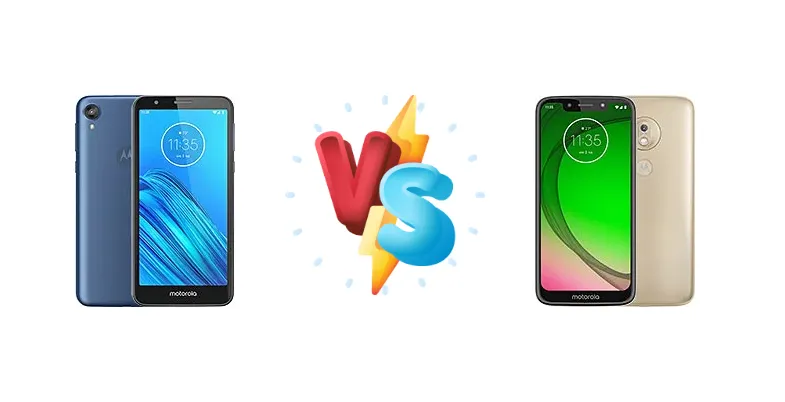
|
🏆 Quick Verdict
For most users, the Motorola Moto G7 Play is the superior choice. Its Snapdragon 632 chipset offers a significantly smoother experience, especially with multitasking and moderately demanding apps, justifying the likely price premium. While both phones share similar battery endurance, the G7 Play’s improved performance makes it the better all-rounder.
| PHONES | ||
|---|---|---|
| Phone Names | Motorola Moto E6 | Motorola Moto G7 Play |
| Network | ||
|---|---|---|
| 2G bands | GSM 850 / 900 / 1800 / 1900 | GSM 850 / 900 / 1800 / 1900 |
| 3G bands | HSDPA 850 / 900 / 1700(AWS) / 1900 / 2100 | HSDPA 850 / 900 / 1700(AWS) / 1900 / 2100 |
| 4G bands | 2, 4, 5, 12, 13, 25, 26, 41, 66, 71 | 1, 2, 3, 4, 5, 7, 8, 20, 28, 38, 40, 41 - Europe |
| Speed | HSPA 42.2/5.76 Mbps, LTE (2CA) Cat7 300/50 Mbps | HSPA 42.2/5.76 Mbps, LTE (2CA) Cat7 300/50 Mbps |
| Technology | GSM / CDMA / HSPA / EVDO / LTE | GSM / HSPA / LTE |
| CDMA2000 1xEV-DO - Verizon | 1, 2, 3, 4, 5, 7, 8, 12, 13, 14, 17, 20, 25, 26, 29, 30, 38, 39, 40, 41, 41, 66, 71 - USA | |
| Launch | ||
|---|---|---|
| Announced | 2019, July. Released 2019, August | 2019, February. Released 2019, March |
| Status | Discontinued | Discontinued |
| Body | ||
|---|---|---|
| Build | - | Glass front (Gorilla Glass 3), plastic back, plastic frame |
| Dimensions | 149.7 x 72.3 x 8.6 mm (5.89 x 2.85 x 0.34 in) | 147.3 x 71.5 x 8 mm (5.80 x 2.81 x 0.31 in) |
| SIM | · Nano-SIM· Nano-SIM + Nano-SIM | · Nano-SIM· Nano-SIM + Nano-SIM |
| Weight | 159 g (5.61 oz) | 149 g (5.26 oz) |
| Splash resistant | Splash resistant (market dependent) | |
| Display | ||
|---|---|---|
| Protection | - | Corning Gorilla Glass 3 (market dependent) |
| Resolution | 720 x 1440 pixels, 18:9 ratio (~296 ppi density) | 720 x 1512 pixels, 19:9 ratio (~294 ppi density) |
| Size | 5.5 inches, 76.5 cm2 (~70.7% screen-to-body ratio) | 5.7 inches, 81.4 cm2 (~77.3% screen-to-body ratio) |
| Type | IPS LCD | IPS LCD |
| Platform | ||
|---|---|---|
| CPU | Octa-core 1.4 GHz Cortex-A53 | Octa-core (4x1.8 GHz Kryo 250 Gold & 4x1.8 GHz Kryo 250 Silver) |
| Chipset | Qualcomm SDM435 Snapdragon 435 (28 nm) | Qualcomm SDM632 Snapdragon 632 (14 nm) |
| GPU | Adreno 505 | Adreno 506 |
| OS | Android 9.0 (Pie) | Android 9.0 (Pie), upgradable to Android 10 |
| Memory | ||
|---|---|---|
| Card slot | microSDXC (dedicated slot) | microSDXC (dedicated slot) |
| Internal | 16GB 2GB RAM | 32GB 2GB RAM, 32GB 3GB RAM |
| eMMC 5.1 | eMMC 5.1 | |
| Main Camera | ||
|---|---|---|
| Features | LED flash, HDR, panorama | LED flash, panorama, HDR |
| Single | 13 MP, f/2.0, 1/3.1", 1.12µm, PDAF | 13 MP, f/2.0, 1/3.1", 1.12µm, PDAF |
| Video | 1080p@30fps | 4K@30fps, 1080p@30fps |
| Selfie camera | ||
|---|---|---|
| Features | HDR | LED flash |
| Single | 5 MP, f/2.0, 1/5.0", 1.12µm | 8 MP, f/2.2, 1/4.0", 1.12µm |
| Video | - | 1080p@30fps |
| Sound | ||
|---|---|---|
| 3.5mm jack | Yes | Yes |
| 35mm jack | Yes | Yes |
| Loudspeaker | Yes | Yes |
| Comms | ||
|---|---|---|
| Bluetooth | 4.2, A2DP, LE | 4.2, A2DP, LE |
| NFC | No | No |
| Positioning | GPS, GLONASS, BDS | GPS, GLONASS |
| Radio | FM radio | FM radio |
| USB | microUSB 2.0 | USB Type-C 2.0, OTG |
| WLAN | Wi-Fi 802.11 b/g/n, Wi-Fi Direct or Wi-Fi 802.11 a/b/g/n | Wi-Fi 802.11 b/g/n |
| Features | ||
|---|---|---|
| Sensors | Accelerometer, proximity, compass | Fingerprint (rear-mounted), accelerometer, gyro, proximity, compass |
| Battery | ||
|---|---|---|
| Charging | - | 10W wired |
| Type | Li-Ion 3000 mAh, removable | Li-Ion 3000 mAh, non-removable |
| Misc | ||
|---|---|---|
| Colors | Starry Black, Navy Blue | Deep indigo, Fine Gold, Starry Black |
| Models | XT2005-3, XT2005-1, XT2005DL | XT1952-4, XT1952-5 |
| Price | About 130 EUR | About 160 EUR |
| SAR | 1.16 W/kg (head) 1.43 W/kg (body) | 0.74 W/kg (head) 1.40 W/kg (body) |
| SAR EU | - | 0.84 W/kg (head) 0.85 W/kg (body) |
| Tests | ||
|---|---|---|
| Audio quality | - | Noise -90.0dB / Crosstalk -92.9dB |
| Battery life | - | Endurance rating 103h |
| Camera | - | Photo / Video |
| Display | - | Contrast ratio: 1468:1 (nominal), 3.180 (sunlight) |
| Loudspeaker | - | Voice 66dB / Noise 74dB / Ring 81dB |
| Performance | - | AnTuTu: 97230 (v7) GeekBench: 4154 (v4.4) GFXBench: 7.7fps (ES 3.1 onscreen) |
Motorola Moto E6
- Lowest possible price point
- Acceptable battery life for basic use
- Compact and lightweight design
- Significantly slower performance
- Likely lower quality display
- Limited camera capabilities
Motorola Moto G7 Play
- Noticeably faster performance with Snapdragon 632
- More efficient chipset for longer battery life under load
- Potentially better display quality
- Higher price than the Moto E6
- Still a budget device with limitations
- Charging speed is relatively slow (10W)
Display Comparison
Both the Moto E6 and G7 Play feature displays with a contrast ratio of 1468:1 (nominal) and 3.180 (sunlight). This suggests similar outdoor visibility. However, the specifics of panel technology (IPS vs. TFT) and resolution are not provided. Given the E6’s lower price point, it likely utilizes a less refined panel. The G7 Play, benefiting from its slightly higher position in the lineup, may offer better color accuracy and viewing angles. The lack of detailed display specs makes a definitive judgment difficult, but the G7 Play’s overall component quality suggests a slight advantage.
Camera Comparison
Both phones are listed as having 'Photo / Video' capabilities, but specific details are absent. Given the market positioning, expect modest camera performance from both. The E6 likely features a simpler camera system with a lower-resolution primary sensor. The G7 Play, while still not a camera powerhouse, may benefit from slightly better image processing and potentially a larger sensor. Without sensor size or aperture information, it’s difficult to assess the true camera capabilities, but the G7 Play’s more powerful chipset could contribute to faster image processing and improved low-light performance. The inclusion of a 2MP macro lens on either device is unlikely to provide significant benefit.
Performance
The performance gap between these two devices is substantial. The Moto E6’s Qualcomm Snapdragon 435, built on a 28nm process, is an entry-level chipset. Its octa-core Cortex-A53 CPU clocked at 1.4 GHz is adequate for basic tasks but will struggle with demanding applications. In contrast, the Moto G7 Play boasts the Snapdragon 632, fabricated on a more efficient 14nm process. Its CPU configuration – four Kryo 250 Gold cores at 1.8 GHz and four Kryo 250 Silver cores at 1.8 GHz – provides a significant performance uplift, particularly in multi-threaded workloads. This translates to smoother app launches, faster web browsing, and a more responsive overall experience. The 632’s Adreno 509 GPU also offers a considerably better gaming experience than the E6’s Adreno 308.
Battery Life
Both the Moto E6 and G7 Play achieve an endurance rating of 103 hours, indicating comparable battery life under similar usage conditions. However, the Snapdragon 632 in the G7 Play is more power-efficient than the Snapdragon 435 in the E6. This means the G7 Play can deliver similar endurance with potentially more demanding tasks. The G7 Play also supports 10W wired charging, while the E6’s charging speed is unspecified, likely being slower. While both offer all-day battery life for moderate users, the G7 Play’s efficiency and charging support provide a slight edge.
Buying Guide
Buy the Motorola Moto E6 if you absolutely need the lowest possible price and your smartphone usage is limited to basic tasks like calls, texts, and light social media. It’s a functional device for first-time smartphone users or as a reliable backup. Buy the Motorola Moto G7 Play if you value a more responsive user experience, enjoy occasional gaming, or frequently switch between apps. The Snapdragon 632 provides a noticeable performance boost that enhances everyday usability.