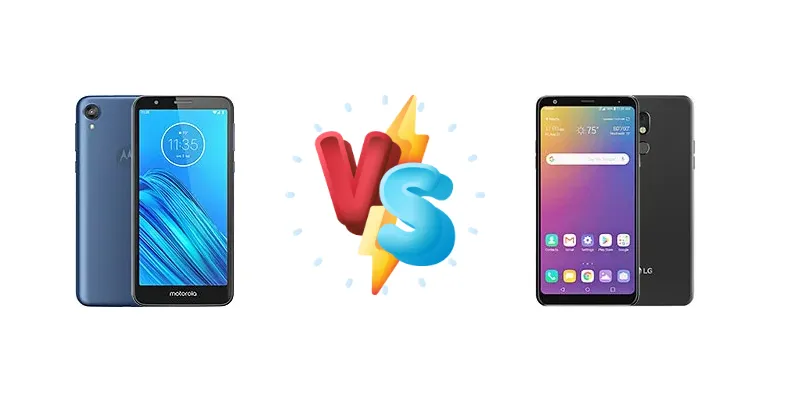
The Motorola Moto E6 and LG Stylo 5 represent two compelling options in the ultra-budget smartphone space. While both aim to deliver essential smartphone functionality at a low price point, they take different approaches to achieving this. The Moto E6 prioritizes a streamlined experience, while the Stylo 5 adds features like faster charging and a higher contrast display. This comparison will dissect their key differences to determine which device offers the best value.
🏆 Quick Verdict
For the average user prioritizing battery life and a more usable display in brighter conditions, the LG Stylo 5 is the better choice. Its Snapdragon 450 chipset, coupled with 20W charging and a superior display contrast ratio, provides a more refined experience despite the similar core architecture to the Moto E6.
| Network |
|---|
| 2G bands | GSM 850 / 900 / 1800 / 1900 | GSM 850 / 900 / 1800 / 1900 |
| 3G bands | HSDPA 850 / 900 / 1700(AWS) / 1900 / 2100 | HSDPA 850 / 1700(AWS) / 1900 |
| 4G bands | 2, 4, 5, 12, 13, 25, 26, 41, 66, 71 | 2, 4, 5, 12, 14, 29, 30, 66 |
| Speed | HSPA 42.2/5.76 Mbps, LTE (2CA) Cat7 300/50 Mbps | HSPA, LTE |
| Technology | GSM / CDMA / HSPA / EVDO / LTE | GSM / HSPA / LTE |
| | CDMA2000 1xEV-DO - Verizon | - |
| Launch |
|---|
| Announced | 2019, July. Released 2019, August | 2019, June. Released 2019, June |
| Status | Discontinued | Discontinued |
| Body |
|---|
| Build | - | Glass front (Gorilla Glass 5), aluminum back, aluminum frame |
| Dimensions | 149.7 x 72.3 x 8.6 mm (5.89 x 2.85 x 0.34 in) | 160 x 77.7 x 8.4 mm (6.30 x 3.06 x 0.33 in) |
| SIM | · Nano-SIM· Nano-SIM + Nano-SIM | Nano-SIM |
| Weight | 159 g (5.61 oz) | 179 g (6.31 oz) |
| | Splash resistant | Stylus |
| Display |
|---|
| Protection | - | Corning Gorilla Glass 5 |
| Resolution | 720 x 1440 pixels, 18:9 ratio (~296 ppi density) | 1080 x 2160 pixels, 18:9 ratio (~390 ppi density) |
| Size | 5.5 inches, 76.5 cm2 (~70.7% screen-to-body ratio) | 6.2 inches, 99.2 cm2 (~79.8% screen-to-body ratio) |
| Type | IPS LCD | IPS LCD |
| Platform |
|---|
| CPU | Octa-core 1.4 GHz Cortex-A53 | Octa-core 1.8 GHz Cortex-A53 |
| Chipset | Qualcomm SDM435 Snapdragon 435 (28 nm) | Qualcomm SDM450 Snapdragon 450 (14 nm) |
| GPU | Adreno 505 | Adreno 506 |
| OS | Android 9.0 (Pie) | Android 9.0 (Pie) |
| Memory |
|---|
| Card slot | microSDXC (dedicated slot) | microSDXC (dedicated slot) |
| Internal | 16GB 2GB RAM | 32GB 3GB RAM |
| | eMMC 5.1 | eMMC 5.1 |
| Main Camera |
|---|
| Features | LED flash, HDR, panorama | LED flash, panorama, HDR |
| Single | 13 MP, f/2.0, 1/3.1", 1.12µm, PDAF | 13 MP, PDAF |
| Video | 1080p@30fps | 1080p@30fps |
| Selfie camera |
|---|
| Dual | - | 16 MP, f/2.0, 26mm (wide), 1/3.06", 1.0µm
8 MP |
| Features | HDR | - |
| Single | 5 MP, f/2.0, 1/5.0", 1.12µm | 5 MP |
| Video | - | 1080p@30fps |
| Sound |
|---|
| 3.5mm jack | Yes | Yes |
| 35mm jack | Yes | Yes |
| Loudspeaker | Yes | Yes |
| Comms |
|---|
| Bluetooth | 4.2, A2DP, LE | 4.2, A2DP, LE |
| NFC | No | No |
| Positioning | GPS, GLONASS, BDS | GPS |
| Radio | FM radio | No |
| USB | microUSB 2.0 | USB Type-C 2.0 |
| WLAN | Wi-Fi 802.11 b/g/n, Wi-Fi Direct or Wi-Fi 802.11 a/b/g/n | Wi-Fi 802.11 a/b/g/n/ac, dual-band, Wi-Fi Direct |
| Features |
|---|
| Sensors | Accelerometer, proximity, compass | Fingerprint (rear-mounted), accelerometer, proximity |
| Battery |
|---|
| Charging | - | 20W wired |
| Type | Li-Ion 3000 mAh, removable | Li-Ion 3500 mAh, non-removable |
| Misc |
|---|
| Colors | Starry Black, Navy Blue | Blonde Rose, Platinum Gray |
| Models | XT2005-3, XT2005-1, XT2005DL | LM-Q720 |
| Price | About 130 EUR | About 200 EUR |
| SAR | 1.16 W/kg (head) 1.43 W/kg (body) | - |
| Tests |
|---|
| Audio quality | - |
Noise-93.5dB / Crosstalk -92.0dB |
| Battery life | - |
Endurance rating 79h
|
| Camera | - |
Photo / Video |
| Display | - |
Contrast ratio: 1485 (nominal), 3.218 (sunlight) |
| Loudspeaker | - |
Voice 62dB / Noise 69dB / Ring 70dB
|
| Performance | - |
GeekBench: 4695 (v4.4)
GFXBench: 6fps (ES 3.1 onscreen) |
Motorola Moto E6
- Potentially lower price point
- Simple and streamlined Android experience
- Reliable for basic tasks
- Older, less efficient Snapdragon 435 chipset
- Likely slower charging speeds
- Inferior display quality (based on available data)
LG Stylo 5
- More powerful and efficient Snapdragon 450 chipset
- Faster 20W wired charging
- Superior display contrast ratio for better visibility
- Slightly higher price
- May include more pre-installed bloatware
- Still limited performance for demanding tasks
Display Comparison
The LG Stylo 5 boasts a significant advantage in display quality, evidenced by its contrast ratios of 1485 (nominal) and 3.218 (sunlight). This means blacks will appear deeper and the screen will remain more readable under direct sunlight compared to the Moto E6, which lacks these specified contrast figures. While both likely utilize IPS LCD panels, the Stylo 5’s higher contrast suggests better panel calibration or a more effective anti-reflective coating. The Moto E6’s display specifications are not provided, making a direct pixel density or resolution comparison impossible, but it’s reasonable to assume it’s a lower-resolution panel given the price point.
Camera Comparison
Detailed camera specifications are limited for both devices. However, given the market segment, it’s safe to assume both feature basic camera setups focused on everyday snapshots. The absence of details like sensor size or aperture makes a precise comparison difficult. It’s likely both phones rely heavily on software processing to enhance image quality. Without further information, it’s difficult to declare a clear winner, but the LG Stylo 5’s slightly higher price point *might* indicate a marginally better camera module, though this is speculative.
Performance
Both devices utilize Qualcomm Snapdragon 400-series chipsets with octa-core Cortex-A53 CPUs, but the LG Stylo 5’s Snapdragon 450, fabricated on a 14nm process, offers a clear advantage over the Moto E6’s Snapdragon 435, built on a larger 28nm node. The smaller process node translates to improved power efficiency and potentially higher sustained clock speeds. The Stylo 5’s CPU is clocked at 1.8 GHz versus the Moto E6’s 1.4 GHz, further contributing to a more responsive user experience, particularly when multitasking or running slightly more demanding applications. While neither phone is a gaming powerhouse, the Stylo 5 will handle casual games with fewer stutters.
Battery Life
The LG Stylo 5’s endurance rating of 79 hours is a significant highlight, indicating excellent battery life. While the Moto E6’s battery capacity isn’t specified, the Stylo 5’s 79-hour rating suggests a well-optimized combination of battery size and power efficiency. Crucially, the Stylo 5 supports 20W wired charging, allowing for significantly faster top-ups compared to the Moto E6, which likely utilizes a slower charging standard. This faster charging capability is a major convenience factor for users who frequently find themselves needing to quickly replenish their battery.
Buying Guide
Buy the Motorola Moto E6 if you need a basic, reliable smartphone for essential tasks like calls, texts, and light social media use, and are on an extremely tight budget. Buy the LG Stylo 5 if you prefer a phone with faster charging, a more visible screen outdoors, and a slightly more responsive user experience, even if it means spending a bit more.
Frequently Asked Questions
❓ Is the Snapdragon 450 in the LG Stylo 5 capable of running popular apps like TikTok and Instagram smoothly?
Yes, the Snapdragon 450 is generally sufficient for running social media apps like TikTok and Instagram without significant lag. While it won't offer a high-end experience, it provides a usable and responsive experience for these common applications. The 1.8 GHz clock speed and improved efficiency over the Snapdragon 435 contribute to smoother performance.
❓ How long does it realistically take to fully charge the LG Stylo 5 with the 20W charger?
While a precise 0-100% charge time isn't officially specified, with 20W charging, the LG Stylo 5 should fully charge in approximately 2 to 2.5 hours. This is a significant improvement over the slower charging speeds typically found in phones in this price range, offering a substantial convenience benefit.
❓ Does the Moto E6 receive regular software updates and security patches?
Motorola's update track record for budget devices like the Moto E6 is often limited. While it likely launched with a relatively recent version of Android, expect fewer major Android version updates and potentially infrequent security patches compared to higher-end devices. This is a common trade-off in the ultra-budget segment.
❓ Is the LG Stylo 5 a good option for someone who frequently uses their phone outdoors?
Yes, the LG Stylo 5 is a better choice for outdoor use due to its significantly higher display contrast ratio (3.218 in sunlight). This means the screen will remain more readable even under direct sunlight, unlike the Moto E6 which lacks specified contrast data and is likely less visible outdoors.