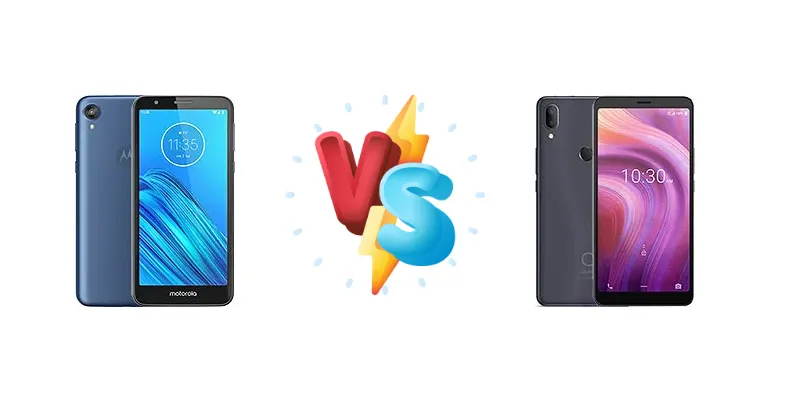
The Motorola Moto E6 and Alcatel 3v (2019) represent the ultra-budget end of the Android spectrum. Both aim to deliver smartphone functionality at the lowest possible price point, but they take different approaches to achieving this. The key differentiator lies in their chipsets: Qualcomm’s Snapdragon 435 versus MediaTek’s Helio P22. This comparison will dissect these differences and determine which phone offers the best value for users prioritizing performance, battery life, and overall usability.
🏆 Quick Verdict
For the average user, the Alcatel 3v (2019) is the better choice. While both phones are entry-level, the Helio P22’s 12nm process and higher clock speed (2.0 GHz vs 1.4 GHz) provide a noticeable performance boost in everyday tasks and light gaming, justifying its slight price premium. The 15W charging is also a significant advantage.
| Network |
|---|
| 2G bands | GSM 850 / 900 / 1800 / 1900 | GSM 850 / 900 / 1800 / 1900 |
| 3G bands | HSDPA 850 / 900 / 1700(AWS) / 1900 / 2100 | HSDPA 850 / 900 / 1700(AWS) / 1900 / 2100 |
| 4G bands | 2, 4, 5, 12, 13, 25, 26, 41, 66, 71 | 1, 2, 3, 4, 5, 7, 12, 13, 17, 20, 25, 26, 41, 66, 71 |
| Speed | HSPA 42.2/5.76 Mbps, LTE (2CA) Cat7 300/50 Mbps | HSPA 42.2/11.5 Mbps, LTE Cat4 150/50 Mbps |
| Technology | GSM / CDMA / HSPA / EVDO / LTE | GSM / HSPA / LTE |
| | CDMA2000 1xEV-DO - Verizon | - |
| Launch |
|---|
| Announced | 2019, July. Released 2019, August | 2019, Q2. Released 2019, Q4 |
| Status | Discontinued | Discontinued |
| Body |
|---|
| Build | - | Glass front (DragonTrail Pro glass), plastic back, plastic frame |
| Dimensions | 149.7 x 72.3 x 8.6 mm (5.89 x 2.85 x 0.34 in) | 174.5 x 83.3 x 8.4 mm (6.87 x 3.28 x 0.33 in) |
| SIM | · Nano-SIM· Nano-SIM + Nano-SIM | Nano-SIM |
| Weight | 159 g (5.61 oz) | 197.9 g (6.98 oz) |
| | Splash resistant | - |
| Display |
|---|
| Protection | - | DragonTrail Pro |
| Resolution | 720 x 1440 pixels, 18:9 ratio (~296 ppi density) | 720 x 1440 pixels, 18:9 ratio (~240 ppi density) |
| Size | 5.5 inches, 76.5 cm2 (~70.7% screen-to-body ratio) | 6.7 inches, 115.8 cm2 (~79.7% screen-to-body ratio) |
| Type | IPS LCD | IPS LCD |
| Platform |
|---|
| CPU | Octa-core 1.4 GHz Cortex-A53 | Octa-core 2.0 GHz Cortex-A53 |
| Chipset | Qualcomm SDM435 Snapdragon 435 (28 nm) | Mediatek MT6762 Helio P22 (12 nm) |
| GPU | Adreno 505 | PowerVR GE8320 |
| OS | Android 9.0 (Pie) | Android 9.0 (Pie) |
| Memory |
|---|
| Card slot | microSDXC (dedicated slot) | microSDXC (dedicated slot) |
| Internal | 16GB 2GB RAM | 32GB 3GB RAM |
| | eMMC 5.1 | eMMC 5.1 |
| Main Camera |
|---|
| Dual | - | 16 MP, PDAF
Auxiliary lens |
| Features | LED flash, HDR, panorama | LED flash, HDR, panorama |
| Single | 13 MP, f/2.0, 1/3.1", 1.12µm, PDAF | - |
| Video | 1080p@30fps | 1080p@30fps |
| Selfie camera |
|---|
| Features | HDR | - |
| Single | 5 MP, f/2.0, 1/5.0", 1.12µm | 8 MP |
| Video | - | 720p@30fps |
| Sound |
|---|
| 3.5mm jack | Yes | Yes |
| 35mm jack | Yes | Yes |
| Loudspeaker | Yes | Yes, with stereo speakers |
| Comms |
|---|
| Bluetooth | 4.2, A2DP, LE | 4.2, A2DP, LE |
| NFC | No | No |
| Positioning | GPS, GLONASS, BDS | GPS |
| Radio | FM radio | FM radio |
| USB | microUSB 2.0 | USB Type-C 2.0 |
| WLAN | Wi-Fi 802.11 b/g/n, Wi-Fi Direct or Wi-Fi 802.11 a/b/g/n | Wi-Fi 802.11 a/b/g/n, dual-band, Wi-Fi Direct |
| Features |
|---|
| Sensors | Accelerometer, proximity, compass | Fingerprint (rear-mounted), accelerometer, proximity, compass |
| Battery |
|---|
| Charging | - | 15W wired |
| Type | Li-Ion 3000 mAh, removable | Li-Po 4000 mAh |
| Misc |
|---|
| Colors | Starry Black, Navy Blue | Elegant Black |
| Models | XT2005-3, XT2005-1, XT2005DL | 5032W |
| Price | About 130 EUR | About 170 EUR |
| SAR | 1.16 W/kg (head) 1.43 W/kg (body) | - |
Motorola Moto E6
- Potentially longer software support from Motorola
- Proven Qualcomm chipset
- Likely lower price point
- Less powerful chipset compared to Helio P22
- Larger 28nm process leads to lower efficiency
- Slower charging speeds
alcatel 3v (2019)
- More powerful MediaTek Helio P22 chipset
- 12nm process for better efficiency
- 15W wired charging for faster top-ups
- Potentially less frequent software updates
- MediaTek chipsets sometimes have less consistent driver support
- May be slightly more expensive
Display Comparison
Neither device boasts a standout display. Both likely utilize LCD panels, typical for this price bracket. The Moto E6’s display specifications are not readily available, but given its market positioning, it’s likely a 720p+ resolution. The Alcatel 3v (2019) also features a 720p+ display. The real difference isn’t in resolution, but in the underlying processing power to drive the UI smoothly on the display. The Alcatel’s more powerful chipset will contribute to a more fluid visual experience.
Camera Comparison
Camera performance on both devices will be basic. Details are scarce, but both likely feature a primary camera paired with depth or macro sensors. The Alcatel 3v (2019) may have a slight edge due to the more capable ISP (Image Signal Processor) integrated within the Helio P22 chipset, potentially leading to better image processing and noise reduction. However, don’t expect flagship-level image quality from either device. The usefulness of any 2MP macro sensor on either phone is questionable.
Performance
The core of the difference lies in the chipsets. The Alcatel 3v (2019) utilizes the MediaTek Helio P22, built on a more efficient 12nm process, and clocked at 2.0 GHz. This contrasts with the Motorola Moto E6’s Qualcomm Snapdragon 435, fabricated on a larger 28nm node and running at 1.4 GHz. The 12nm process allows the Helio P22 to deliver more performance per watt, meaning less heat generation and potentially better sustained performance. While both CPUs feature octa-core Cortex-A53 cores, the higher clock speed and process node give the Helio P22 a clear advantage in CPU-bound tasks. The GPU in the Helio P22 will also provide a better gaming experience, though both phones are limited to casual gaming.
Battery Life
Battery capacity is not specified for either device in the provided data. However, the Alcatel 3v (2019) includes 15W wired charging, a significant advantage over the likely 5W or 10W charging on the Moto E6. This faster charging will drastically reduce the time spent tethered to a wall outlet, making the Alcatel 3v more convenient for users who need to quickly top up their battery. The more efficient Helio P22 chipset may also contribute to slightly better battery life, even with a similar capacity battery.
Buying Guide
Buy the Motorola Moto E6 if you prioritize a proven, if slower, platform and potentially longer software support from Motorola. It’s a solid choice for basic communication and extremely light usage. Buy the Alcatel 3v (2019) if you prefer a more responsive user experience, faster app loading times, and the convenience of 15W wired charging. It’s better suited for users who occasionally browse the web, use social media, or play casual games.
Frequently Asked Questions
❓ Will the Alcatel 3v (2019) overheat during extended use like web browsing or social media?
The MediaTek Helio P22’s 12nm process is more efficient than the Snapdragon 435’s 28nm process. This means it generates less heat under load, reducing the likelihood of significant overheating during typical usage scenarios like web browsing or social media. While it’s not a gaming powerhouse, it should handle these tasks comfortably without throttling.
❓ Is the performance difference between the Snapdragon 435 and Helio P22 noticeable in everyday tasks?
Yes, the difference is noticeable. The Helio P22’s higher clock speed (2.0 GHz vs 1.4 GHz) and more efficient 12nm process translate to faster app loading times, smoother multitasking, and a more responsive user interface. While neither phone is a performance champion, the Alcatel 3v (2019) will feel snappier in daily use.
❓ Can the Alcatel 3v (2019) handle popular games like PUBG Mobile or Call of Duty Mobile?
While the Alcatel 3v (2019) can *run* these games, expect to play them at the lowest graphics settings and potentially with reduced frame rates. The Helio P22’s GPU is not designed for demanding gaming. The experience will be playable, but not optimal. The Moto E6 would struggle even more.