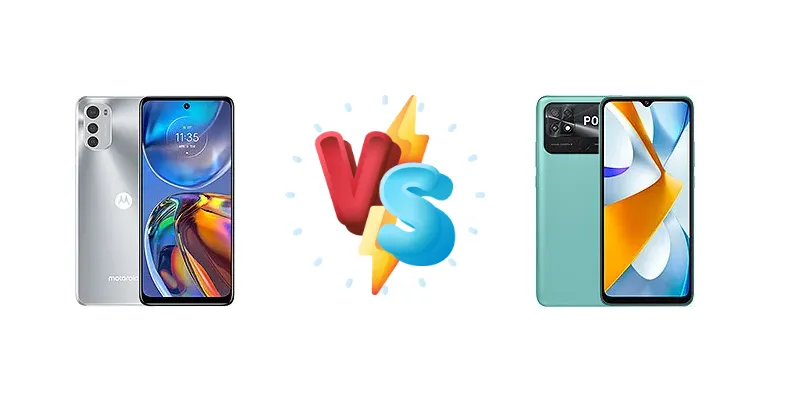
The sub-$150 smartphone market is fiercely competitive. Both the Motorola Moto E32s and the Xiaomi Poco C40 aim to deliver essential smartphone functionality at an incredibly affordable price. However, they take different approaches to achieving this, particularly in their core processing power and charging capabilities. This comparison dissects these differences to determine which device offers the best value.
🏆 Quick Verdict
For the average user prioritizing basic tasks and longer battery life, the Xiaomi Poco C40 is the better choice. Its 18W charging significantly reduces downtime compared to the Moto E32s’ 15W, and the newer Cortex-A55 cores offer a slight efficiency advantage. However, the Moto E32s remains a viable option for those seeking a familiar Motorola experience.
| Network |
|---|
| 2G bands | GSM 850 / 900 / 1800 / 1900 | GSM 850 / 900 / 1800 / 1900 |
| 3G bands | HSDPA 850 / 900 / 1900 / 2100 | HSDPA 850 / 900 / 1700(AWS) / 1900 / 2100 |
| 4G bands | 1, 3, 5, 7, 8, 20, 38, 40, 41 | 1, 2, 3, 4, 5, 7, 8, 20, 28, 38, 40, 41 |
| Speed | HSPA, LTE | HSPA, LTE |
| Technology | GSM / HSPA / LTE | GSM / HSPA / LTE |
| Launch |
|---|
| Announced | 2022, May 13 | 2022, June 06 |
| Status | Available. Released 2022, June 02 | Available. Released 2022, June 17 |
| Body |
|---|
| Build | Glass front, plastic frame, plastic back | - |
| Dimensions | 164 x 75 x 8.5 mm (6.46 x 2.95 x 0.33 in) | 169.6 x 76.6 x 9.2 mm (6.68 x 3.02 x 0.36 in) |
| SIM | · Nano-SIM· Nano-SIM + Nano-SIM | Nano-SIM + Nano-SIM |
| Weight | 185 g (6.53 oz) | 204 g (7.20 oz) |
| | Water repellent design | Dust & splash resistant |
| Display |
|---|
| Protection | - | Corning Gorilla Glass |
| Resolution | 720 x 1600 pixels, 20:9 ratio (~270 ppi density) | 720 x 1650 pixels (~268 ppi density) |
| Size | 6.5 inches, 102.0 cm2 (~82.9% screen-to-body ratio) | 6.71 inches, 106.5 cm2 (~82.0% screen-to-body ratio) |
| Type | IPS LCD, 90Hz | IPS LCD, 400 nits |
| Platform |
|---|
| CPU | Octa-core (4x2.3 GHz Cortex-A53 & 4x1.8 GHz Cortex-A53) | Octa-core (4x2.0 GHz Cortex-A55 & 4x1.5 GHz Cortex-A55) |
| Chipset | Mediatek MT6765V/CB Helio G37 (12 nm) | JLQ JR510 (11 nm) |
| GPU | PowerVR GE8320 | Mali-G57 MC1 |
| OS | Android 11 | Android 11, MIUI 13 for POCO |
| Memory |
|---|
| Card slot | microSDXC (dedicated slot) | microSDXC |
| Internal | 32GB 3GB RAM, 64GB 3GB RAM, 64GB 4GB RAM | 32GB 2GB RAM, 32GB 3GB RAM, 32GB 4GB RAM, 64GB 4GB RAM |
| Main Camera |
|---|
| Dual | - | 13 MP, f/2.2, (wide), PDAF
Auxiliary lens |
| Features | LED flash, HDR, panorama | LED flash, HDR, panorama |
| Single | - | 5 MP, f/2.2 |
| Triple | 16 MP, f/2.2, 26mm (wide), 1.0µm, PDAF
2 MP (macro)
Auxiliary lens | - |
| Video | 1080p@30fps | 1080p@30fps |
| Selfie camera |
|---|
| Features | HDR | HDR |
| Single | 8 MP, f/2.0, (wide) | 5 MP, f/2.2 |
| Video | 1080p@30fps | 1080p@30fps |
| Sound |
|---|
| 3.5mm jack | Yes | Yes |
| 35mm jack | Yes | Yes |
| Loudspeaker | Yes | Yes |
| Comms |
|---|
| Bluetooth | 5.0, A2DP, LE | 5.0, A2DP, LE |
| Infrared port | - | Yes |
| NFC | No | Yes (market/region dependent) |
| Positioning | GPS, GLONASS, GALILEO | GPS, GLONASS, GALILEO, BDS |
| Radio | Unspecified | FM radio |
| USB | USB Type-C 2.0 | USB Type-C 2.0 |
| WLAN | Wi-Fi 802.11 a/b/g/n/ac, dual-band | Wi-Fi 802.11 a/b/g/n/ac, dual-band, Wi-Fi Direct |
| Features |
|---|
| Sensors | Fingerprint (side-mounted), accelerometer, proximity | Fingerprint (rear-mounted), accelerometer, proximity |
| Battery |
|---|
| Charging | 15W wired | 18W wired |
| Type | Li-Po 5000 mAh | Li-Po 6000 mAh |
| Misc |
|---|
| Colors | Slate Gray, Misty Silver | Power Black, Coral Green, Poco Yellow |
| Models | - | 220333QPG |
| Price | About 80 EUR | About 110 EUR |
Motorola Moto E32s
- Familiar Motorola Android experience
- Reliable brand reputation
- Potentially more natural camera processing
- Slower 15W charging
- Less efficient older Cortex-A53 cores
- 12nm process node
Xiaomi Poco C40
- Faster 18W charging
- More efficient Cortex-A55 cores
- 11nm process node
- Xiaomi’s MIUI software customization
- Potentially more aggressive image processing
- Less established brand in some markets
Display Comparison
Neither device boasts a standout display. Both likely utilize LCD panels, typical for this price bracket. Specifics like resolution and peak brightness are not provided, but we can assume they are similar – around 720p+ and adequate for indoor use. The focus here isn't on visual fidelity, but on basic readability. Bezels are likely to be substantial on both, maximizing screen real estate within a compact form factor.
Camera Comparison
Camera performance is likely to be similar on both devices, leaning towards basic functionality. Details on sensor size and aperture are unavailable, but given the price point, expect 13MP or similar main sensors. Image processing will be the key differentiator, and Xiaomi’s software typically leans towards more saturated and contrast-boosted images, while Motorola aims for a more natural look. The presence of low-resolution auxiliary cameras (likely 2MP) on both devices offers minimal practical benefit beyond marketing.
Performance
The core difference lies in the chipsets. The Moto E32s uses the Mediatek Helio G37, built on a 12nm process, featuring a mix of Cortex-A53 cores clocked up to 2.3 GHz. The Poco C40, however, employs the JLQ JR510 (11nm) with a homogenous cluster of Cortex-A55 cores clocked up to 2.0 GHz. While the G37 has higher peak clock speeds, the A55 architecture in the JR510 is more efficient and offers improved instructions per clock (IPC). This translates to better performance in sustained tasks and potentially better power efficiency. The 11nm process node of the JR510 also contributes to improved efficiency compared to the 12nm G37. This difference is most noticeable in multi-tasking and app loading times.
Battery Life
Both phones are geared towards all-day battery life. The Poco C40’s 18W charging is a significant advantage over the Moto E32s’ 15W. While neither is exceptionally fast by modern standards, the 3W difference translates to a noticeably quicker top-up time. This is crucial for users who rely heavily on their phones throughout the day and don't have ample time for extended charging sessions. The actual battery capacity isn't specified, but both likely hover around the 4000-5000 mAh range, sufficient for a full day of moderate use.
Buying Guide
Buy the Motorola Moto E32s if you prioritize a well-established brand with a clean Android experience and are comfortable with slower charging speeds. Buy the Xiaomi Poco C40 if you value faster charging, a slightly more modern CPU architecture, and don't mind Xiaomi's MIUI software customization. Both are excellent choices for first-time smartphone users or as reliable backup devices.
Frequently Asked Questions
❓ Will the Poco C40’s JLQ JR510 chipset struggle with demanding apps like TikTok or Facebook?
While the JLQ JR510 isn't a powerhouse, it's sufficient for running popular social media apps like TikTok and Facebook smoothly. The Cortex-A55 cores are optimized for efficiency and handle everyday tasks well. However, expect some loading times and occasional stutters with very complex filters or features.
❓ Is the 15W charging on the Moto E32s slow enough to be a major inconvenience?
For casual users who charge their phone overnight, 15W charging on the Moto E32s is likely adequate. However, if you frequently find yourself needing a quick top-up during the day, the Poco C40’s 18W charging will be significantly more convenient, shaving off valuable charging time.
❓ Does either phone support VoLTE or Wi-Fi calling?
Support for VoLTE and Wi-Fi calling varies by region and carrier. It's crucial to check compatibility with your specific provider before purchasing either device. Both Motorola and Xiaomi typically include these features in their phones, but it's not guaranteed on these budget models.
❓ How does the software experience differ between Motorola’s near-stock Android and Xiaomi’s MIUI?
Motorola offers a near-stock Android experience, prioritizing simplicity and minimal bloatware. Xiaomi’s MIUI is heavily customized, offering a wide range of features and personalization options, but also includes pre-installed apps and a different user interface. Preference here is subjective; some users prefer the cleaner Motorola experience, while others appreciate MIUI’s added functionality.