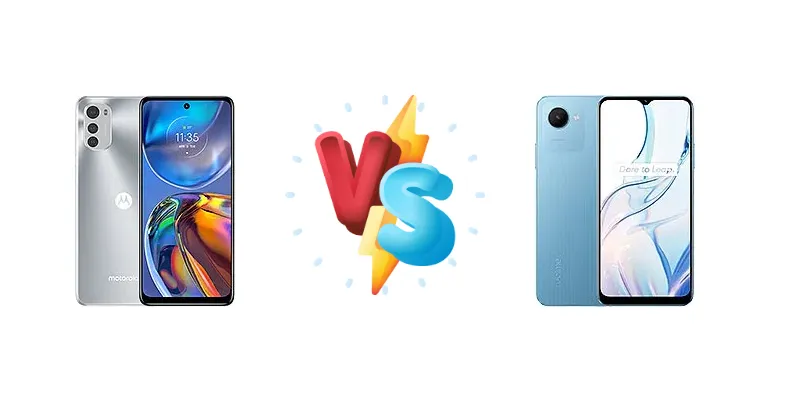
The Motorola Moto E32s and Realme C30s represent the fiercely competitive entry-level smartphone market. Both aim to deliver essential smartphone functionality at an incredibly accessible price point, but they take different approaches to achieving this. This comparison dissects their core specifications to determine which device offers the best balance of performance and features for the budget-conscious consumer.
🏆 Quick Verdict
For most users, the Motorola Moto E32s emerges as the stronger choice. Its Mediatek Helio G37 chipset, built on a 12nm process, provides a noticeable performance advantage over the Realme C30s’ unspecified Cortex-A55 CPU, making it better suited for multitasking and moderately demanding apps. While the Realme C30s is cheaper, the performance trade-off is significant.
| Network |
|---|
| 2G bands | GSM 850 / 900 / 1800 / 1900 | GSM 850 / 900 / 1800 / 1900 |
| 3G bands | HSDPA 850 / 900 / 1900 / 2100 | HSDPA 850 / 900 / 2100 |
| 4G bands | 1, 3, 5, 7, 8, 20, 38, 40, 41 | 1, 3, 5, 8, 38, 40, 41 |
| Speed | HSPA, LTE | HSPA, LTE |
| Technology | GSM / HSPA / LTE | GSM / HSPA / LTE |
| Launch |
|---|
| Announced | 2022, May 13 | 2022, September 14 |
| Status | Available. Released 2022, June 02 | Available. Released 2022, September 23 |
| Body |
|---|
| Build | Glass front, plastic frame, plastic back | Glass front, plastic frame, plastic back |
| Dimensions | 164 x 75 x 8.5 mm (6.46 x 2.95 x 0.33 in) | 164.2 x 75.7 x 8.5 mm (6.46 x 2.98 x 0.33 in) |
| SIM | · Nano-SIM· Nano-SIM + Nano-SIM | Nano-SIM + Nano-SIM |
| Weight | 185 g (6.53 oz) | 186 g (6.56 oz) |
| | Water repellent design | - |
| Display |
|---|
| Resolution | 720 x 1600 pixels, 20:9 ratio (~270 ppi density) | 720 x 1600 pixels, 20:9 ratio (~270 ppi density) |
| Size | 6.5 inches, 102.0 cm2 (~82.9% screen-to-body ratio) | 6.5 inches, 102.0 cm2 (~82.1% screen-to-body ratio) |
| Type | IPS LCD, 90Hz | IPS LCD |
| Platform |
|---|
| CPU | Octa-core (4x2.3 GHz Cortex-A53 & 4x1.8 GHz Cortex-A53) | Octa-core 1.6 GHz Cortex-A55 |
| Chipset | Mediatek MT6765V/CB Helio G37 (12 nm) | - |
| GPU | PowerVR GE8320 | IMG8322 |
| OS | Android 11 | Android 12, Realme UI Go |
| Memory |
|---|
| Card slot | microSDXC (dedicated slot) | microSDXC (dedicated slot) |
| Internal | 32GB 3GB RAM, 64GB 3GB RAM, 64GB 4GB RAM | 32GB 2GB RAM, 32GB 3GB RAM, 64GB 3GB RAM, 64GB 4GB RAM |
| Main Camera |
|---|
| Features | LED flash, HDR, panorama | LED flash, HDR, panorama |
| Single | - | 8 MP, (wide), 1/4.0", 1.12µm |
| Triple | 16 MP, f/2.2, 26mm (wide), 1.0µm, PDAF
2 MP (macro)
Auxiliary lens | - |
| Video | 1080p@30fps | 1080p@30fps |
| Selfie camera |
|---|
| Features | HDR | HDR |
| Single | 8 MP, f/2.0, (wide) | 5 MP, (wide), 1/5.0", 1.12µm |
| Video | 1080p@30fps | 720p@30fps |
| Sound |
|---|
| 3.5mm jack | Yes | Yes |
| 35mm jack | Yes | Yes |
| Loudspeaker | Yes | Yes |
| Comms |
|---|
| Bluetooth | 5.0, A2DP, LE | 4.2, A2DP |
| NFC | No | No |
| Positioning | GPS, GLONASS, GALILEO | GPS, GLONASS |
| Radio | Unspecified | Unspecified |
| USB | USB Type-C 2.0 | microUSB 2.0, OTG |
| WLAN | Wi-Fi 802.11 a/b/g/n/ac, dual-band | Wi-Fi 802.11 b/g/n |
| Features |
|---|
| Sensors | Fingerprint (side-mounted), accelerometer, proximity | Fingerprint (side-mounted), accelerometer, proximity |
| Battery |
|---|
| Charging | 15W wired | 10W wired |
| Type | Li-Po 5000 mAh | 5000 mAh |
| Misc |
|---|
| Colors | Slate Gray, Misty Silver | Stripe Blue, Stripe Black |
| Models | - | RMX3690 |
| Price | About 80 EUR | About 100 EUR |
Motorola Moto E32s
- More powerful Mediatek Helio G37 chipset
- Faster 15W charging
- Potentially better sustained performance due to 12nm process
- May be slightly more expensive than the Realme C30s
- Detailed display specs are unavailable
Realme C30s
- Likely the more affordable option
- Simple and straightforward user experience
- Potentially longer battery life (depending on capacity)
- Significantly weaker CPU performance
- Slower 10W charging
- Limited multitasking capabilities
Display Comparison
Neither device boasts a standout display. Both are likely to feature LCD panels, typical for this price bracket. However, detailed display specs (resolution, brightness, color gamut) are missing for the Realme C30s. The Moto E32s’ focus is on affordability, so expect a basic viewing experience on both. Bezels are likely to be substantial on both devices, impacting the overall screen-to-body ratio.
Camera Comparison
Camera performance is expected to be basic on both devices. Detailed camera specs are unavailable, but both are likely to feature a primary camera and potentially a depth sensor. The Realme C30s often includes a 2MP macro camera, which offers limited practical benefit due to its low resolution. Without sensor size or aperture information, it’s difficult to assess image quality, but expect both to perform adequately in well-lit conditions. Image processing will likely be minimal on both devices.
Performance
The core difference lies in the chipsets. The Motorola Moto E32s utilizes the Mediatek Helio G37, a 12nm octa-core processor with a mix of Cortex-A53 cores clocked up to 2.3 GHz. This architecture, while not cutting-edge, offers a more robust performance profile than the Realme C30s’ octa-core CPU clocked at 1.6 GHz, which uses Cortex-A55 cores. The 12nm fabrication process of the Helio G37 generally translates to better sustained performance compared to a potentially larger node used in the C30s. The Realme C30s’ CPU, while efficient, is geared towards basic tasks, and will likely struggle with heavier applications or multitasking. RAM specifications are missing for both, but are likely to be limited, further impacting performance.
Battery Life
Battery capacity is not specified for either device, but both are likely to feature batteries in the 4000-5000 mAh range. However, the charging speeds differ significantly. The Motorola Moto E32s supports 15W wired charging, while the Realme C30s is limited to 10W. This means the Moto E32s will recharge noticeably faster, reducing downtime. While a larger battery capacity on the C30s *could* offset the slower charging, the performance difference in the chipset suggests the E32s will be more efficient overall.
Buying Guide
Buy the Motorola Moto E32s if you prioritize a smoother user experience, even with basic tasks, and anticipate using your phone for more than just calls and messaging. The Helio G37 chipset offers a tangible benefit for app loading times and general responsiveness. Buy the Realme C30s if your primary need is a very basic, affordable phone for essential communication and you are willing to accept slower performance and limited multitasking capabilities.
Frequently Asked Questions
❓ Will the Realme C30s struggle with popular social media apps like Facebook and Instagram?
The Realme C30s’ 1.6 GHz Cortex-A55 CPU is designed for basic tasks. While it *will* run these apps, expect slower loading times, occasional lag, and a less fluid experience, especially when multitasking or using the apps for extended periods. The Moto E32s’ Helio G37 will provide a noticeably smoother experience.
❓ How long will it take to fully charge the Motorola Moto E32s with the 15W charger?
While the exact 0-100% charge time isn't specified, 15W charging is significantly faster than the Realme C30s’ 10W. Expect a full charge in approximately 2.5 to 3.5 hours, depending on usage during charging. This is a substantial improvement over the potentially 4+ hours required for the C30s.
❓ Is the Motorola Moto E32s a good choice for playing mobile games?
The Moto E32s is not a gaming powerhouse, but the Helio G37 is capable of handling less demanding mobile games at lower settings. Expect playable frame rates in titles like PUBG Mobile or Call of Duty Mobile, but you’ll likely need to reduce graphics settings to achieve a smooth experience. The Realme C30s will struggle with even moderately demanding games.