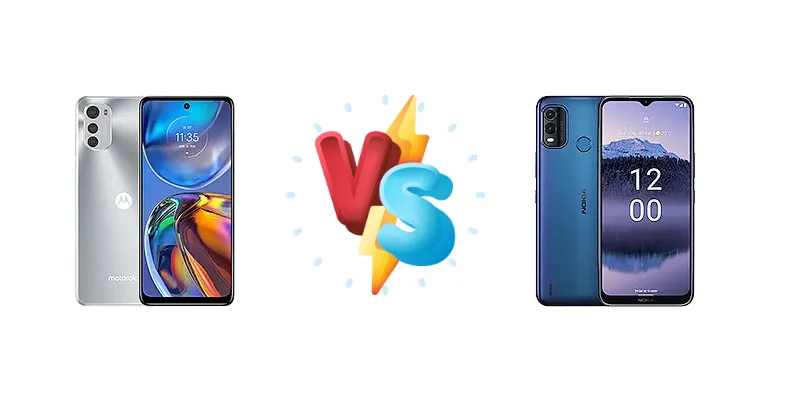
The Motorola Moto E32s and Nokia G11 Plus represent the fiercely competitive sub-$150 smartphone market. Both aim to deliver essential functionality at an accessible price, but they take different approaches to achieving this. The E32s leans on MediaTek’s Helio G37, while the G11 Plus opts for Unisoc’s T606. This comparison dissects the key differences to help you determine which device best suits your needs.
🏆 Quick Verdict
For most users, the Motorola Moto E32s emerges as the slightly better choice. Its Helio G37 chipset, while not a powerhouse, offers a more balanced CPU performance profile than the Unisoc T606, translating to a smoother experience in everyday tasks and light multitasking. The faster 15W charging is also a significant advantage.
| Network |
|---|
| 2G bands | GSM 850 / 900 / 1800 / 1900 | GSM 850 / 900 / 1800 / 1900 |
| 3G bands | HSDPA 850 / 900 / 1900 / 2100 | HSDPA 850 / 900 / 2100 - International |
| 4G bands | 1, 3, 5, 7, 8, 20, 38, 40, 41 | 1, 3, 5, 7, 8, 20, 28, 38, 40, 41 - International |
| Speed | HSPA, LTE | HSPA 42.2/5.76 Mbps, LTE Cat4 150/50 Mbps |
| Technology | GSM / HSPA / LTE | GSM / HSPA / LTE |
| | - | 1, 3, 5, 8, 40, 41 - India |
| Launch |
|---|
| Announced | 2022, May 13 | 2022, June 29 |
| Status | Available. Released 2022, June 02 | Available. Released 2022, July 20 |
| Body |
|---|
| Build | Glass front, plastic frame, plastic back | Glass front, plastic frame, plastic back |
| Dimensions | 164 x 75 x 8.5 mm (6.46 x 2.95 x 0.33 in) | 164.8 x 75.9 x 8.6 mm (6.49 x 2.99 x 0.34 in) |
| SIM | · Nano-SIM· Nano-SIM + Nano-SIM | · Nano-SIM· Nano-SIM + Nano-SIM |
| Weight | 185 g (6.53 oz) | 192 g (6.77 oz) |
| | Water repellent design | Splash protection |
| Display |
|---|
| Resolution | 720 x 1600 pixels, 20:9 ratio (~270 ppi density) | 720 x 1600 pixels, 20:9 ratio (~269 ppi density) |
| Size | 6.5 inches, 102.0 cm2 (~82.9% screen-to-body ratio) | 6.52 inches, 102.6 cm2 (~82.1% screen-to-body ratio) |
| Type | IPS LCD, 90Hz | IPS LCD, 90Hz, 400 nits (typ) |
| Platform |
|---|
| CPU | Octa-core (4x2.3 GHz Cortex-A53 & 4x1.8 GHz Cortex-A53) | Octa-core (2x1.6 GHz Cortex-A75 & 6x1.6 GHz Cortex-A55) |
| Chipset | Mediatek MT6765V/CB Helio G37 (12 nm) | Unisoc T606 (12 nm) |
| GPU | PowerVR GE8320 | Mali-G57 MP1 |
| OS | Android 11 | Android 12, upgradable to Android 13 |
| Memory |
|---|
| Card slot | microSDXC (dedicated slot) | microSDXC (dedicated slot) |
| Internal | 32GB 3GB RAM, 64GB 3GB RAM, 64GB 4GB RAM | 32GB 3GB RAM, 64GB 3GB RAM, 64GB 4GB RAM, 128GB 3GB RAM |
| | - | eMMC 5.1 |
| Main Camera |
|---|
| Dual | - | 50 MP, f/1.8, (wide), 1/2.67", PDAF
Auxiliary lens |
| Features | LED flash, HDR, panorama | LED flash |
| Single | - | 8 MP, f/2.0, (wide), 1/4.0" |
| Triple | 16 MP, f/2.2, 26mm (wide), 1.0µm, PDAF
2 MP (macro)
Auxiliary lens | - |
| Video | 1080p@30fps | 1080p@30fps |
| Selfie camera |
|---|
| Features | HDR | - |
| Single | 8 MP, f/2.0, (wide) | 8 MP, f/2.0, (wide), 1/4.0" |
| Video | 1080p@30fps | 1080p@30fps |
| Sound |
|---|
| 3.5mm jack | Yes | Yes |
| 35mm jack | Yes | Yes |
| Loudspeaker | Yes | Yes |
| Comms |
|---|
| Bluetooth | 5.0, A2DP, LE | 5.0, A2DP, LE |
| NFC | No | No |
| Positioning | GPS, GLONASS, GALILEO | GPS |
| Radio | Unspecified | FM radio |
| USB | USB Type-C 2.0 | USB Type-C 2.0, OTG |
| WLAN | Wi-Fi 802.11 a/b/g/n/ac, dual-band | Wi-Fi 802.11 a/b/g/n/ac, dual-band, Wi-Fi Direct |
| Features |
|---|
| Sensors | Fingerprint (side-mounted), accelerometer, proximity | Fingerprint (rear-mounted), accelerometer, proximity |
| Battery |
|---|
| Charging | 15W wired | 10W wired |
| Type | Li-Po 5000 mAh | Li-Ion 5000 mAh |
| Misc |
|---|
| Colors | Slate Gray, Misty Silver | Lake Blue, Charcoal Grey |
| Price | About 80 EUR | About 130 EUR |
Motorola Moto E32s
- Faster 15W charging
- Potentially smoother performance with Helio G37
- More balanced CPU core configuration
- Unisoc T606 may offer slightly better efficiency
- Software support may be shorter than Nokia
Nokia G11 Plus
- Nokia’s clean software experience
- Potentially longer software support
- More modern CPU core architecture (A75)
- Slower 10W charging
- Helio G37 offers more consistent performance
- Lower CPU clock speeds
Display Comparison
Neither device boasts a standout display. Both likely utilize LCD panels, common in this price bracket. Without specific brightness data, it's difficult to declare a clear winner. However, the focus should be on usability rather than visual fidelity. Expect adequate viewing angles and color reproduction for basic tasks, but neither will excel in direct sunlight. Bezels are likely comparable, reflecting the budget nature of both phones.
Camera Comparison
Camera performance is likely to be similar, with both phones relying on budget sensors and image processing. Without specific sensor details, it’s safe to assume both will struggle in low-light conditions. The focus should be on adequate daylight photography for social media sharing. The inclusion of a 2MP macro lens on both devices is largely a marketing gimmick and offers limited practical benefit. Image processing will likely be the differentiating factor, with Nokia potentially offering a more natural look, while Motorola might lean towards more saturated colors.
Performance
The core difference lies in the chipsets. The Motorola Moto E32s’ MediaTek Helio G37 features a 2.3 GHz quad-core Cortex-A53 cluster paired with a 1.8 GHz quad-core Cortex-A53 cluster. The Nokia G11 Plus’ Unisoc T606 utilizes a more modern, but less aggressively clocked, configuration: 1.6 GHz Cortex-A75 cores (x2) and 1.6 GHz Cortex-A55 cores (x6). While the A75 cores in the Unisoc chip are individually more powerful than the A53 cores in the MediaTek, the G37’s higher clock speeds and more balanced core configuration likely result in better overall responsiveness for common tasks. The Unisoc T606’s architecture *should* offer better efficiency, but the real-world impact on battery life is likely minimal given the similar battery capacities we expect in these devices.
Battery Life
Both phones are expected to house around a 5000mAh battery, providing all-day battery life for moderate usage. However, the Motorola Moto E32s’ 15W charging is a clear advantage over the Nokia G11 Plus’ 10W charging. This translates to significantly faster top-up times, reducing downtime and increasing convenience. While battery capacity is important, the ability to quickly replenish it is a crucial factor for many users.
Buying Guide
Buy the Motorola Moto E32s if you prioritize a slightly more responsive user experience for daily apps and occasional gaming, and value faster charging speeds. Buy the Nokia G11 Plus if you specifically prefer Nokia’s software experience and are willing to trade a bit of performance for potentially longer software support, and are less concerned about quick top-ups.
Frequently Asked Questions
❓ Will the Unisoc T606 in the Nokia G11 Plus struggle with multitasking?
The Unisoc T606 is capable of handling basic multitasking, but it may exhibit slowdowns when running multiple demanding apps simultaneously. The Helio G37 in the Moto E32s is likely to offer a smoother experience with more intensive multitasking scenarios due to its higher clock speeds.
❓ How long will it take to fully charge the Motorola Moto E32s with the 15W charger?
While a precise figure depends on the battery level, the Motorola Moto E32s should fully charge from 0% to 100% in approximately 2.5 to 3 hours with the included 15W charger. This is significantly faster than the Nokia G11 Plus, which will likely take over 4 hours with its 10W charger.
❓ Is the Motorola Moto E32s a good option for playing mobile games?
The Moto E32s can handle casual mobile games, but it's not designed for demanding titles. The Helio G37's integrated GPU will struggle with high graphics settings and frame rates in more intensive games. Expect to lower settings for a playable experience.
❓ Does the Nokia G11 Plus receive regular software updates?
Nokia is known for providing relatively consistent software updates, even for its budget devices. While the G11 Plus may not receive the same level of support as flagship models, it's likely to receive at least one major Android version update and regular security patches.