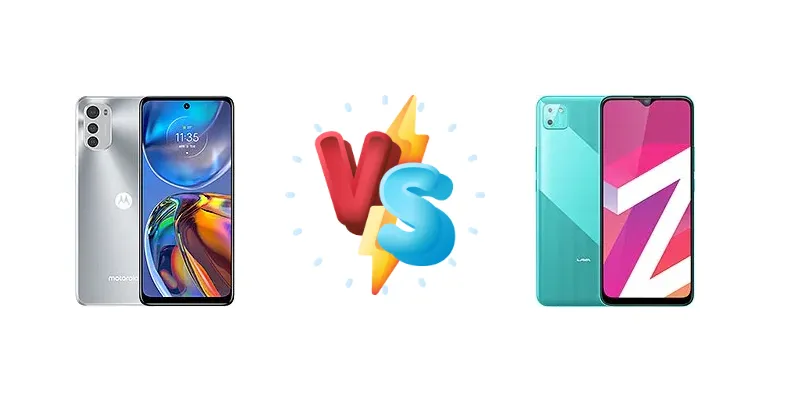
The Motorola Moto E32s and Lava Z2 Max represent the extreme end of the budget smartphone market. While both aim to deliver essential smartphone functionality at a low price, they take drastically different approaches to achieving this. The E32s leverages a more modern, albeit entry-level, chipset, while the Z2 Max opts for a simpler, older CPU design. This comparison will dissect these differences to determine which phone offers the best value.
🏆 Quick Verdict
For the vast majority of users, the Motorola Moto E32s is the superior choice. Its Mediatek Helio G37 chipset provides a significantly more responsive experience for everyday tasks and even light gaming, offsetting the Lava Z2 Max’s potentially longer battery life due to its less demanding processor. The E32s offers a better balance of performance and features.
| Network |
|---|
| 2G bands | GSM 850 / 900 / 1800 / 1900 | GSM 850 / 900 / 1800 / 1900 |
| 3G bands | HSDPA 850 / 900 / 1900 / 2100 | HSDPA 900 / 2100 |
| 4G bands | 1, 3, 5, 7, 8, 20, 38, 40, 41 | 1, 3, 5, 8, 40, 41 |
| Speed | HSPA, LTE | HSPA 42.2/5.76 Mbps, LTE Cat4 150/50 Mbps |
| Technology | GSM / HSPA / LTE | GSM / HSPA / LTE |
| Launch |
|---|
| Announced | 2022, May 13 | 2021, May 11 |
| Status | Available. Released 2022, June 02 | Available. Released 2021, May 11 |
| Body |
|---|
| Build | Glass front, plastic frame, plastic back | Glass front, plastic back, plastic frame |
| Dimensions | 164 x 75 x 8.5 mm (6.46 x 2.95 x 0.33 in) | 174.7 x 78.6 x 9.1 mm (6.88 x 3.09 x 0.36 in) |
| SIM | · Nano-SIM· Nano-SIM + Nano-SIM | Nano-SIM + Nano-SIM |
| Weight | 185 g (6.53 oz) | 216 g (7.62 oz) |
| | Water repellent design | - |
| Display |
|---|
| Protection | - | Corning Gorilla Glass 3 |
| Resolution | 720 x 1600 pixels, 20:9 ratio (~270 ppi density) | 720 x 1640 pixels (~256 ppi density) |
| Size | 6.5 inches, 102.0 cm2 (~82.9% screen-to-body ratio) | 7.0 inches, 116.4 cm2 (~84.7% screen-to-body ratio) |
| Type | IPS LCD, 90Hz | IPS LCD |
| Platform |
|---|
| CPU | Octa-core (4x2.3 GHz Cortex-A53 & 4x1.8 GHz Cortex-A53) | Quad-core 1.8 GHz |
| Chipset | Mediatek MT6765V/CB Helio G37 (12 nm) | - |
| GPU | PowerVR GE8320 | - |
| OS | Android 11 | Android 10 (Go edition) |
| Memory |
|---|
| Card slot | microSDXC (dedicated slot) | microSDXC (dedicated slot) |
| Internal | 32GB 3GB RAM, 64GB 3GB RAM, 64GB 4GB RAM | 32GB 2GB RAM |
| | - | eMMC 5.1 |
| Main Camera |
|---|
| Dual | - | 13 MP, f/1.9, (wide), 1/3.0", 1.12µm, AF
Auxiliary lens |
| Features | LED flash, HDR, panorama | LED flash |
| Single | - | 8 MP, f/2.0, (wide), 1.12µm |
| Triple | 16 MP, f/2.2, 26mm (wide), 1.0µm, PDAF
2 MP (macro)
Auxiliary lens | - |
| Video | 1080p@30fps | 720p@30fps |
| Selfie camera |
|---|
| Features | HDR | - |
| Single | 8 MP, f/2.0, (wide) | 8 MP, f/2.0, (wide), 1.12µm |
| Video | 1080p@30fps | - |
| Sound |
|---|
| 3.5mm jack | Yes | Yes |
| 35mm jack | Yes | Yes |
| Loudspeaker | Yes | Yes |
| Comms |
|---|
| Bluetooth | 5.0, A2DP, LE | 5.0, A2DP, LE |
| NFC | No | No |
| Positioning | GPS, GLONASS, GALILEO | GPS |
| Radio | Unspecified | FM radio |
| USB | USB Type-C 2.0 | USB Type-C 2.0, OTG |
| WLAN | Wi-Fi 802.11 a/b/g/n/ac, dual-band | Wi-Fi 802.11 b/g/n, Wi-Fi Direct |
| Features |
|---|
| Sensors | Fingerprint (side-mounted), accelerometer, proximity | Accelerometer |
| Battery |
|---|
| Charging | 15W wired | - |
| Type | Li-Po 5000 mAh | Li-Po 6000 mAh |
| Misc |
|---|
| Colors | Slate Gray, Misty Silver | Stroked Blue, Stroked Cyan |
| Models | - | LS0001 |
| Price | About 80 EUR | About 90 EUR |
Motorola Moto E32s
- Significantly faster processor for smoother performance
- Octa-core CPU enables better multitasking
- 15W fast charging for quicker power-ups
- Display quality likely average for the price range
- Camera performance is limited
Lava Z2 Max
- Potentially longer battery life due to less demanding processor
- Simple and easy-to-use interface
- Very affordable price point
- Slow quad-core processor results in sluggish performance
- Limited camera capabilities
- Lack of detailed specifications makes assessment difficult
Display Comparison
Unfortunately, detailed display specifications for the Lava Z2 Max are unavailable. However, given its price point, it likely features a lower resolution and less color-accurate panel than the Moto E32s. The E32s, while not boasting a high-end display, benefits from a more modern manufacturing process, potentially leading to better viewing angles and contrast. The absence of detailed specs for the Z2 Max makes a direct comparison difficult, but the E32s is likely to offer a more pleasant visual experience.
Camera Comparison
Camera details for the Lava Z2 Max are scarce. The Moto E32s, while not equipped with a flagship camera system, offers a more defined imaging experience. Without specific sensor information for the Z2 Max, it’s safe to assume its camera performance will be limited, especially in low-light conditions. The E32s’ camera, even with its limitations, benefits from Mediatek’s image signal processor (ISP) which provides some level of image enhancement and noise reduction. The lack of detail regarding the Z2 Max’s camera makes a meaningful comparison impossible, but the E32s is likely to deliver more consistent and usable photos.
Performance
The performance disparity between these two devices is substantial. The Motorola Moto E32s is powered by the Mediatek Helio G37, an octa-core processor built on a 12nm process. This means it has eight processing cores – four clocked at 2.3 GHz and four at 1.8 GHz – allowing for parallel processing and improved multitasking. In contrast, the Lava Z2 Max utilizes a quad-core 1.8 GHz CPU. The E32s’ octa-core architecture and higher clock speeds translate to significantly faster app launch times, smoother scrolling, and a more responsive overall user experience. While neither phone is a gaming powerhouse, the E32s’ integrated GPU will handle casual games far better than the Z2 Max’s basic CPU graphics. The 12nm process of the Helio G37 also suggests better power efficiency compared to potentially older manufacturing nodes used in the Z2 Max’s CPU.
Battery Life
The Lava Z2 Max may have an advantage in pure battery longevity due to its less power-hungry quad-core processor. However, the Motorola Moto E32s’ 15W wired charging offers a faster path to replenishing the battery. While the exact battery capacity of the Z2 Max is unknown, the E32s’ more efficient chipset and faster charging capabilities mean users are less likely to be tethered to a charger for extended periods. The trade-off is between potentially longer standby time on the Z2 Max versus quicker top-ups on the E32s.
Buying Guide
Buy the Motorola Moto E32s if you prioritize a smoother user experience, occasional gaming, and a more future-proof platform. It’s ideal for users who frequently use social media, browse the web, or stream videos. Buy the Lava Z2 Max if your primary need is basic communication – calls and texts – and you absolutely require the longest possible battery life with minimal app usage. It’s best suited for users who are technologically averse and only need a phone for essential functions.
Frequently Asked Questions
❓ Will the Moto E32s be able to run popular social media apps like Facebook and Instagram smoothly?
Yes, the Mediatek Helio G37 chipset in the Moto E32s is more than capable of handling social media apps like Facebook and Instagram without significant lag. The octa-core processor and sufficient RAM will ensure a relatively smooth experience, even with multiple apps open.
❓ Is the Lava Z2 Max suitable for someone who primarily uses their phone for making calls and sending text messages?
Absolutely. The Lava Z2 Max’s quad-core processor is sufficient for basic communication tasks like making calls and sending text messages. Its potential strength lies in its battery life, which could be longer than the Moto E32s due to the less demanding processor.
❓ Can I play games on the Moto E32s?
The Moto E32s can handle casual games, but it’s not designed for demanding titles. You’ll likely be able to play games like Candy Crush or Subway Surfers without issues, but more graphically intensive games may experience lag or require reduced settings.