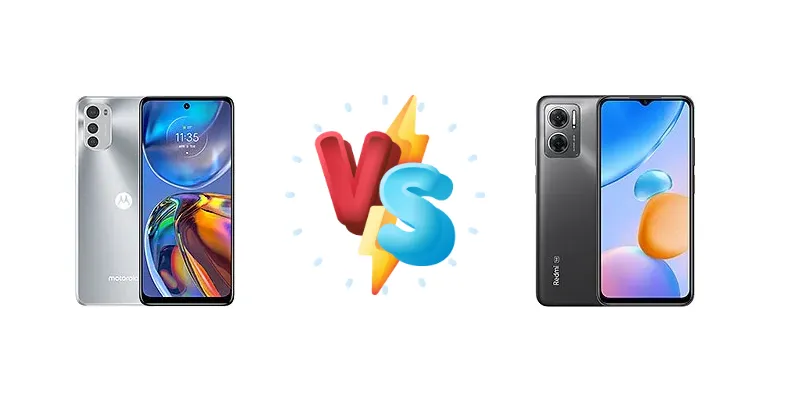
The Motorola Moto E32 and Xiaomi Redmi 10 5G represent the increasingly competitive sub-$200 5G smartphone market. Both aim to deliver 5G connectivity without breaking the bank, but they achieve this with different approaches to chipset selection and overall design. This comparison dissects their key specifications to determine which device offers the best balance of performance, features, and value.
🏆 Quick Verdict
For most users, the Xiaomi Redmi 10 5G emerges as the stronger choice. Its Mediatek Dimensity 700, built on a more efficient 7nm process, provides a noticeable performance advantage over the Motorola Moto E32’s Unisoc T606, making it better suited for demanding apps and multitasking. While both offer 18W charging, the Redmi 10 5G’s superior processing power justifies its slight price premium.
| Network |
|---|
| 2G bands | GSM 850 / 900 / 1800 / 1900 | GSM 850 / 900 / 1800 / 1900 |
| 3G bands | HSDPA 850 / 900 / 1900 / 2100 | HSDPA 850 / 900 / 1700(AWS) / 1900 / 2100 |
| 4G bands | 1, 3, 5, 7, 8, 20, 38, 40, 41 | 1, 2, 3, 4, 5, 7, 8, 20, 28, 38, 40, 41 |
| 5G bands | - | 1, 3, 5, 7, 8, 20, 28, 38, 40, 41, 77, 78 SA/NSA |
| Speed | HSPA, LTE | HSPA, LTE, 5G |
| Technology | GSM / HSPA / LTE | GSM / HSPA / LTE / 5G |
| Launch |
|---|
| Announced | 2022, May 05 | 2022, March 29 |
| Status | Available. Released 2022, May 05 | Available. Released 2022, September 23 |
| Body |
|---|
| Build | Glass front, plastic frame, plastic back | - |
| Dimensions | 164 x 75 x 8.5 mm (6.46 x 2.95 x 0.33 in) | 164 x 76.1 x 8.9 mm (6.46 x 3.00 x 0.35 in) |
| SIM | · Nano-SIM· Nano-SIM + Nano-SIM | Nano-SIM + Nano-SIM |
| Weight | 184 g (6.49 oz) | 200 g (7.05 oz) |
| | Water repellent design | - |
| Display |
|---|
| Protection | - | Corning Gorilla Glass 3 |
| Resolution | 720 x 1600 pixels, 20:9 ratio (~268 ppi density) | 1080 x 2408 pixels, 20:9 ratio (~401 ppi density) |
| Size | 6.5 inches, 103.5 cm2 (~84.2% screen-to-body ratio) | 6.58 inches, 104.3 cm2 (~83.6% screen-to-body ratio) |
| Type | IPS LCD, 90Hz | IPS LCD, 90Hz |
| Platform |
|---|
| CPU | Octa-core (2x1.6 GHz Cortex-A75 & 6x1.6 GHz Cortex-A55) | Octa-core (2x2.2 GHz Cortex-A76 & 6x2.0 GHz Cortex-A55) |
| Chipset | Unisoc T606 (12 nm) | Mediatek Dimensity 700 (7 nm) |
| GPU | Mali-G57 MP1 | Mali-G57 MC2 |
| OS | Android 11 | Android 12, MIUI 13 |
| Memory |
|---|
| Card slot | microSDXC (dedicated slot) | microSDXC (dedicated slot) |
| Internal | 64GB 4GB RAM | 64GB 4GB RAM, 128GB 4GB RAM, 128GB 6GB RAM |
| | - | UFS 2.2 |
| Main Camera |
|---|
| Dual | - | 50 MP, f/1.8, (wide), PDAF
Auxiliary lens |
| Features | LED flash, HDR, panorama | LED flash, HDR, panorama |
| Single | - | 5 MP, f/2.2 |
| Triple | 16 MP, f/2.2, 26mm (wide), 1.0µm, PDAF
2 MP (macro)
Auxiliary lens | - |
| Video | 1080p@30fps | 1080p@30fps |
| Selfie camera |
|---|
| Features | HDR | HDR |
| Single | 8 MP, f/2.0, (wide), 1/4.0", 1.12µm | 5 MP, f/2.2 |
| Video | 1080p@30fps | 1080p@30fps |
| Sound |
|---|
| 3.5mm jack | Yes | Yes |
| 35mm jack | Yes | Yes |
| Loudspeaker | Yes | Yes |
| | - | 24-bit/192kHz audio |
| Comms |
|---|
| Bluetooth | 5.0, A2DP, LE | 5.1, A2DP, LE |
| Infrared port | - | Yes |
| NFC | No | Yes (market/region dependent) |
| Positioning | GPS, GLONASS, GALILEO | GPS, GLONASS, BDS, GALILEO |
| Radio | Unspecified | FM radio |
| USB | USB Type-C 2.0 | USB Type-C 2.0, OTG |
| WLAN | Wi-Fi 802.11 b/g/n, Wi-Fi Direct | Wi-Fi 802.11 a/b/g/n/ac, dual-band, Wi-Fi Direct |
| Features |
|---|
| Sensors | Fingerprint (side-mounted), accelerometer, proximity | Fingerprint (side-mounted), accelerometer, proximity, compass |
| Battery |
|---|
| Charging | 18W wired | 18W wired |
| Type | Li-Po 5000 mAh | Li-Po 5000 mAh |
| Misc |
|---|
| Colors | Misty Silver, Pearl Blue, Slate Grey | Graphite Gray, Chrome Silver, Aurora Green |
| Models | - | 22041219G, 22041219NY |
| Price | About 150 EUR | About 100 EUR |
| SAR | - | 1.09 W/kg (head) 1.09 W/kg (body) |
| SAR EU | - | 0.60 W/kg (head) 0.99 W/kg (body) |
Motorola Moto E32
- Clean Android experience (likely minimal bloatware)
- Potentially lower price point
- Simple and straightforward user interface
- Less powerful Unisoc T606 chipset
- Likely lower performance in demanding tasks
- May exhibit more thermal throttling under load
Xiaomi Redmi 10 5G
- More powerful Mediatek Dimensity 700 chipset
- Improved 5G performance
- Better sustained performance and efficiency
- Xiaomi’s MIUI software can be feature-rich but also bloated
- Potentially slightly higher price
- May receive more pre-installed apps
Display Comparison
Neither device boasts a standout display. Both likely utilize LCD panels, a common cost-saving measure in this segment. The key difference lies under the hood: processing power impacts UI smoothness. While specific display specs (resolution, brightness) are absent, the Redmi 10 5G’s more powerful chipset will contribute to a more responsive and fluid user experience when navigating the interface and scrolling through content. Bezels are expected to be similar on both, reflecting their budget positioning.
Camera Comparison
Camera performance is likely to be similar, with both phones relying on budget sensors. Without specific sensor details, it’s safe to assume both will struggle in low-light conditions. The Redmi 10 5G *may* have a slight edge due to the Dimensity 700’s image signal processor (ISP), which could offer better noise reduction and image processing capabilities. However, the presence of a 2MP macro lens on both devices suggests limited utility; these sensors typically produce low-quality images. Focusing on the main sensor’s performance is more relevant.
Performance
The performance gap is the most significant differentiator. The Xiaomi Redmi 10 5G’s Mediatek Dimensity 700 (7nm) is a clear upgrade over the Motorola Moto E32’s Unisoc T606 (12nm). The 7nm process node allows for greater transistor density and improved power efficiency, translating to better sustained performance and reduced thermal throttling. The Dimensity 700’s Cortex-A76 cores (2x2.2 GHz) are also architecturally superior to the Moto E32’s Cortex-A75 cores (2x1.6 GHz), resulting in faster single-core and multi-core performance. This benefits everything from app launch times to gaming.
Battery Life
Both devices feature 18W wired charging, suggesting similar charging speeds – approximately 2-3 hours for a full charge. While battery capacity isn’t specified, the Redmi 10 5G’s more efficient Dimensity 700 chipset will likely result in better battery life, despite potentially having a similar capacity to the Moto E32. The 7nm process consumes less power, allowing the Redmi 10 5G to deliver more screen-on time for everyday tasks.
Buying Guide
Buy the Motorola Moto E32 if you prioritize a simple, clean Android experience and are primarily focused on basic smartphone tasks like calling, texting, and light social media use. Buy the Xiaomi Redmi 10 5G if you need a more capable device for gaming, streaming, and running multiple apps simultaneously, and if 5G performance is a key consideration. The Redmi 10 5G is the better option for users who anticipate heavier usage.
Frequently Asked Questions
❓ Will the Redmi 10 5G overheat during extended gaming sessions?
While the Dimensity 700 is more efficient than the Unisoc T606, prolonged gaming will still generate heat. However, the 7nm process and potentially better thermal design in the Redmi 10 5G should result in less aggressive thermal throttling compared to the Moto E32, allowing for more sustained performance.
❓ Is the 5G connectivity on the Redmi 10 5G significantly faster than 4G on the Moto E32?
Yes, 5G offers substantially faster speeds than 4G, *assuming* you have 5G coverage in your area. The Redmi 10 5G’s Dimensity 700 chipset includes an integrated 5G modem, enabling access to these faster speeds. The Moto E32 will be limited to 4G speeds, which are considerably slower for data-intensive tasks like streaming and downloading.
❓ How much bloatware is pre-installed on the Xiaomi Redmi 10 5G?
Xiaomi’s MIUI software is known for including pre-installed apps (bloatware). While the amount varies by region, expect to find several Xiaomi and third-party apps pre-loaded. Many of these can be uninstalled, but it requires some effort. The Moto E32 typically offers a cleaner Android experience with less bloatware.